Smartwatch-Based Ecological Momentary Assessment for High-Temporal-Density, Longitudinal Measurement of Alcohol Use (AlcoWatch): Feasibility Evaluation.
Chris Stone, Sally Adams, Robyn E Wootton, Andy Skinner
{"title":"Smartwatch-Based Ecological Momentary Assessment for High-Temporal-Density, Longitudinal Measurement of Alcohol Use (AlcoWatch): Feasibility Evaluation.","authors":"Chris Stone, Sally Adams, Robyn E Wootton, Andy Skinner","doi":"10.2196/63184","DOIUrl":null,"url":null,"abstract":"<p><strong>Background: </strong>Ecological momentary assessment methods have recently been adapted for use on smartwatches. One particular class of these methods, developed to minimize participant burden and maximize engagement and compliance, is referred to as microinteraction-based ecological momentary assessment (μEMA).</p><p><strong>Objective: </strong>This study explores the feasibility of using these smartwatch-based μEMA methods to capture longitudinal, high-temporal-density self-report data about alcohol consumption in a nonclinical population selected to represent high- and low-socioeconomic position (SEP) groups.</p><p><strong>Methods: </strong>A total of 32 participants from the Avon Longitudinal Study of Parents and Children (13 high and 19 low SEP) wore a smartwatch running a custom-developed μEMA app for 3 months between October 2019 and June 2020. Every day over a 12-week period, participants were asked 5 times a day about any alcoholic drinks they had consumed in the previous 2 hours, and the context in which they were consumed. They were also asked if they had missed recording any alcoholic drinks the day before. As a comparison, participants also completed fortnightly online diaries of alcohol consumed using the Timeline Followback (TLFB) method. At the end of the study, participants completed a semistructured interview about their experiences.</p><p><strong>Results: </strong>The compliance rate for all participants who started the study for the smartwatch μEMA method decreased from around 70% in week 1 to 45% in week 12, compared with the online TLFB method which was flatter at around 50% over the 12 weeks. The compliance for all participants still active for the smartwatch μEMA method was much flatter, around 70% for the whole 12 weeks, while for the online TLFB method, it varied between 50% and 80% over the same period. The completion rate for the smartwatch μEMA method varied around 80% across the 12 weeks. Within high- and low-SEP groups there was considerable variation in compliance and completion at each week of the study for both methods. However, almost all point estimates for both smartwatch μEMA and online TLFB indicated lower levels of engagement for low-SEP participants. All participants scored \"experiences of using\" the 2 methods equally highly, with \"willingness to use again\" slightly higher for smartwatch μEMA.</p><p><strong>Conclusions: </strong>Our findings demonstrate the acceptability and potential utility of smartwatch μEMA methods for capturing data on alcohol consumption. These methods have the benefits of capturing higher-temporal-density longitudinal data on alcohol consumption, promoting greater participant engagement with less missing data, and potentially being less susceptible to recall errors than established methods such as TLFB. Future studies should explore the factors impacting participant attrition (the biggest reason for reduced engagement), latency issues, and the validity of alcohol data captured with these methods. The consistent pattern of lower engagement among low-SEP participants than high-SEP participants indicates that further work is warranted to explore the impact and causes of these differences.</p>","PeriodicalId":14841,"journal":{"name":"JMIR Formative Research","volume":"9 ","pages":"e63184"},"PeriodicalIF":2.0000,"publicationDate":"2025-03-25","publicationTypes":"Journal Article","fieldsOfStudy":null,"isOpenAccess":false,"openAccessPdf":"https://www.ncbi.nlm.nih.gov/pmc/articles/PMC11979524/pdf/","citationCount":"0","resultStr":null,"platform":"Semanticscholar","paperid":null,"PeriodicalName":"JMIR Formative Research","FirstCategoryId":"1085","ListUrlMain":"https://doi.org/10.2196/63184","RegionNum":0,"RegionCategory":null,"ArticlePicture":[],"TitleCN":null,"AbstractTextCN":null,"PMCID":null,"EPubDate":"","PubModel":"","JCR":"Q3","JCRName":"HEALTH CARE SCIENCES & SERVICES","Score":null,"Total":0}
引用次数: 0
Abstract
Background: Ecological momentary assessment methods have recently been adapted for use on smartwatches. One particular class of these methods, developed to minimize participant burden and maximize engagement and compliance, is referred to as microinteraction-based ecological momentary assessment (μEMA).
Objective: This study explores the feasibility of using these smartwatch-based μEMA methods to capture longitudinal, high-temporal-density self-report data about alcohol consumption in a nonclinical population selected to represent high- and low-socioeconomic position (SEP) groups.
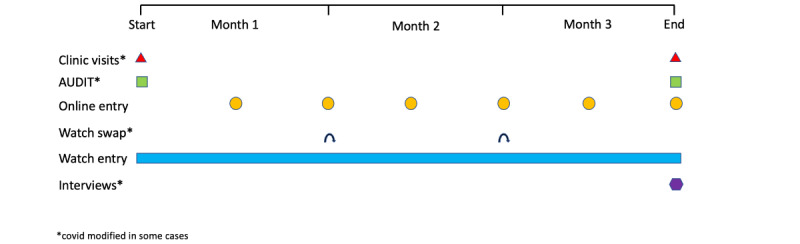
Methods: A total of 32 participants from the Avon Longitudinal Study of Parents and Children (13 high and 19 low SEP) wore a smartwatch running a custom-developed μEMA app for 3 months between October 2019 and June 2020. Every day over a 12-week period, participants were asked 5 times a day about any alcoholic drinks they had consumed in the previous 2 hours, and the context in which they were consumed. They were also asked if they had missed recording any alcoholic drinks the day before. As a comparison, participants also completed fortnightly online diaries of alcohol consumed using the Timeline Followback (TLFB) method. At the end of the study, participants completed a semistructured interview about their experiences.
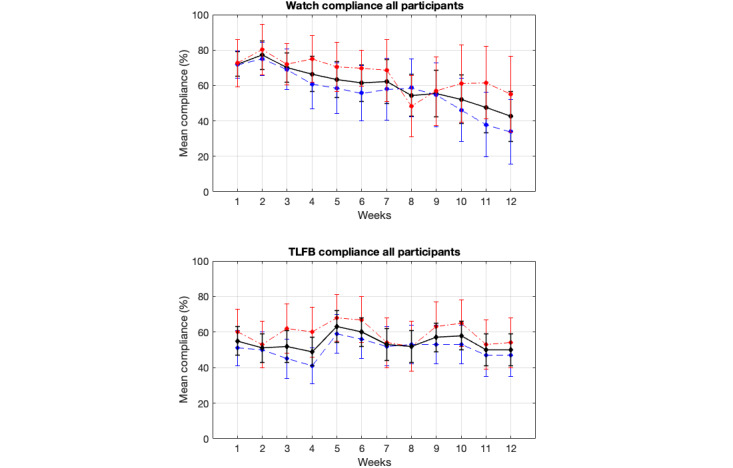
Results: The compliance rate for all participants who started the study for the smartwatch μEMA method decreased from around 70% in week 1 to 45% in week 12, compared with the online TLFB method which was flatter at around 50% over the 12 weeks. The compliance for all participants still active for the smartwatch μEMA method was much flatter, around 70% for the whole 12 weeks, while for the online TLFB method, it varied between 50% and 80% over the same period. The completion rate for the smartwatch μEMA method varied around 80% across the 12 weeks. Within high- and low-SEP groups there was considerable variation in compliance and completion at each week of the study for both methods. However, almost all point estimates for both smartwatch μEMA and online TLFB indicated lower levels of engagement for low-SEP participants. All participants scored "experiences of using" the 2 methods equally highly, with "willingness to use again" slightly higher for smartwatch μEMA.
Conclusions: Our findings demonstrate the acceptability and potential utility of smartwatch μEMA methods for capturing data on alcohol consumption. These methods have the benefits of capturing higher-temporal-density longitudinal data on alcohol consumption, promoting greater participant engagement with less missing data, and potentially being less susceptible to recall errors than established methods such as TLFB. Future studies should explore the factors impacting participant attrition (the biggest reason for reduced engagement), latency issues, and the validity of alcohol data captured with these methods. The consistent pattern of lower engagement among low-SEP participants than high-SEP participants indicates that further work is warranted to explore the impact and causes of these differences.






 京公网安备 11010802042870号
京ICP备2023020795号-1
京公网安备 11010802042870号
京ICP备2023020795号-1

 分享
分享
 求助内容:
求助内容: 应助结果提醒方式:
 扫码关注我们
