MDD2DG-IRA: Multivariate Degree Distribution to Dynamic Graph With Inter-Channel Relevance Attention Mechanism for Multi-Channel Myocardial Infarction ECG Analysis.
Xiaodong Yang, Guangkang Jiang, Zhengping Zhu, Dandan Wu, Aijun He, Jun Wang
{"title":"MDD2DG-IRA: Multivariate Degree Distribution to Dynamic Graph With Inter-Channel Relevance Attention Mechanism for Multi-Channel Myocardial Infarction ECG Analysis.","authors":"Xiaodong Yang, Guangkang Jiang, Zhengping Zhu, Dandan Wu, Aijun He, Jun Wang","doi":"10.1109/JBHI.2025.3554309","DOIUrl":null,"url":null,"abstract":"<p><p>We introduced a novel methodology Multivariate Degree Distribution to Dynamic Graph (MDD2DG) with Inter-channel Relevance Attention (IRA) mechanism to analyze multi-channel Electrocardiogram (ECG) signals and explore signal connections across different channels. Our methodology comprises three main steps. First, multi-channel cardiac signals are transformed into multi-channel visual graphs to extract crucial degree distribution features. Then, degree distributions are mapped into dynamic graphs using a neural network with an IRA mechanism. After that, critical features are extracted within dynamic graphs utilizing a Graph Convolutional Neural Networks (GCNNs), and classification is subsequently performed using a multilayer perceptron. In this model, a method of multi-scale position embedding was introduced, which significantly enhanced the processing efficiency of the model by providing a simpler yet sufficiently effective feature representation. Compared to traditional complex network methods, our approach replaces fixed formula-calculated features with dynamic graph models, resulting in improved recognition accuracy. In the experiments, we achieved an impressive 99.94% classification accuracy for distinguishing ECG signals from the five distinct locations (AMI, ASMI, ALMI, IMI and ILMI) with myocardial infarction (MI) as well as those of the healthy controls (HC). This work contributes to the analysis of complex physiological signals in the field of multi-channel ECG sequence, and provides a robust approach with promising implications for improving clinical medicine and the early detection of cardiac diseases.</p>","PeriodicalId":13073,"journal":{"name":"IEEE Journal of Biomedical and Health Informatics","volume":"PP ","pages":"5503-5514"},"PeriodicalIF":6.8000,"publicationDate":"2025-08-01","publicationTypes":"Journal Article","fieldsOfStudy":null,"isOpenAccess":false,"openAccessPdf":"","citationCount":"0","resultStr":null,"platform":"Semanticscholar","paperid":null,"PeriodicalName":"IEEE Journal of Biomedical and Health Informatics","FirstCategoryId":"5","ListUrlMain":"https://doi.org/10.1109/JBHI.2025.3554309","RegionNum":2,"RegionCategory":"医学","ArticlePicture":[],"TitleCN":null,"AbstractTextCN":null,"PMCID":null,"EPubDate":"","PubModel":"","JCR":"Q1","JCRName":"COMPUTER SCIENCE, INFORMATION SYSTEMS","Score":null,"Total":0}
引用次数: 0
Abstract
We introduced a novel methodology Multivariate Degree Distribution to Dynamic Graph (MDD2DG) with Inter-channel Relevance Attention (IRA) mechanism to analyze multi-channel Electrocardiogram (ECG) signals and explore signal connections across different channels. Our methodology comprises three main steps. First, multi-channel cardiac signals are transformed into multi-channel visual graphs to extract crucial degree distribution features. Then, degree distributions are mapped into dynamic graphs using a neural network with an IRA mechanism. After that, critical features are extracted within dynamic graphs utilizing a Graph Convolutional Neural Networks (GCNNs), and classification is subsequently performed using a multilayer perceptron. In this model, a method of multi-scale position embedding was introduced, which significantly enhanced the processing efficiency of the model by providing a simpler yet sufficiently effective feature representation. Compared to traditional complex network methods, our approach replaces fixed formula-calculated features with dynamic graph models, resulting in improved recognition accuracy. In the experiments, we achieved an impressive 99.94% classification accuracy for distinguishing ECG signals from the five distinct locations (AMI, ASMI, ALMI, IMI and ILMI) with myocardial infarction (MI) as well as those of the healthy controls (HC). This work contributes to the analysis of complex physiological signals in the field of multi-channel ECG sequence, and provides a robust approach with promising implications for improving clinical medicine and the early detection of cardiac diseases.
期刊介绍:
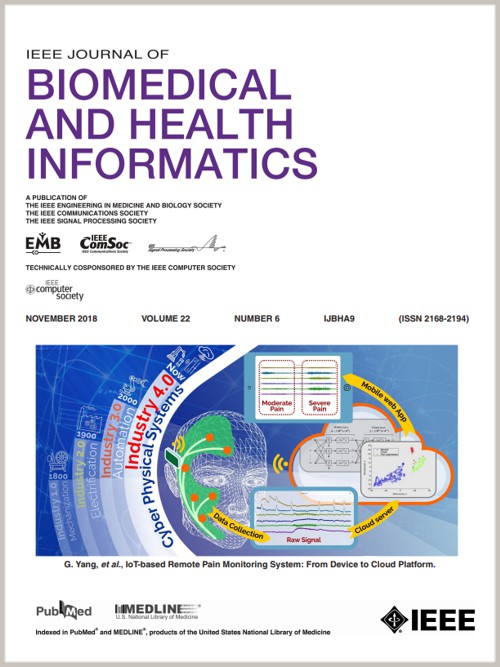
IEEE Journal of Biomedical and Health Informatics publishes original papers presenting recent advances where information and communication technologies intersect with health, healthcare, life sciences, and biomedicine. Topics include acquisition, transmission, storage, retrieval, management, and analysis of biomedical and health information. The journal covers applications of information technologies in healthcare, patient monitoring, preventive care, early disease diagnosis, therapy discovery, and personalized treatment protocols. It explores electronic medical and health records, clinical information systems, decision support systems, medical and biological imaging informatics, wearable systems, body area/sensor networks, and more. Integration-related topics like interoperability, evidence-based medicine, and secure patient data are also addressed.



 京公网安备 11010802042870号
京ICP备2023020795号-1
京公网安备 11010802042870号
京ICP备2023020795号-1

 分享
分享
 求助内容:
求助内容: 应助结果提醒方式:
 扫码关注我们
