Multilevel Intervention to Increase Patient Portal Use in Adults With Type 2 Diabetes Who Access Health Care at Community Health Centers: Single Arm, Pre-Post Pilot Study.
Robin Whittemore, Sangchoon Jeon, Samuel Akyirem, Helen N C Chen, Joanna Lipson, Maritza Minchala, Julie Wagner
{"title":"Multilevel Intervention to Increase Patient Portal Use in Adults With Type 2 Diabetes Who Access Health Care at Community Health Centers: Single Arm, Pre-Post Pilot Study.","authors":"Robin Whittemore, Sangchoon Jeon, Samuel Akyirem, Helen N C Chen, Joanna Lipson, Maritza Minchala, Julie Wagner","doi":"10.2196/67293","DOIUrl":null,"url":null,"abstract":"<p><strong>Background: </strong>Diabetes self-management education and support (DSMS) delivered via patient portals significantly improves glycemic control. Yet, disparities in patient portal use persist. Community health centers (CHCs) deliver care to anyone who needs it, regardless of income or insurance status.</p><p><strong>Objective: </strong>This study aimed to evaluate the feasibility, acceptability, and preliminary efficacy of a multilevel intervention to increase access and use of portals (MAP) among people with type 2 diabetes (T2D) receiving health care at CHCs.</p><p><strong>Methods: </strong>A within-subjects, pre-post design was used. Adults with T2D who were portal naive were recruited from 2 CHCs. After informed consent, participants met with a community health worker for referrals for social determinants of health, provision of a tablet with cell service, and individualized training on use of the tablet and portal. Next, a nurse met individually with participants to develop a DSMS plan and then communicated with patients via the portal at least twice weekly during the first 3 months and weekly for the latter 3 months. Data were collected at baseline, 3 months and 6 months. The primary outcome was patient activation and engagement with the portal. Secondary outcomes included technology attitudes, digital health literacy, health-related outcomes and psychosocial function.</p><p><strong>Results: </strong>In total, 26 patients were eligible, 23 received the intervention, and one was lost to follow up. The sample was predominately Latino or Hispanic (17/22, 77%) and reported low income (19/22, 86%< US $40,000/year), low education (13/22, 59% <high school), and no health insurance (12/22, 55%). All participants had access to a Smartphone, but 91% (20/22) had never accessed a health app. The baseline hemoglobin A<sub>1c</sub> level was 8.31%. Portal activation was high; 100% (22/22) of participants created a portal account and logged in within the first month. Mean participant logins per week over the first 3 months was 3.16 (SD 1.55) and 1.45 (SD 0.93) over the final 3 months; mean logins per month over the first 3 months was 12.65 (SD 6.21) and 5.79 (SD 3.74) over last 3 months. Engagement was high; 96% (20/21) logged in at least twice per month in the first 3 months and 76% (16/21) between 3 and 6 months. At 6 months, improvements were seen in technology confidence, digital health literacy, diabetes self-efficacy, and diabetes distress. Participant satisfaction with MAP was high as was intention to continue portal use. Barriers to clinical integration and recommendations for portal development were identified.</p><p><strong>Conclusions: </strong>MAP shows promise for improving health equity in portal use for T2D. Larger, controlled studies are needed to determine how best to implement MAP in complex clinical settings and to evaluate efficacy over time.</p><p><strong>Trial registration: </strong>ClinicalTrials.gov NCT05180721; https://clinicaltrials.gov/study/NCT05180721.</p>","PeriodicalId":14841,"journal":{"name":"JMIR Formative Research","volume":"9 ","pages":"e67293"},"PeriodicalIF":2.0000,"publicationDate":"2025-03-25","publicationTypes":"Journal Article","fieldsOfStudy":null,"isOpenAccess":false,"openAccessPdf":"https://www.ncbi.nlm.nih.gov/pmc/articles/PMC11979536/pdf/","citationCount":"0","resultStr":null,"platform":"Semanticscholar","paperid":null,"PeriodicalName":"JMIR Formative Research","FirstCategoryId":"1085","ListUrlMain":"https://doi.org/10.2196/67293","RegionNum":0,"RegionCategory":null,"ArticlePicture":[],"TitleCN":null,"AbstractTextCN":null,"PMCID":null,"EPubDate":"","PubModel":"","JCR":"Q3","JCRName":"HEALTH CARE SCIENCES & SERVICES","Score":null,"Total":0}
引用次数: 0
Abstract
Background: Diabetes self-management education and support (DSMS) delivered via patient portals significantly improves glycemic control. Yet, disparities in patient portal use persist. Community health centers (CHCs) deliver care to anyone who needs it, regardless of income or insurance status.
Objective: This study aimed to evaluate the feasibility, acceptability, and preliminary efficacy of a multilevel intervention to increase access and use of portals (MAP) among people with type 2 diabetes (T2D) receiving health care at CHCs.
Methods: A within-subjects, pre-post design was used. Adults with T2D who were portal naive were recruited from 2 CHCs. After informed consent, participants met with a community health worker for referrals for social determinants of health, provision of a tablet with cell service, and individualized training on use of the tablet and portal. Next, a nurse met individually with participants to develop a DSMS plan and then communicated with patients via the portal at least twice weekly during the first 3 months and weekly for the latter 3 months. Data were collected at baseline, 3 months and 6 months. The primary outcome was patient activation and engagement with the portal. Secondary outcomes included technology attitudes, digital health literacy, health-related outcomes and psychosocial function.
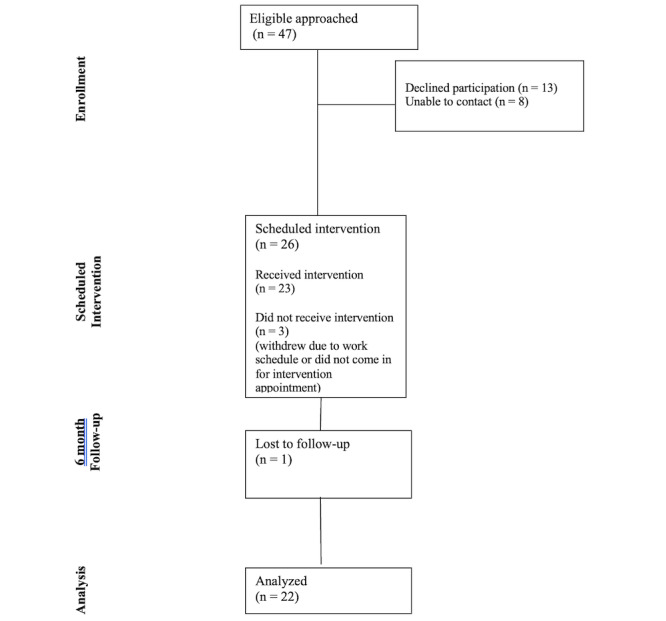
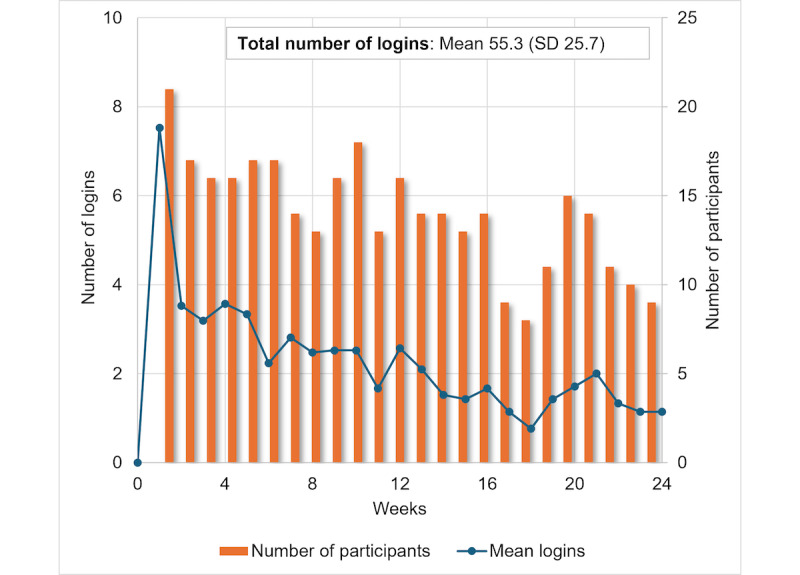
Results: In total, 26 patients were eligible, 23 received the intervention, and one was lost to follow up. The sample was predominately Latino or Hispanic (17/22, 77%) and reported low income (19/22, 86%< US $40,000/year), low education (13/22, 59% 1c level was 8.31%. Portal activation was high; 100% (22/22) of participants created a portal account and logged in within the first month. Mean participant logins per week over the first 3 months was 3.16 (SD 1.55) and 1.45 (SD 0.93) over the final 3 months; mean logins per month over the first 3 months was 12.65 (SD 6.21) and 5.79 (SD 3.74) over last 3 months. Engagement was high; 96% (20/21) logged in at least twice per month in the first 3 months and 76% (16/21) between 3 and 6 months. At 6 months, improvements were seen in technology confidence, digital health literacy, diabetes self-efficacy, and diabetes distress. Participant satisfaction with MAP was high as was intention to continue portal use. Barriers to clinical integration and recommendations for portal development were identified.
Conclusions: MAP shows promise for improving health equity in portal use for T2D. Larger, controlled studies are needed to determine how best to implement MAP in complex clinical settings and to evaluate efficacy over time.




 京公网安备 11010802042870号
京ICP备2023020795号-1
京公网安备 11010802042870号
京ICP备2023020795号-1

 分享
分享
 求助内容:
求助内容: 应助结果提醒方式:
 扫码关注我们
