Microscope-Assisted Hypertensive Retinopathy Diagnosis Using Deep Learning Models

IF 2.1 3区 工程技术 Q2 ANATOMY & MORPHOLOGY Microscopy Research and Technique Pub Date : 2025-03-24 DOI:10.1002/jemt.24847
Shahzad Akbar, Usama Shahzore, Tanzila Saba, Faten S. Alamri, Sadaf S. Khan, Amjad R. Khan
{"title":"Microscope-Assisted Hypertensive Retinopathy Diagnosis Using Deep Learning Models","authors":"Shahzad Akbar,&nbsp;Usama Shahzore,&nbsp;Tanzila Saba,&nbsp;Faten S. Alamri,&nbsp;Sadaf S. Khan,&nbsp;Amjad R. Khan","doi":"10.1002/jemt.24847","DOIUrl":null,"url":null,"abstract":"<div>\n \n <p>The retina is the most crucial part of the human eye, and it can be affected due to hypertension. However, retinal abnormalities due to hypertension are termed hypertensive retinopathy (HR). A severe stage of HR can lead to complete blindness if not diagnosed and treated on time. Manually analyzing retinal images for HR diagnosis is time-consuming and prone to errors. This research article provides a novel technique based on U-Net and Dense-Net for automatic HR detection and grading through retinal images. The presented method consists of preprocessing, vessel segmentation, artery or vein (A/V) classification, and vessel width calculation to compute the arteriovenous ratio (AVR). In the preprocessing phase, the Gabor filter is applied to the retinal image to enhance the vascular network of the image. The preprocessed image is fed into the U-Net architecture to segment the vascular network image. The segmented vascular network image is fed into the Dense-Net architecture for A/V classification. The A/V classified vascular network is divided into several artery and vein segments at the bifurcation and crossover points. The A/V segments are labeled for width calculation to compute the AVR. The AVR is a standard parameter for HR detection and grading. The evaluation results show an average accuracy of 99.40% in HR classification and 99.77% in HR grading on the AVRDB dataset. The evaluated results are beneficial for the automatic HR detection and grading for clinical purposes.</p>\n </div>","PeriodicalId":18684,"journal":{"name":"Microscopy Research and Technique","volume":"88 8","pages":"2333-2348"},"PeriodicalIF":2.1000,"publicationDate":"2025-03-24","publicationTypes":"Journal Article","fieldsOfStudy":null,"isOpenAccess":false,"openAccessPdf":"","citationCount":"0","resultStr":null,"platform":"Semanticscholar","paperid":null,"PeriodicalName":"Microscopy Research and Technique","FirstCategoryId":"5","ListUrlMain":"https://analyticalsciencejournals.onlinelibrary.wiley.com/doi/10.1002/jemt.24847","RegionNum":3,"RegionCategory":"工程技术","ArticlePicture":[],"TitleCN":null,"AbstractTextCN":null,"PMCID":null,"EPubDate":"","PubModel":"","JCR":"Q2","JCRName":"ANATOMY & MORPHOLOGY","Score":null,"Total":0}
引用次数: 0

Abstract

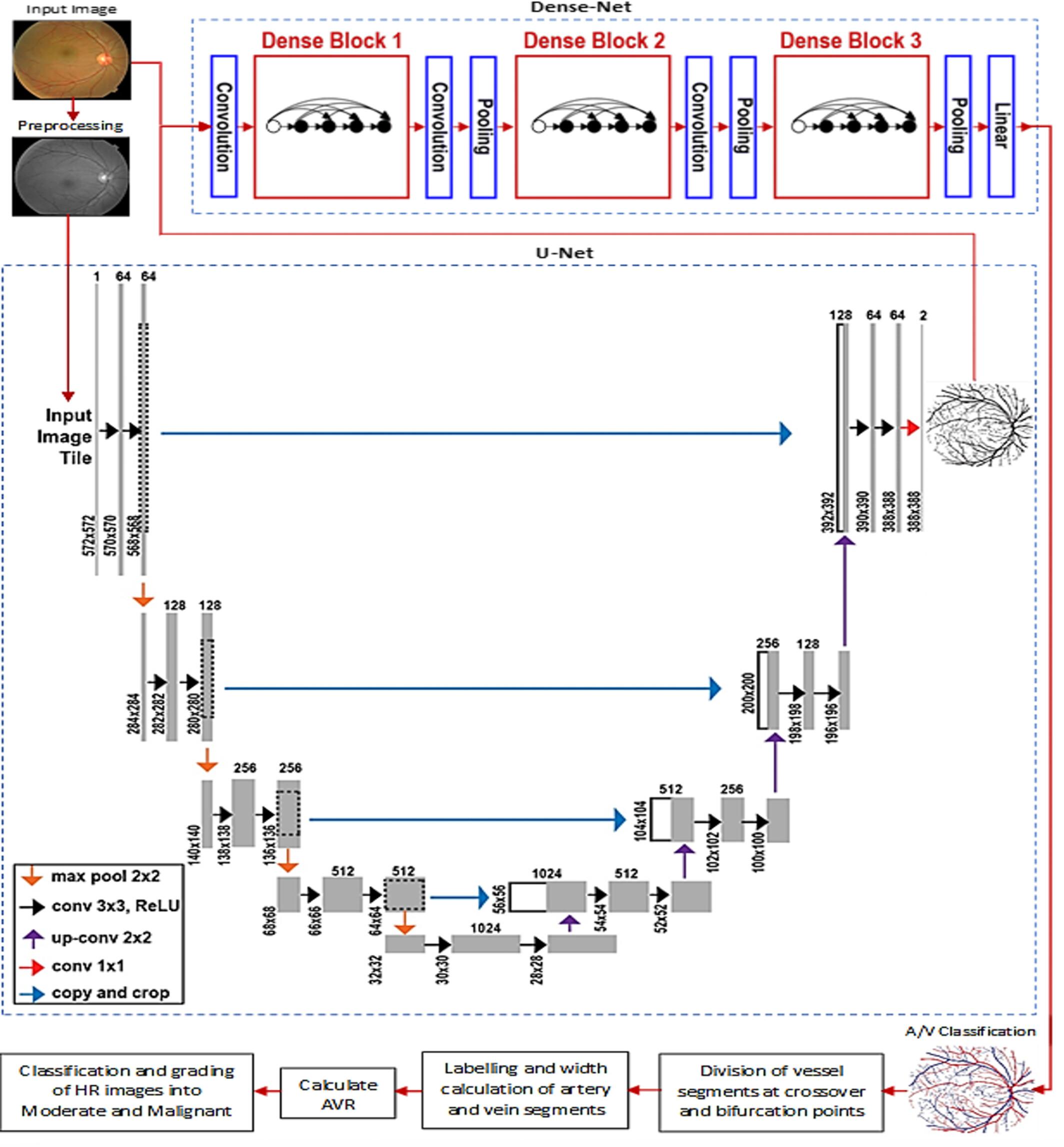
The retina is the most crucial part of the human eye, and it can be affected due to hypertension. However, retinal abnormalities due to hypertension are termed hypertensive retinopathy (HR). A severe stage of HR can lead to complete blindness if not diagnosed and treated on time. Manually analyzing retinal images for HR diagnosis is time-consuming and prone to errors. This research article provides a novel technique based on U-Net and Dense-Net for automatic HR detection and grading through retinal images. The presented method consists of preprocessing, vessel segmentation, artery or vein (A/V) classification, and vessel width calculation to compute the arteriovenous ratio (AVR). In the preprocessing phase, the Gabor filter is applied to the retinal image to enhance the vascular network of the image. The preprocessed image is fed into the U-Net architecture to segment the vascular network image. The segmented vascular network image is fed into the Dense-Net architecture for A/V classification. The A/V classified vascular network is divided into several artery and vein segments at the bifurcation and crossover points. The A/V segments are labeled for width calculation to compute the AVR. The AVR is a standard parameter for HR detection and grading. The evaluation results show an average accuracy of 99.40% in HR classification and 99.77% in HR grading on the AVRDB dataset. The evaluated results are beneficial for the automatic HR detection and grading for clinical purposes.
Abstract Image

Abstract Image

Abstract Image

Abstract Image

查看原文
分享 分享
微信好友 朋友圈 QQ好友 复制链接
本刊更多论文
使用深度学习模型的显微镜辅助高血压视网膜病变诊断。
视网膜是人眼最重要的部分,高血压会影响视网膜。然而,高血压引起的视网膜异常被称为高血压性视网膜病变(HR)。如果不及时诊断和治疗,严重阶段的HR可能导致完全失明。人工分析视网膜图像进行HR诊断既耗时又容易出错。本文提出了一种基于U-Net和Dense-Net的视网膜图像HR自动检测与分级新技术。该方法包括预处理、血管分割、动脉或静脉(A/V)分类和血管宽度计算,以计算动静脉比(AVR)。在预处理阶段,对视网膜图像进行Gabor滤波,增强图像的血管网络。将预处理后的图像输入到U-Net架构中,对血管网络图像进行分割。将分割后的血管网络图像输入到Dense-Net架构中进行A/V分类。A/V分类血管网在分岔点和交点处分为若干动静脉段。A/V段被标记为宽度计算,以计算AVR。AVR是HR检测和分级的标准参数。评价结果表明,在AVRDB数据集上,HR分类的平均准确率为99.40%,HR分级的平均准确率为99.77%。评价结果有利于临床HR的自动检测和分级。
本文章由计算机程序翻译,如有差异,请以英文原文为准。
求助全文
约1分钟内获得全文 去求助
来源期刊
Microscopy Research and Technique
Microscopy Research and Technique 医学-解剖学与形态学
CiteScore
5.30
自引率
20.00%
发文量
233
审稿时长
4.7 months
期刊介绍: Microscopy Research and Technique (MRT) publishes articles on all aspects of advanced microscopy original architecture and methodologies with applications in the biological, clinical, chemical, and materials sciences. Original basic and applied research as well as technical papers dealing with the various subsets of microscopy are encouraged. MRT is the right form for those developing new microscopy methods or using the microscope to answer key questions in basic and applied research.
期刊最新文献
Scanning Electron Microscopic Evaluation of Indocyanine Green-Loaded Cerium Oxide Nanoparticle-Mediated Photodynamic Therapy and Potassium Titanyl Phosphate Laser as Post-Space Disinfectant: Effects on Smear Layer Removal and Bond Strength. Accessibility of Acid Sites and Catalytic Performance of FCC Catalysts on Different Matrices Studied by Super-Resolution Fluorescence Microscopy. RETRACTION: Environmentally Friendly Green Approach for the Fabrication of Silver Oxide Nanoparticles: Characterization and Diverse Biomedical Applications. Automatic Nanoparticles Counting for TEM Images by Combination of Distance Transform, Watershed Segmentation and U-Net Machine Learning. Effects of Rare Earth and Alkali Promoters on Distribution Profile and Properties of Spherical Shaped γ-Al2O3 Supported Ni Catalysts.
×
引用
GB/T 7714-2015
复制
MLA
复制
APA
复制
导出至
BibTeX EndNote RefMan NoteFirst NoteExpress
×
×
提示
您的信息不完整,为了账户安全,请先补充。
现在去补充
×
提示
您因"违规操作"
具体请查看互助需知
我知道了
×
提示
现在去查看 取消
×
提示
确定
0
微信
客服QQ
Book学术公众号 扫码关注我们
反馈
×
意见反馈
请填写您的意见或建议
请填写您的手机或邮箱
已复制链接
已复制链接
快去分享给好友吧!
我知道了
×
扫码分享
扫码分享
Book学术官方微信
Book学术文献互助
Book学术文献互助群
群 号:604180095
Book学术
文献互助 智能选刊 最新文献 互助须知 联系我们:info@booksci.cn
Book学术提供免费学术资源搜索服务,方便国内外学者检索中英文文献。致力于提供最便捷和优质的服务体验。
Copyright © 2023 Book学术 All rights reserved.
ghs 京公网安备 11010802042870号 京ICP备2023020795号-1