Xianlei Huang, Hang Zheng, Weilin Liu, Li Zhu, Guowen Yuan, Jie Xu, Kaiyuan Wang, Lei Wang, Shao-Chun Li, Libo Gao
{"title":"Realization of highly asymmetric hydrogenated graphene in the van der Waals confined space.","authors":"Xianlei Huang, Hang Zheng, Weilin Liu, Li Zhu, Guowen Yuan, Jie Xu, Kaiyuan Wang, Lei Wang, Shao-Chun Li, Libo Gao","doi":"10.1093/nsr/nwaf067","DOIUrl":null,"url":null,"abstract":"<p><p>The van der Waals (vdW) confined space provides a distinct environment from free space, enabling the production of two-dimensional Janus materials, like highly asymmetric hydrogenated graphene (AH-Gr). Here, we develop a vdW confined space assisted hydrogenation method to produce AH-Gr. The confined space between graphene and the substrate aggregates hydrogen radicals, making the bottom-side of graphene more prone to hydrogenation. The dense and homogeneous confined spaces between adjacent vdW crystals promote rapid and uniform distribution of carbon-hydrogen (C-H) bonds. The hydrogen-to-carbon atomic (H/C) ratios can be quantitatively controlled by adjusting the permeated proton dose. All AH-Gr, regardless of H/C ratios, remain vacancy-free. The spatial distributions of C-H bonds significantly influence the electrical and magnetic properties of AH-Gr. Asymmetric hydrogenation transforms graphene from a semi-metal to a semiconductor, suppresses the quantum Hall effect, and reduces the phase coherence length. This study provides new insights into the preparation and characteristics of hydrogenated graphene, broadening the applications of vdW confined space.</p>","PeriodicalId":18842,"journal":{"name":"National Science Review","volume":"12 4","pages":"nwaf067"},"PeriodicalIF":17.1000,"publicationDate":"2025-02-22","publicationTypes":"Journal Article","fieldsOfStudy":null,"isOpenAccess":false,"openAccessPdf":"https://www.ncbi.nlm.nih.gov/pmc/articles/PMC11932338/pdf/","citationCount":"0","resultStr":null,"platform":"Semanticscholar","paperid":null,"PeriodicalName":"National Science Review","FirstCategoryId":"103","ListUrlMain":"https://doi.org/10.1093/nsr/nwaf067","RegionNum":1,"RegionCategory":"综合性期刊","ArticlePicture":[],"TitleCN":null,"AbstractTextCN":null,"PMCID":null,"EPubDate":"2025/4/1 0:00:00","PubModel":"eCollection","JCR":"Q1","JCRName":"MULTIDISCIPLINARY SCIENCES","Score":null,"Total":0}
引用次数: 0
Abstract
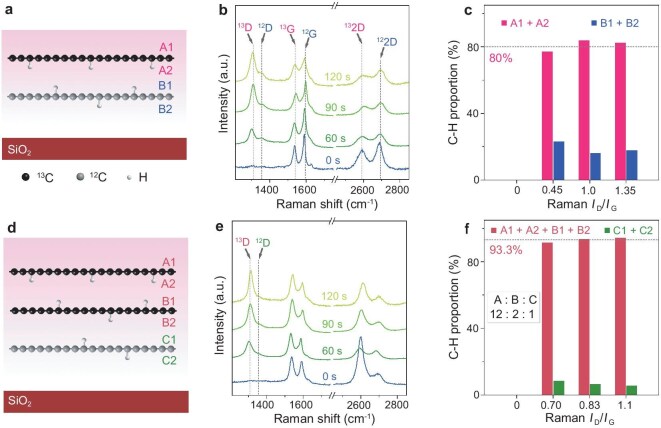
The van der Waals (vdW) confined space provides a distinct environment from free space, enabling the production of two-dimensional Janus materials, like highly asymmetric hydrogenated graphene (AH-Gr). Here, we develop a vdW confined space assisted hydrogenation method to produce AH-Gr. The confined space between graphene and the substrate aggregates hydrogen radicals, making the bottom-side of graphene more prone to hydrogenation. The dense and homogeneous confined spaces between adjacent vdW crystals promote rapid and uniform distribution of carbon-hydrogen (C-H) bonds. The hydrogen-to-carbon atomic (H/C) ratios can be quantitatively controlled by adjusting the permeated proton dose. All AH-Gr, regardless of H/C ratios, remain vacancy-free. The spatial distributions of C-H bonds significantly influence the electrical and magnetic properties of AH-Gr. Asymmetric hydrogenation transforms graphene from a semi-metal to a semiconductor, suppresses the quantum Hall effect, and reduces the phase coherence length. This study provides new insights into the preparation and characteristics of hydrogenated graphene, broadening the applications of vdW confined space.
期刊介绍:
National Science Review (NSR; ISSN abbreviation: Natl. Sci. Rev.) is an English-language peer-reviewed multidisciplinary open-access scientific journal published by Oxford University Press under the auspices of the Chinese Academy of Sciences.According to Journal Citation Reports, its 2021 impact factor was 23.178.
National Science Review publishes both review articles and perspectives as well as original research in the form of brief communications and research articles.





 京公网安备 11010802042870号
京ICP备2023020795号-1
京公网安备 11010802042870号
京ICP备2023020795号-1

 分享
分享
 求助内容:
求助内容: 应助结果提醒方式:
 扫码关注我们
