Kritika Shukla, Nikita, Altaf Ahmad, Md Salik Noorani, Ravi Gupta
{"title":"Phytohormones and emerging plant growth regulators in tailoring plant immunity against viral infections.","authors":"Kritika Shukla, Nikita, Altaf Ahmad, Md Salik Noorani, Ravi Gupta","doi":"10.1111/ppl.70171","DOIUrl":null,"url":null,"abstract":"<p><p>Viral infections are major contributors to crop yield loss and represent a significant threat to sustainable agriculture. Plants respond to virus attacks by activating sophisticated signalling cascades that initiate multiple defence mechanisms. Notably, several phytohormones, including salicylic acid (SA), jasmonic acid (JA), abscisic acid (ABA), and ethylene (ET), are known to shape these defence responses. In recent years, various plant growth regulators (PGRs) such as melatonin, carrageenans, sulfated fucan oligosaccharides, nitric oxide (NO), brassinosteroids (BRs), and hydrogen sulfide (H<sub>2</sub>S) have also emerged as crucial regulators of plant defence responses against virus infections. Emerging evidence indicates that these PGRs coordinate with phytohormones to activate various defence strategies, including (1) stomatal closure to limit pathogen entry, (2) callose deposition to block plasmodesmata and restrict viral spread within host tissues, (3) attenuation of viral replication, and (4) activation of RNA interference (RNAi), a crucial antiviral defence response. However, the interactions and crosstalk between PGRs and phytohormones remain largely underexplored, thereby limiting our ability to develop innovative strategies for managing viral diseases. This review discusses the diverse functions and crosstalk among various phytohormones and PGRs in orchestrating the plant defence mechanisms, highlighting their impact on viral replication, movement, and intercellular transport.</p>","PeriodicalId":20164,"journal":{"name":"Physiologia plantarum","volume":"177 2","pages":"e70171"},"PeriodicalIF":3.6000,"publicationDate":"2025-03-01","publicationTypes":"Journal Article","fieldsOfStudy":null,"isOpenAccess":false,"openAccessPdf":"https://www.ncbi.nlm.nih.gov/pmc/articles/PMC11932968/pdf/","citationCount":"0","resultStr":null,"platform":"Semanticscholar","paperid":null,"PeriodicalName":"Physiologia plantarum","FirstCategoryId":"99","ListUrlMain":"https://doi.org/10.1111/ppl.70171","RegionNum":2,"RegionCategory":"生物学","ArticlePicture":[],"TitleCN":null,"AbstractTextCN":null,"PMCID":null,"EPubDate":"","PubModel":"","JCR":"Q1","JCRName":"PLANT SCIENCES","Score":null,"Total":0}
引用次数: 0
Abstract
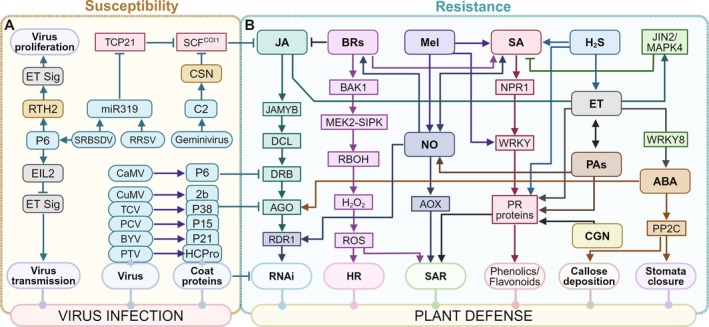
Viral infections are major contributors to crop yield loss and represent a significant threat to sustainable agriculture. Plants respond to virus attacks by activating sophisticated signalling cascades that initiate multiple defence mechanisms. Notably, several phytohormones, including salicylic acid (SA), jasmonic acid (JA), abscisic acid (ABA), and ethylene (ET), are known to shape these defence responses. In recent years, various plant growth regulators (PGRs) such as melatonin, carrageenans, sulfated fucan oligosaccharides, nitric oxide (NO), brassinosteroids (BRs), and hydrogen sulfide (H2S) have also emerged as crucial regulators of plant defence responses against virus infections. Emerging evidence indicates that these PGRs coordinate with phytohormones to activate various defence strategies, including (1) stomatal closure to limit pathogen entry, (2) callose deposition to block plasmodesmata and restrict viral spread within host tissues, (3) attenuation of viral replication, and (4) activation of RNA interference (RNAi), a crucial antiviral defence response. However, the interactions and crosstalk between PGRs and phytohormones remain largely underexplored, thereby limiting our ability to develop innovative strategies for managing viral diseases. This review discusses the diverse functions and crosstalk among various phytohormones and PGRs in orchestrating the plant defence mechanisms, highlighting their impact on viral replication, movement, and intercellular transport.
期刊介绍:
Physiologia Plantarum is an international journal committed to publishing the best full-length original research papers that advance our understanding of primary mechanisms of plant development, growth and productivity as well as plant interactions with the biotic and abiotic environment. All organisational levels of experimental plant biology – from molecular and cell biology, biochemistry and biophysics to ecophysiology and global change biology – fall within the scope of the journal. The content is distributed between 5 main subject areas supervised by Subject Editors specialised in the respective domain: (1) biochemistry and metabolism, (2) ecophysiology, stress and adaptation, (3) uptake, transport and assimilation, (4) development, growth and differentiation, (5) photobiology and photosynthesis.



 京公网安备 11010802042870号
京ICP备2023020795号-1
京公网安备 11010802042870号
京ICP备2023020795号-1

 分享
分享
 求助内容:
求助内容: 应助结果提醒方式:
 扫码关注我们
