Peter Rupprecht, Wei Fan, Steve J Sullivan, Fritjof Helmchen, Andrei D Sdrulla
{"title":"Spike rate inference from mouse spinal cord calcium imaging data.","authors":"Peter Rupprecht, Wei Fan, Steve J Sullivan, Fritjof Helmchen, Andrei D Sdrulla","doi":"10.1523/JNEUROSCI.1187-24.2025","DOIUrl":null,"url":null,"abstract":"<p><p>Calcium imaging is a key method to record the spiking activity of identified and genetically targeted neurons. However, the observed calcium signals are only an indirect readout of the underlying electrophysiological events (single spikes or bursts of spikes) and require dedicated algorithms to recover the spike rate. These algorithms for spike inference can be optimized using ground truth data from combined electrical and optical recordings, but it is not clear how such optimized algorithms perform on cell types and brain regions for which ground truth does not exist. Here, we use a state-of-the-art algorithm based on supervised deep learning (CASCADE) and a non-supervised algorithm based on non-negative deconvolution (OASIS) to test spike rate inference in spinal cord neurons. To enable these tests, we recorded specific ground truth from glutamatergic and GABAergic somatosensory neurons in the superficial dorsal horn of spinal cord in mice of both sexes. We find that CASCADE and OASIS algorithms that were designed for cortical excitatory neurons generalize well to both spinal cord cell types. However, CASCADE models re-trained on our ground truth further improved the performance, resulting in a more accurate inference of spiking activity from spinal cord neurons. We openly provide re-trained models that can be applied to spinal cord data with variable noise levels and frame rates. Together, our ground-truth recordings and analyses provide a solid foundation for the interpretation of calcium imaging data from spinal cord dorsal horn and showcase how spike rate inference can generalize between different regions of the nervous system.<b>Significance Statement</b> Calcium imaging is a powerful method for measuring the activity of genetically identified neurons. However, accurate interpretation of calcium transients depends on having a detailed understanding of how neuronal activity correlates with fluorescence. Such calibration recordings have been performed for cerebral cortex but not yet for most other CNS regions and neuron types. Here, we obtained ground truth data in spinal cord by conducting simultaneous calcium and electrophysiology recordings in excitatory and inhibitory neurons. We systematically investigated the transferability of cortical algorithms to spinal neuron subpopulations and generated inference algorithms optimized to excitatory and inhibitory neurons. Our study provides a foundation for the rigorous interpretation of calcium imaging data from spinal cord.</p>","PeriodicalId":50114,"journal":{"name":"Journal of Neuroscience","volume":" ","pages":""},"PeriodicalIF":4.0000,"publicationDate":"2025-03-24","publicationTypes":"Journal Article","fieldsOfStudy":null,"isOpenAccess":false,"openAccessPdf":"https://www.ncbi.nlm.nih.gov/pmc/articles/PMC12044035/pdf/","citationCount":"0","resultStr":null,"platform":"Semanticscholar","paperid":null,"PeriodicalName":"Journal of Neuroscience","FirstCategoryId":"3","ListUrlMain":"https://doi.org/10.1523/JNEUROSCI.1187-24.2025","RegionNum":2,"RegionCategory":"医学","ArticlePicture":[],"TitleCN":null,"AbstractTextCN":null,"PMCID":null,"EPubDate":"","PubModel":"","JCR":"Q1","JCRName":"NEUROSCIENCES","Score":null,"Total":0}
引用次数: 0
Abstract
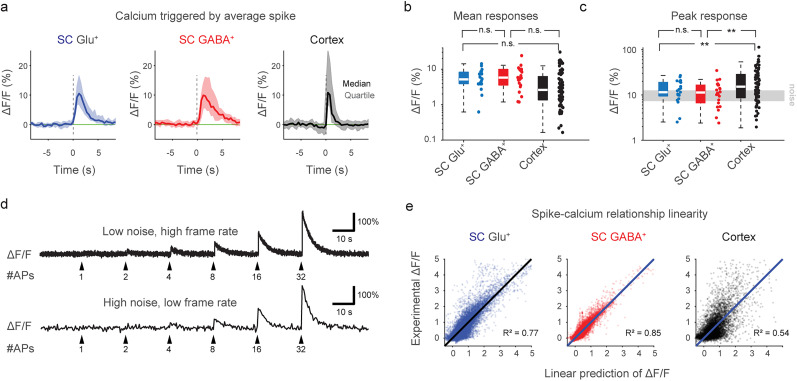
Calcium imaging is a key method to record the spiking activity of identified and genetically targeted neurons. However, the observed calcium signals are only an indirect readout of the underlying electrophysiological events (single spikes or bursts of spikes) and require dedicated algorithms to recover the spike rate. These algorithms for spike inference can be optimized using ground truth data from combined electrical and optical recordings, but it is not clear how such optimized algorithms perform on cell types and brain regions for which ground truth does not exist. Here, we use a state-of-the-art algorithm based on supervised deep learning (CASCADE) and a non-supervised algorithm based on non-negative deconvolution (OASIS) to test spike rate inference in spinal cord neurons. To enable these tests, we recorded specific ground truth from glutamatergic and GABAergic somatosensory neurons in the superficial dorsal horn of spinal cord in mice of both sexes. We find that CASCADE and OASIS algorithms that were designed for cortical excitatory neurons generalize well to both spinal cord cell types. However, CASCADE models re-trained on our ground truth further improved the performance, resulting in a more accurate inference of spiking activity from spinal cord neurons. We openly provide re-trained models that can be applied to spinal cord data with variable noise levels and frame rates. Together, our ground-truth recordings and analyses provide a solid foundation for the interpretation of calcium imaging data from spinal cord dorsal horn and showcase how spike rate inference can generalize between different regions of the nervous system.Significance Statement Calcium imaging is a powerful method for measuring the activity of genetically identified neurons. However, accurate interpretation of calcium transients depends on having a detailed understanding of how neuronal activity correlates with fluorescence. Such calibration recordings have been performed for cerebral cortex but not yet for most other CNS regions and neuron types. Here, we obtained ground truth data in spinal cord by conducting simultaneous calcium and electrophysiology recordings in excitatory and inhibitory neurons. We systematically investigated the transferability of cortical algorithms to spinal neuron subpopulations and generated inference algorithms optimized to excitatory and inhibitory neurons. Our study provides a foundation for the rigorous interpretation of calcium imaging data from spinal cord.
期刊介绍:
JNeurosci (ISSN 0270-6474) is an official journal of the Society for Neuroscience. It is published weekly by the Society, fifty weeks a year, one volume a year. JNeurosci publishes papers on a broad range of topics of general interest to those working on the nervous system. Authors now have an Open Choice option for their published articles





 京公网安备 11010802042870号
京ICP备2023020795号-1
京公网安备 11010802042870号
京ICP备2023020795号-1

 分享
分享
 求助内容:
求助内容: 应助结果提醒方式:
 扫码关注我们
