Yeshuang Wang , Mingxian Duan , Zhelin Su , Chao Yang , Bingning Wang , Jiawei Kou , Huiling Fan
{"title":"Fe2+-Triggered Unexpected Room Temperature H2S Catalytic Oxidation Activity in MIL-100(Fe)","authors":"Yeshuang Wang , Mingxian Duan , Zhelin Su , Chao Yang , Bingning Wang , Jiawei Kou , Huiling Fan","doi":"10.1016/j.seppur.2025.132695","DOIUrl":null,"url":null,"abstract":"<div><div>The abundant Fe<sup>3+</sup> Lewis acidic sites and well-developed pore structure endow the Fe-MOFs with great potential for H<sub>2</sub>S catalytic oxidation at room temperature, but their performance is inferior owing to the insufficient redox ability of the Fe<sup>3+</sup> species inherent in frameworks. Herein, an effective protocol was proposed for the first time to remarkably improve the catalytic oxidation performance of MIL-100(Fe) under ambient conditions through the introduction of Fe<sup>2+</sup> coordinatively unsaturated site (CUS) species into the framework. As expected, the sample after modification had a superior H<sub>2</sub>S breakthrough capacity of 267.3 mg S/g, an 18.4-fold increase compared with that without Fe<sup>2+</sup> CUS (14.5 mg S/g). The introduced Fe<sup>2+</sup> species triggered the Fe<sup>3+</sup>/Fe<sup>2+</sup> redox cycle for H<sub>2</sub>S catalytic oxidation by enhancing the oxidative ability of the Fe<sup>3+</sup> CUS intrinsic to the framework. Moreover, the Fe<sup>2+</sup> CUS was also found act as an active site for O<sub>2</sub> activation into O<sub>2</sub><sup>∙–</sup>, which not only provides an additional pathway for H<sub>2</sub>S catalytic oxidation but also accelerates the redox cycling of Fe<sup>3+</sup>/Fe<sup>2+</sup> during the catalytic oxidation process. On the basis of the experimental findings, a plausible catalytic mechanism involving mixed-valence iron sites in MIL-100(Fe) was proposed.</div></div>","PeriodicalId":427,"journal":{"name":"Separation and Purification Technology","volume":"365 ","pages":"Article 132695"},"PeriodicalIF":9.0000,"publicationDate":"2025-03-26","publicationTypes":"Journal Article","fieldsOfStudy":null,"isOpenAccess":false,"openAccessPdf":"","citationCount":"0","resultStr":null,"platform":"Semanticscholar","paperid":null,"PeriodicalName":"Separation and Purification Technology","FirstCategoryId":"5","ListUrlMain":"https://www.sciencedirect.com/science/article/pii/S1383586625012924","RegionNum":1,"RegionCategory":"工程技术","ArticlePicture":[],"TitleCN":null,"AbstractTextCN":null,"PMCID":null,"EPubDate":"","PubModel":"","JCR":"Q1","JCRName":"ENGINEERING, CHEMICAL","Score":null,"Total":0}
引用次数: 0
Abstract
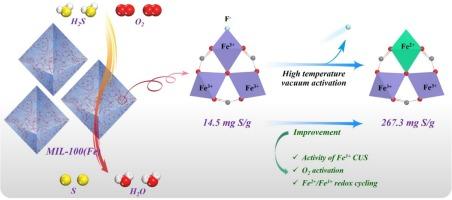
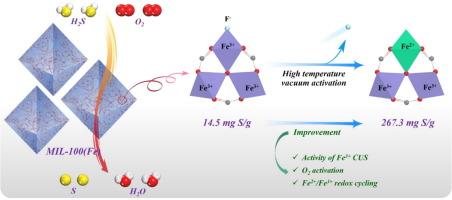
The abundant Fe3+ Lewis acidic sites and well-developed pore structure endow the Fe-MOFs with great potential for H2S catalytic oxidation at room temperature, but their performance is inferior owing to the insufficient redox ability of the Fe3+ species inherent in frameworks. Herein, an effective protocol was proposed for the first time to remarkably improve the catalytic oxidation performance of MIL-100(Fe) under ambient conditions through the introduction of Fe2+ coordinatively unsaturated site (CUS) species into the framework. As expected, the sample after modification had a superior H2S breakthrough capacity of 267.3 mg S/g, an 18.4-fold increase compared with that without Fe2+ CUS (14.5 mg S/g). The introduced Fe2+ species triggered the Fe3+/Fe2+ redox cycle for H2S catalytic oxidation by enhancing the oxidative ability of the Fe3+ CUS intrinsic to the framework. Moreover, the Fe2+ CUS was also found act as an active site for O2 activation into O2∙–, which not only provides an additional pathway for H2S catalytic oxidation but also accelerates the redox cycling of Fe3+/Fe2+ during the catalytic oxidation process. On the basis of the experimental findings, a plausible catalytic mechanism involving mixed-valence iron sites in MIL-100(Fe) was proposed.
期刊介绍:
Separation and Purification Technology is a premier journal committed to sharing innovative methods for separation and purification in chemical and environmental engineering, encompassing both homogeneous solutions and heterogeneous mixtures. Our scope includes the separation and/or purification of liquids, vapors, and gases, as well as carbon capture and separation techniques. However, it's important to note that methods solely intended for analytical purposes are not within the scope of the journal. Additionally, disciplines such as soil science, polymer science, and metallurgy fall outside the purview of Separation and Purification Technology. Join us in advancing the field of separation and purification methods for sustainable solutions in chemical and environmental engineering.



 京公网安备 11010802042870号
京ICP备2023020795号-1
京公网安备 11010802042870号
京ICP备2023020795号-1

 分享
分享
 求助内容:
求助内容: 应助结果提醒方式:
 扫码关注我们
