Ruijuan Zhang , Xinran Yu , Weijun Tian , Minghan Li , Jing Zhao , Zhiyang Lu , Bingkun Liu , Bingjie Huo , Zhuo Chen , Xinbo Wang
{"title":"Sunlight activation of persulfate by g-C3N4@FexTi3-xO4 photocatalyst for atrazine degradation","authors":"Ruijuan Zhang , Xinran Yu , Weijun Tian , Minghan Li , Jing Zhao , Zhiyang Lu , Bingkun Liu , Bingjie Huo , Zhuo Chen , Xinbo Wang","doi":"10.1016/j.seppur.2025.132694","DOIUrl":null,"url":null,"abstract":"<div><div>Atrazine (ATZ) is a highly persistent, not readily decomposable triazine herbicide that is widely distributed in the environment, causing not only ecological impacts but also harm to human health. In this study, g-C<sub>3</sub>N<sub>4</sub>@Fe<sub>x</sub>Ti<sub>3-x</sub>O<sub>4</sub> catalysts were prepared for photocatalytic activation of peroxydisulfate (PDS) to degrade ATZ in water. An exploration was conducted into the impact of various environmental factors on ATZ degradation, and a subsequent analysis was performed on the degradation mechanism. The results showed that g-C<sub>3</sub>N<sub>4</sub>@Fe<sub>x</sub>Ti<sub>3-x</sub>O<sub>4</sub> exhibited excellent PDS activation properties and removed more than 99 % of ATZ in water within 120 min. The ATZ degradation efficiency increased significantly with the increase of catalyst dosing (50 – 500 mg/L) and PDS concentration (0.1 – 2 mM). Catalysts demonstrate exceptional degradation performance under both neutral and acidic conditions, particularly under acidic conditions where the degradation time of atrazine is reduced to 40 min. Moreover, the electron paramagnetic resonance (EPR) and free radical quenching experiments confirmed the occurrence of a free radical conversion process, which primarily includes the active species of ⋅OH and<span><math><mrow><msubsup><mrow><mi>SO</mi></mrow><mrow><mn>4</mn></mrow><mrow><mo>·</mo><mo>-</mo></mrow></msubsup></mrow></math></span>. And ⋅OH, <span><math><mrow><msubsup><mrow><mi>SO</mi></mrow><mrow><mn>4</mn></mrow><mrow><mo>·</mo><mo>-</mo></mrow></msubsup></mrow></math></span>and h<sup>+</sup> is involved in the process of ATZ degradation. Results of degradation pathways and toxicity analysis has demonstrated g-C<sub>3</sub>N<sub>4</sub>@Fe<sub>x</sub>Ti<sub>3-x</sub>O<sub>4</sub> to be highly effective in reducing the ecological impact of ATZ, and the catalytic material possesses excellent recycling potential, making it ideal for use in real-world environments.</div></div>","PeriodicalId":427,"journal":{"name":"Separation and Purification Technology","volume":"365 ","pages":"Article 132694"},"PeriodicalIF":9.0000,"publicationDate":"2025-03-26","publicationTypes":"Journal Article","fieldsOfStudy":null,"isOpenAccess":false,"openAccessPdf":"","citationCount":"0","resultStr":null,"platform":"Semanticscholar","paperid":null,"PeriodicalName":"Separation and Purification Technology","FirstCategoryId":"5","ListUrlMain":"https://www.sciencedirect.com/science/article/pii/S1383586625012912","RegionNum":1,"RegionCategory":"工程技术","ArticlePicture":[],"TitleCN":null,"AbstractTextCN":null,"PMCID":null,"EPubDate":"","PubModel":"","JCR":"Q1","JCRName":"ENGINEERING, CHEMICAL","Score":null,"Total":0}
引用次数: 0
Abstract
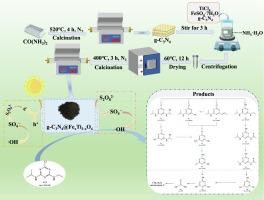
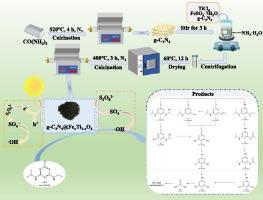
Atrazine (ATZ) is a highly persistent, not readily decomposable triazine herbicide that is widely distributed in the environment, causing not only ecological impacts but also harm to human health. In this study, g-C3N4@FexTi3-xO4 catalysts were prepared for photocatalytic activation of peroxydisulfate (PDS) to degrade ATZ in water. An exploration was conducted into the impact of various environmental factors on ATZ degradation, and a subsequent analysis was performed on the degradation mechanism. The results showed that g-C3N4@FexTi3-xO4 exhibited excellent PDS activation properties and removed more than 99 % of ATZ in water within 120 min. The ATZ degradation efficiency increased significantly with the increase of catalyst dosing (50 – 500 mg/L) and PDS concentration (0.1 – 2 mM). Catalysts demonstrate exceptional degradation performance under both neutral and acidic conditions, particularly under acidic conditions where the degradation time of atrazine is reduced to 40 min. Moreover, the electron paramagnetic resonance (EPR) and free radical quenching experiments confirmed the occurrence of a free radical conversion process, which primarily includes the active species of ⋅OH and. And ⋅OH, and h+ is involved in the process of ATZ degradation. Results of degradation pathways and toxicity analysis has demonstrated g-C3N4@FexTi3-xO4 to be highly effective in reducing the ecological impact of ATZ, and the catalytic material possesses excellent recycling potential, making it ideal for use in real-world environments.
期刊介绍:
Separation and Purification Technology is a premier journal committed to sharing innovative methods for separation and purification in chemical and environmental engineering, encompassing both homogeneous solutions and heterogeneous mixtures. Our scope includes the separation and/or purification of liquids, vapors, and gases, as well as carbon capture and separation techniques. However, it's important to note that methods solely intended for analytical purposes are not within the scope of the journal. Additionally, disciplines such as soil science, polymer science, and metallurgy fall outside the purview of Separation and Purification Technology. Join us in advancing the field of separation and purification methods for sustainable solutions in chemical and environmental engineering.



 京公网安备 11010802042870号
京ICP备2023020795号-1
京公网安备 11010802042870号
京ICP备2023020795号-1

 分享
分享
 求助内容:
求助内容: 应助结果提醒方式:
 扫码关注我们
