Yuanhong Yu , Xianyu Song , Xu Yang , Chengjie Wang , Xiaoyu Wu , Yanglong Wang , Wenjun Xiang , Shuangliang Zhao , Honglai Liu
{"title":"Optimization of chitosan-based demulsifiers via interfacial displacement: A molecular dynamics and principal component analysis approach","authors":"Yuanhong Yu , Xianyu Song , Xu Yang , Chengjie Wang , Xiaoyu Wu , Yanglong Wang , Wenjun Xiang , Shuangliang Zhao , Honglai Liu","doi":"10.1016/j.seppur.2025.132693","DOIUrl":null,"url":null,"abstract":"<div><div>Chitosan-based materials, distinguished by eco-friendly attributes and tunable side-chain modifications, offer a viable next-generation approach for emulsion separation. The structural properties of asphaltenes, particularly island and archipelago configurations, significantly affect emulsification dynamics in the oil and gas industry. Modifying chitosan enhances its ability to displace asphaltenes at the oil/water interface, thereby expediting emulsion separation. This study focuses on ethylene oxide- and zwitterion-modified chitosan. Experimentally validated molecular dynamics (MD) simulations, coupled with unsupervised learning-based principal component analysis (PCA), are employed to analyze the interfacial displacement. Interfacial tension obtained using pendant drop tensiometry was systematically examined, providing critical validation for the computational predictions. The interfacial tension at varying asphaltene concentrations reveals a strong experimental correlation (R<sup>2</sup> = 0.95), further confirming the high accuracy of the computational framework. Zwitterion-modified chitosan, despite exhibiting lower interfacial tension, does not show a significant improvement in displacement efficiency. In contrast, ethylene oxide-modified chitosan significantly enhances interfacial displacement efficiency compared to unmodified chitosan, achieving a 22.22–57.15 % increase for island-like asphaltene and a 26.67–44.45 % increase for archipelago-shaped asphaltene. The enhanced performance of ethylene oxide-modified chitosan is attributed to its ability to increase van der Waals interactions with asphaltene, which destabilize asphaltene films and facilitate interfacial displacement. Furthermore, van der Waals interactions between the demulsifier and asphaltenes, rather than electrostatic interactions, are discovered to boost displacement efficiency and demulsification performance. PCA reveals the competitive adsorption between chitosan and asphaltenes at the oil/water interface, driving asphaltene displacement and destabilization, ultimately leading to efficient emulsion separation. This integrated approach not only elucidates the molecular-level mechanistic foundations of chitosan-based demulsification but also provides a versatile framework for the rational design of other biopolymer-based interfacial materials.</div></div>","PeriodicalId":427,"journal":{"name":"Separation and Purification Technology","volume":"365 ","pages":"Article 132693"},"PeriodicalIF":9.0000,"publicationDate":"2025-09-11","publicationTypes":"Journal Article","fieldsOfStudy":null,"isOpenAccess":false,"openAccessPdf":"","citationCount":"0","resultStr":null,"platform":"Semanticscholar","paperid":null,"PeriodicalName":"Separation and Purification Technology","FirstCategoryId":"5","ListUrlMain":"https://www.sciencedirect.com/science/article/pii/S1383586625012900","RegionNum":1,"RegionCategory":"工程技术","ArticlePicture":[],"TitleCN":null,"AbstractTextCN":null,"PMCID":null,"EPubDate":"2025/3/25 0:00:00","PubModel":"Epub","JCR":"Q1","JCRName":"ENGINEERING, CHEMICAL","Score":null,"Total":0}
引用次数: 0
Abstract
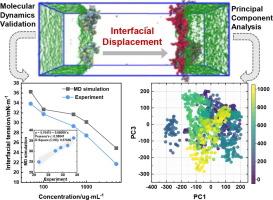
Chitosan-based materials, distinguished by eco-friendly attributes and tunable side-chain modifications, offer a viable next-generation approach for emulsion separation. The structural properties of asphaltenes, particularly island and archipelago configurations, significantly affect emulsification dynamics in the oil and gas industry. Modifying chitosan enhances its ability to displace asphaltenes at the oil/water interface, thereby expediting emulsion separation. This study focuses on ethylene oxide- and zwitterion-modified chitosan. Experimentally validated molecular dynamics (MD) simulations, coupled with unsupervised learning-based principal component analysis (PCA), are employed to analyze the interfacial displacement. Interfacial tension obtained using pendant drop tensiometry was systematically examined, providing critical validation for the computational predictions. The interfacial tension at varying asphaltene concentrations reveals a strong experimental correlation (R2 = 0.95), further confirming the high accuracy of the computational framework. Zwitterion-modified chitosan, despite exhibiting lower interfacial tension, does not show a significant improvement in displacement efficiency. In contrast, ethylene oxide-modified chitosan significantly enhances interfacial displacement efficiency compared to unmodified chitosan, achieving a 22.22–57.15 % increase for island-like asphaltene and a 26.67–44.45 % increase for archipelago-shaped asphaltene. The enhanced performance of ethylene oxide-modified chitosan is attributed to its ability to increase van der Waals interactions with asphaltene, which destabilize asphaltene films and facilitate interfacial displacement. Furthermore, van der Waals interactions between the demulsifier and asphaltenes, rather than electrostatic interactions, are discovered to boost displacement efficiency and demulsification performance. PCA reveals the competitive adsorption between chitosan and asphaltenes at the oil/water interface, driving asphaltene displacement and destabilization, ultimately leading to efficient emulsion separation. This integrated approach not only elucidates the molecular-level mechanistic foundations of chitosan-based demulsification but also provides a versatile framework for the rational design of other biopolymer-based interfacial materials.
期刊介绍:
Separation and Purification Technology is a premier journal committed to sharing innovative methods for separation and purification in chemical and environmental engineering, encompassing both homogeneous solutions and heterogeneous mixtures. Our scope includes the separation and/or purification of liquids, vapors, and gases, as well as carbon capture and separation techniques. However, it's important to note that methods solely intended for analytical purposes are not within the scope of the journal. Additionally, disciplines such as soil science, polymer science, and metallurgy fall outside the purview of Separation and Purification Technology. Join us in advancing the field of separation and purification methods for sustainable solutions in chemical and environmental engineering.




 京公网安备 11010802042870号
京ICP备2023020795号-1
京公网安备 11010802042870号
京ICP备2023020795号-1

 分享
分享
 求助内容:
求助内容: 应助结果提醒方式:
 扫码关注我们
