Munan Lyu, Hiroyuki Iida, Thomas Eekhout, Meeri Mäkelä, Sampo Muranen, Lingling Ye, Anne Vatén, Brecht Wybouw, Xin Wang, Bert De Rybel, Ari Pekka Mähönen
{"title":"The dynamic and diverse nature of parenchyma cells in the Arabidopsis root during secondary growth","authors":"Munan Lyu, Hiroyuki Iida, Thomas Eekhout, Meeri Mäkelä, Sampo Muranen, Lingling Ye, Anne Vatén, Brecht Wybouw, Xin Wang, Bert De Rybel, Ari Pekka Mähönen","doi":"10.1038/s41477-025-01938-6","DOIUrl":null,"url":null,"abstract":"During secondary growth, the vascular cambium produces conductive xylem and phloem cells, while the phellogen (cork cambium) deposits phellem (cork) as the outermost protective barrier. Although most of the secondary tissues are made up of parenchyma cells, which are also produced by both cambia, their diversity and function are poorly understood. Here we combined single-cell RNA sequencing analysis with lineage tracing to recreate developmental trajectories of the cell types in the Arabidopsis root undergoing secondary growth. By analysing 93 reporter lines, we were able to identify 20 different cell types or cell states, many of which have not been described before. We additionally observed distinct transcriptome signatures of parenchyma cells depending on their maturation state and proximity to the conductive cell types. Our data show that both xylem and phloem parenchyma tissues are required for normal formation of conductive tissue cell types. Furthermore, we show that mature phloem parenchyma gradually obtains periderm identity, and this transformation can be accelerated by jasmonate treatment or wounding. Our study thus reveals the diversity of parenchyma cells and their capacity to undergo considerable identity changes during secondary growth. A combination of lineage tracing and single-cell RNA sequencing reveals how xylem and phloem parenchyma cells in the secondary tissue of Arabidopsis root mature gradually. Upon root barrier injury, this maturation involves a change in cell identity from phloem parenchyma to barrier cell types.","PeriodicalId":18904,"journal":{"name":"Nature Plants","volume":"11 4","pages":"878-890"},"PeriodicalIF":13.6000,"publicationDate":"2025-03-26","publicationTypes":"Journal Article","fieldsOfStudy":null,"isOpenAccess":false,"openAccessPdf":"https://www.nature.comhttps://www.nature.com/articles/s41477-025-01938-6.pdf","citationCount":"0","resultStr":null,"platform":"Semanticscholar","paperid":null,"PeriodicalName":"Nature Plants","FirstCategoryId":"99","ListUrlMain":"https://www.nature.com/articles/s41477-025-01938-6","RegionNum":1,"RegionCategory":"生物学","ArticlePicture":[],"TitleCN":null,"AbstractTextCN":null,"PMCID":null,"EPubDate":"","PubModel":"","JCR":"Q1","JCRName":"PLANT SCIENCES","Score":null,"Total":0}
引用次数: 0
Abstract
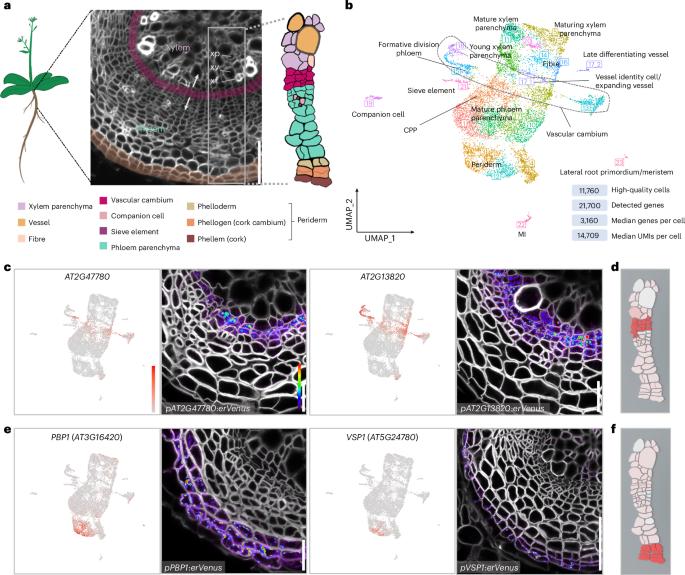
During secondary growth, the vascular cambium produces conductive xylem and phloem cells, while the phellogen (cork cambium) deposits phellem (cork) as the outermost protective barrier. Although most of the secondary tissues are made up of parenchyma cells, which are also produced by both cambia, their diversity and function are poorly understood. Here we combined single-cell RNA sequencing analysis with lineage tracing to recreate developmental trajectories of the cell types in the Arabidopsis root undergoing secondary growth. By analysing 93 reporter lines, we were able to identify 20 different cell types or cell states, many of which have not been described before. We additionally observed distinct transcriptome signatures of parenchyma cells depending on their maturation state and proximity to the conductive cell types. Our data show that both xylem and phloem parenchyma tissues are required for normal formation of conductive tissue cell types. Furthermore, we show that mature phloem parenchyma gradually obtains periderm identity, and this transformation can be accelerated by jasmonate treatment or wounding. Our study thus reveals the diversity of parenchyma cells and their capacity to undergo considerable identity changes during secondary growth. A combination of lineage tracing and single-cell RNA sequencing reveals how xylem and phloem parenchyma cells in the secondary tissue of Arabidopsis root mature gradually. Upon root barrier injury, this maturation involves a change in cell identity from phloem parenchyma to barrier cell types.
期刊介绍:
Nature Plants is an online-only, monthly journal publishing the best research on plants — from their evolution, development, metabolism and environmental interactions to their societal significance.




 京公网安备 11010802042870号
京ICP备2023020795号-1
京公网安备 11010802042870号
京ICP备2023020795号-1

 分享
分享
 求助内容:
求助内容: 应助结果提醒方式:
 扫码关注我们
