Zishuai Hu , Mankun Li , Yidan Pang , Yongmei Liang , Baochen Han , Jian Qi , Fanchun Meng , Yaqiang Li , Guangqian Zhu , Lekbach Yassir , Jianhui Li , Dan Liu
{"title":"2D g-C3N4/sodium alginate-chitosan photocatalytic hydrogel coating with electron-rich microenvironment remarkably enhances synergistic antibacterial and anticorrosive action","authors":"Zishuai Hu , Mankun Li , Yidan Pang , Yongmei Liang , Baochen Han , Jian Qi , Fanchun Meng , Yaqiang Li , Guangqian Zhu , Lekbach Yassir , Jianhui Li , Dan Liu","doi":"10.1016/j.seppur.2025.132692","DOIUrl":null,"url":null,"abstract":"<div><div>Hydrogel coatings demonstrate potential for protecting against microbiologically influenced corrosion; however, they encounter limitations related to weak mechanical properties and toxicity from chemical crosslinkers. In this study, we prepared a photocatalytic antibacterial hydrogel coating using chitosan and sodium alginate loaded with 2D g-C<sub>3</sub>N<sub>4</sub>, which exhibited robust tensile properties, low swelling rates, and exceptional antibacterial efficacy against Escherichia coli and Staphylococcus aureus. The antibacterial activity is primarily attributed to the adsorption of bacteria by –NH<sub>2</sub> groups and the generation of reactive oxygen species by 2D g-C<sub>3</sub>N<sub>4</sub>. Furthermore, the electron-rich microenvironment created by –NH<sub>2</sub> and –OH groups attract the h<sup>+</sup> generated during 2D g-C<sub>3</sub>N<sub>4</sub> photocatalysis, thereby enhancing the efficiency of charge carrier separation. Density functional theory calculations further support this conclusion. The incorporation of 2D g-C<sub>3</sub>N<sub>4</sub> nanomaterials alters the hydrogel coating structure, disrupting hydrogen bonding and exposing additional –NH<sub>2</sub> groups that bind with H<sup>+</sup> to improve active adsorption. This innovative hydrogel coating offers a novel strategy for protecting against microbial corrosion in marine environments.</div></div>","PeriodicalId":427,"journal":{"name":"Separation and Purification Technology","volume":"366 ","pages":"Article 132692"},"PeriodicalIF":9.0000,"publicationDate":"2025-03-26","publicationTypes":"Journal Article","fieldsOfStudy":null,"isOpenAccess":false,"openAccessPdf":"","citationCount":"0","resultStr":null,"platform":"Semanticscholar","paperid":null,"PeriodicalName":"Separation and Purification Technology","FirstCategoryId":"5","ListUrlMain":"https://www.sciencedirect.com/science/article/pii/S1383586625012894","RegionNum":1,"RegionCategory":"工程技术","ArticlePicture":[],"TitleCN":null,"AbstractTextCN":null,"PMCID":null,"EPubDate":"","PubModel":"","JCR":"Q1","JCRName":"ENGINEERING, CHEMICAL","Score":null,"Total":0}
引用次数: 0
Abstract
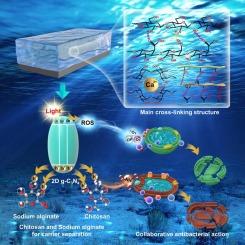
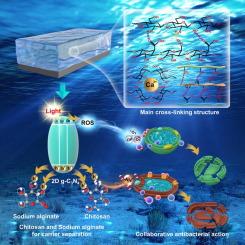
Hydrogel coatings demonstrate potential for protecting against microbiologically influenced corrosion; however, they encounter limitations related to weak mechanical properties and toxicity from chemical crosslinkers. In this study, we prepared a photocatalytic antibacterial hydrogel coating using chitosan and sodium alginate loaded with 2D g-C3N4, which exhibited robust tensile properties, low swelling rates, and exceptional antibacterial efficacy against Escherichia coli and Staphylococcus aureus. The antibacterial activity is primarily attributed to the adsorption of bacteria by –NH2 groups and the generation of reactive oxygen species by 2D g-C3N4. Furthermore, the electron-rich microenvironment created by –NH2 and –OH groups attract the h+ generated during 2D g-C3N4 photocatalysis, thereby enhancing the efficiency of charge carrier separation. Density functional theory calculations further support this conclusion. The incorporation of 2D g-C3N4 nanomaterials alters the hydrogel coating structure, disrupting hydrogen bonding and exposing additional –NH2 groups that bind with H+ to improve active adsorption. This innovative hydrogel coating offers a novel strategy for protecting against microbial corrosion in marine environments.
期刊介绍:
Separation and Purification Technology is a premier journal committed to sharing innovative methods for separation and purification in chemical and environmental engineering, encompassing both homogeneous solutions and heterogeneous mixtures. Our scope includes the separation and/or purification of liquids, vapors, and gases, as well as carbon capture and separation techniques. However, it's important to note that methods solely intended for analytical purposes are not within the scope of the journal. Additionally, disciplines such as soil science, polymer science, and metallurgy fall outside the purview of Separation and Purification Technology. Join us in advancing the field of separation and purification methods for sustainable solutions in chemical and environmental engineering.



 京公网安备 11010802042870号
京ICP备2023020795号-1
京公网安备 11010802042870号
京ICP备2023020795号-1

 分享
分享
 求助内容:
求助内容: 应助结果提醒方式:
 扫码关注我们
