Hao Zhang, Zhibo Song, Kai Yang, Yundong Zhou, Yuchen Ji, Lu Wang, Yuxiang Huang, Shenyang Xu, Jianjun Fang, Wenguang Zhao, Guoyu Qian, Shanglin Wu, José V. Anguita, Gustavo F. Trindade, Shida Xue, Haoliang Wang, Ian S. Gilmore, Yan Zhao, Feng Pan
{"title":"In Situ Aminolysis of Fluoroethylene Carbonate Induced Low-Resistance Interphase Facilitating Extreme Fast Charging of Graphite Anodes","authors":"Hao Zhang, Zhibo Song, Kai Yang, Yundong Zhou, Yuchen Ji, Lu Wang, Yuxiang Huang, Shenyang Xu, Jianjun Fang, Wenguang Zhao, Guoyu Qian, Shanglin Wu, José V. Anguita, Gustavo F. Trindade, Shida Xue, Haoliang Wang, Ian S. Gilmore, Yan Zhao, Feng Pan","doi":"10.1002/aenm.202406104","DOIUrl":null,"url":null,"abstract":"<p>Achieving extreme fast charging (XFC) lithium-ion batteries (LIBs) is essential for future battery applications, yet challenges remain in facilitating interfacial lithium-ion transportation across solid electrolyte interphase (SEI). While traditional SEI design prioritizes chemical composition, this study constructs an “ion-seepage” SEI framework accentuating the spatial distribution and arrangements of inorganic components via in-situ aminolysis reaction between fluoroethylene carbonate (FEC) and protic amines. This SEI architecture with tailored organic and nanoscale inorganic component distributions boosts interfacial Li<sup>+</sup> transfer kinetics, ultimately enabling XFC and stable low-temperature cycling. Practical validation at the pouch-cell level exhibits excellent high-rate (up to 10C) performance, highlighting the great potential of protic amines in commercial extreme fast-charging LIBs. Moreover, this strategy exhibits considerable versatility, across various protic amines, electrolyte systems, and anode materials, providing a universal approach for developing XFC batteries and valuable insights for SEI design.</p>","PeriodicalId":111,"journal":{"name":"Advanced Energy Materials","volume":"15 27","pages":""},"PeriodicalIF":26.0000,"publicationDate":"2025-03-26","publicationTypes":"Journal Article","fieldsOfStudy":null,"isOpenAccess":false,"openAccessPdf":"","citationCount":"0","resultStr":null,"platform":"Semanticscholar","paperid":null,"PeriodicalName":"Advanced Energy Materials","FirstCategoryId":"88","ListUrlMain":"https://advanced.onlinelibrary.wiley.com/doi/10.1002/aenm.202406104","RegionNum":1,"RegionCategory":"材料科学","ArticlePicture":[],"TitleCN":null,"AbstractTextCN":null,"PMCID":null,"EPubDate":"","PubModel":"","JCR":"Q1","JCRName":"CHEMISTRY, PHYSICAL","Score":null,"Total":0}
引用次数: 0
Abstract
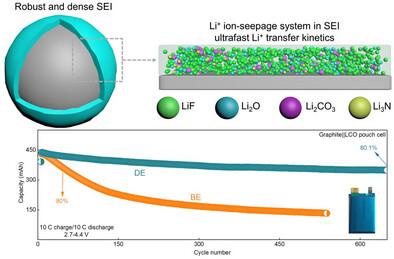
Achieving extreme fast charging (XFC) lithium-ion batteries (LIBs) is essential for future battery applications, yet challenges remain in facilitating interfacial lithium-ion transportation across solid electrolyte interphase (SEI). While traditional SEI design prioritizes chemical composition, this study constructs an “ion-seepage” SEI framework accentuating the spatial distribution and arrangements of inorganic components via in-situ aminolysis reaction between fluoroethylene carbonate (FEC) and protic amines. This SEI architecture with tailored organic and nanoscale inorganic component distributions boosts interfacial Li+ transfer kinetics, ultimately enabling XFC and stable low-temperature cycling. Practical validation at the pouch-cell level exhibits excellent high-rate (up to 10C) performance, highlighting the great potential of protic amines in commercial extreme fast-charging LIBs. Moreover, this strategy exhibits considerable versatility, across various protic amines, electrolyte systems, and anode materials, providing a universal approach for developing XFC batteries and valuable insights for SEI design.
期刊介绍:
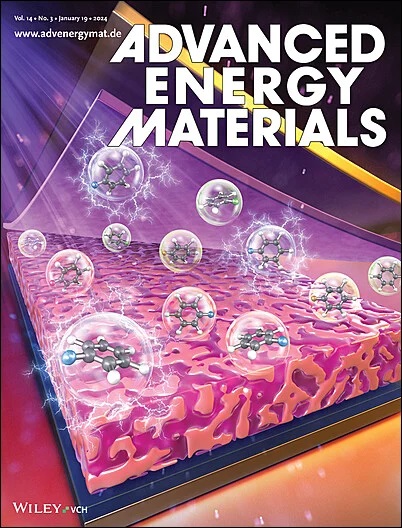
Established in 2011, Advanced Energy Materials is an international, interdisciplinary, English-language journal that focuses on materials used in energy harvesting, conversion, and storage. It is regarded as a top-quality journal alongside Advanced Materials, Advanced Functional Materials, and Small.
With a 2022 Impact Factor of 27.8, Advanced Energy Materials is considered a prime source for the best energy-related research. The journal covers a wide range of topics in energy-related research, including organic and inorganic photovoltaics, batteries and supercapacitors, fuel cells, hydrogen generation and storage, thermoelectrics, water splitting and photocatalysis, solar fuels and thermosolar power, magnetocalorics, and piezoelectronics.
The readership of Advanced Energy Materials includes materials scientists, chemists, physicists, and engineers in both academia and industry. The journal is indexed in various databases and collections, such as Advanced Technologies & Aerospace Database, FIZ Karlsruhe, INSPEC (IET), Science Citation Index Expanded, Technology Collection, and Web of Science, among others.






 京公网安备 11010802042870号
京ICP备2023020795号-1
京公网安备 11010802042870号
京ICP备2023020795号-1

 分享
分享
 求助内容:
求助内容: 应助结果提醒方式:
 扫码关注我们
