Yusheng Chen, Bin Han, Marco Gobbi, Lili Hou, Paolo Samorì
{"title":"Responsive Molecules for Organic Neuromorphic Devices: Harnessing Memory Diversification","authors":"Yusheng Chen, Bin Han, Marco Gobbi, Lili Hou, Paolo Samorì","doi":"10.1002/adma.202418281","DOIUrl":null,"url":null,"abstract":"<p>In the brain, both the recording and decaying of memory information following external stimulus spikes are fundamental learning rules that determine human behaviors. The former is essential to acquire new knowledge and update the database, while the latter filters noise and autorefresh cache data to reduce energy consumption. To execute these functions, the brain relies on different neuromorphic transmitters possessing various memory kinetics, which can be classified as nonvolatile and volatile memory. Inspired by the human brain, nonvolatile and volatile memory electronic devices have been employed to realize artificial neural networks and spiking neural networks, respectively, which have emerged as essential tools in machine learning. Molecular switches, capable of responding to electrical, optical, electrochemical, and magnetic stimuli, display a disruptive potential for emulating information storage in memory devices. This Review highlights recent developments on responsive molecules, their interfacing with low-dimensional nanostructures and nanomaterials, and their integration into electronic devices. By capitalizing on these concepts, a unique account of neurotransmitter-transfer electronic devices based on responsive molecules with ad hoc memory kinetics is provided. Finally, future directions, challenges, and opportunities are discussed on the use of these devices to engineer more complex logic operations and computing functions at the hardware level.</p>","PeriodicalId":114,"journal":{"name":"Advanced Materials","volume":"37 19","pages":""},"PeriodicalIF":26.8000,"publicationDate":"2025-03-26","publicationTypes":"Journal Article","fieldsOfStudy":null,"isOpenAccess":false,"openAccessPdf":"https://onlinelibrary.wiley.com/doi/epdf/10.1002/adma.202418281","citationCount":"0","resultStr":null,"platform":"Semanticscholar","paperid":null,"PeriodicalName":"Advanced Materials","FirstCategoryId":"88","ListUrlMain":"https://advanced.onlinelibrary.wiley.com/doi/10.1002/adma.202418281","RegionNum":1,"RegionCategory":"材料科学","ArticlePicture":[],"TitleCN":null,"AbstractTextCN":null,"PMCID":null,"EPubDate":"","PubModel":"","JCR":"Q1","JCRName":"CHEMISTRY, MULTIDISCIPLINARY","Score":null,"Total":0}
引用次数: 0
Abstract
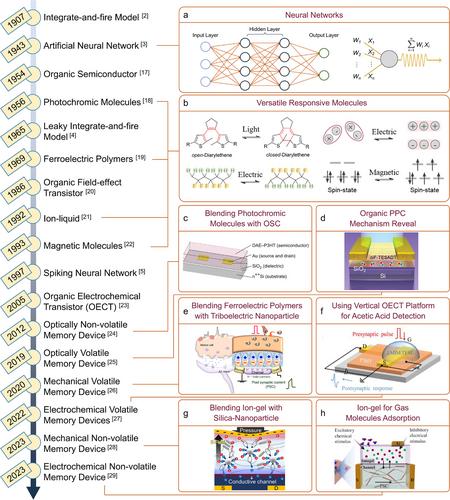
In the brain, both the recording and decaying of memory information following external stimulus spikes are fundamental learning rules that determine human behaviors. The former is essential to acquire new knowledge and update the database, while the latter filters noise and autorefresh cache data to reduce energy consumption. To execute these functions, the brain relies on different neuromorphic transmitters possessing various memory kinetics, which can be classified as nonvolatile and volatile memory. Inspired by the human brain, nonvolatile and volatile memory electronic devices have been employed to realize artificial neural networks and spiking neural networks, respectively, which have emerged as essential tools in machine learning. Molecular switches, capable of responding to electrical, optical, electrochemical, and magnetic stimuli, display a disruptive potential for emulating information storage in memory devices. This Review highlights recent developments on responsive molecules, their interfacing with low-dimensional nanostructures and nanomaterials, and their integration into electronic devices. By capitalizing on these concepts, a unique account of neurotransmitter-transfer electronic devices based on responsive molecules with ad hoc memory kinetics is provided. Finally, future directions, challenges, and opportunities are discussed on the use of these devices to engineer more complex logic operations and computing functions at the hardware level.
期刊介绍:
Advanced Materials, one of the world's most prestigious journals and the foundation of the Advanced portfolio, is the home of choice for best-in-class materials science for more than 30 years. Following this fast-growing and interdisciplinary field, we are considering and publishing the most important discoveries on any and all materials from materials scientists, chemists, physicists, engineers as well as health and life scientists and bringing you the latest results and trends in modern materials-related research every week.






 京公网安备 11010802042870号
京ICP备2023020795号-1
京公网安备 11010802042870号
京ICP备2023020795号-1

 分享
分享
 求助内容:
求助内容: 应助结果提醒方式:
 扫码关注我们
