Jiacheng Liu, Yan Wen, Wei Yan, Zhongliang Huang, Xiaozhi Liu, Xuan Huang, Changhong Zhan, Yuqi Zhang, Wei-Hsiang Huang, Chih-Wen Pao, Zhiwei Hu, Dong Su, Shunji Xie, Ye Wang, Jiajia Han, Haifeng Xiong, Xiaoqing Huang and Nanjun Chen
{"title":"Single-atom mediated crystal facet engineering for the exceptional production of acetate in CO electrolysis†","authors":"Jiacheng Liu, Yan Wen, Wei Yan, Zhongliang Huang, Xiaozhi Liu, Xuan Huang, Changhong Zhan, Yuqi Zhang, Wei-Hsiang Huang, Chih-Wen Pao, Zhiwei Hu, Dong Su, Shunji Xie, Ye Wang, Jiajia Han, Haifeng Xiong, Xiaoqing Huang and Nanjun Chen","doi":"10.1039/D4EE06192F","DOIUrl":null,"url":null,"abstract":"<p >The production of value-added liquid fuels <em>via</em> the electroreduction of CO has received widespread attention. Although copper (Cu) has demonstrated promising activity in producing multi-carbon products, the yield of a specific product like acetate remains limited, resulting in low resource utilization efficiency. Here, we present a Co single-atom mediated Cu(111) (CuCo<small><sub>1</sub></small>) triangular sheet, in which the Co single atom was specifically modified on the exposed Cu(111) crystal face. Importantly, CuCo<small><sub>1</sub></small> sheets achieve an exceptional acetate faradaic efficiency of 72% at a high current density of 600 mA cm<small><sup>−2</sup></small>, along with the topmost acetate formation rate of 1.11 μmol s<small><sup>−1</sup></small> cm<small><sup>−2</sup></small>, surpassing most state-of-the-art Cu-type catalysts. Moreover, the CuCo<small><sub>1</sub></small>-based membrane electrode assembly (MEA) enables a stable production of acetate at 600 mA cm<small><sup>−2</sup></small> for over 500 h, demonstrating the exceptional stability of CuCo<small><sub>1</sub></small>. <em>In situ</em> spectroscopic and computational investigations suggest that Co single atoms can significantly modulate the CO activation step to form *CO adsorption on both the top and bridge sites of Cu sheets, triggering asymmetric C–C coupling to facilitate the *OCCOH intermediate. Furthermore, a Co single atom reduces the energy barrier for the second hydrogenation step over Cu(111), thereby stabilizing ethenone production and enhancing acetate yield. This work provides an avenue to design highly efficient and stable Cu catalysts <em>via</em> the combination of crystal facet design and a single atom promoter.</p>","PeriodicalId":72,"journal":{"name":"Energy & Environmental Science","volume":" 9","pages":" 4396-4404"},"PeriodicalIF":30.8000,"publicationDate":"2025-03-26","publicationTypes":"Journal Article","fieldsOfStudy":null,"isOpenAccess":false,"openAccessPdf":"","citationCount":"0","resultStr":null,"platform":"Semanticscholar","paperid":null,"PeriodicalName":"Energy & Environmental Science","FirstCategoryId":"88","ListUrlMain":"https://pubs.rsc.org/en/content/articlelanding/2025/ee/d4ee06192f","RegionNum":1,"RegionCategory":"材料科学","ArticlePicture":[],"TitleCN":null,"AbstractTextCN":null,"PMCID":null,"EPubDate":"","PubModel":"","JCR":"Q1","JCRName":"CHEMISTRY, MULTIDISCIPLINARY","Score":null,"Total":0}
引用次数: 0
Abstract
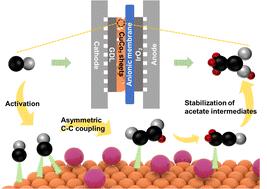
The production of value-added liquid fuels via the electroreduction of CO has received widespread attention. Although copper (Cu) has demonstrated promising activity in producing multi-carbon products, the yield of a specific product like acetate remains limited, resulting in low resource utilization efficiency. Here, we present a Co single-atom mediated Cu(111) (CuCo1) triangular sheet, in which the Co single atom was specifically modified on the exposed Cu(111) crystal face. Importantly, CuCo1 sheets achieve an exceptional acetate faradaic efficiency of 72% at a high current density of 600 mA cm−2, along with the topmost acetate formation rate of 1.11 μmol s−1 cm−2, surpassing most state-of-the-art Cu-type catalysts. Moreover, the CuCo1-based membrane electrode assembly (MEA) enables a stable production of acetate at 600 mA cm−2 for over 500 h, demonstrating the exceptional stability of CuCo1. In situ spectroscopic and computational investigations suggest that Co single atoms can significantly modulate the CO activation step to form *CO adsorption on both the top and bridge sites of Cu sheets, triggering asymmetric C–C coupling to facilitate the *OCCOH intermediate. Furthermore, a Co single atom reduces the energy barrier for the second hydrogenation step over Cu(111), thereby stabilizing ethenone production and enhancing acetate yield. This work provides an avenue to design highly efficient and stable Cu catalysts via the combination of crystal facet design and a single atom promoter.
期刊介绍:
Energy & Environmental Science, a peer-reviewed scientific journal, publishes original research and review articles covering interdisciplinary topics in the (bio)chemical and (bio)physical sciences, as well as chemical engineering disciplines. Published monthly by the Royal Society of Chemistry (RSC), a not-for-profit publisher, Energy & Environmental Science is recognized as a leading journal. It boasts an impressive impact factor of 8.500 as of 2009, ranking 8th among 140 journals in the category "Chemistry, Multidisciplinary," second among 71 journals in "Energy & Fuels," second among 128 journals in "Engineering, Chemical," and first among 181 scientific journals in "Environmental Sciences."
Energy & Environmental Science publishes various types of articles, including Research Papers (original scientific work), Review Articles, Perspectives, and Minireviews (feature review-type articles of broad interest), Communications (original scientific work of an urgent nature), Opinions (personal, often speculative viewpoints or hypotheses on current topics), and Analysis Articles (in-depth examination of energy-related issues).



 京公网安备 11010802042870号
京ICP备2023020795号-1
京公网安备 11010802042870号
京ICP备2023020795号-1

 分享
分享
 求助内容:
求助内容: 应助结果提醒方式:
 扫码关注我们
