Hao Zhang, Suwen Wang, Enmin Lv, Menghui Qi, Chengchao He, Xinglong Dong, Jieshan Qiu, Yong Wang and Zhenhai Wen
{"title":"Porous organic material-based atomically dispersed metal electrocatalysts","authors":"Hao Zhang, Suwen Wang, Enmin Lv, Menghui Qi, Chengchao He, Xinglong Dong, Jieshan Qiu, Yong Wang and Zhenhai Wen","doi":"10.1039/D5EE00273G","DOIUrl":null,"url":null,"abstract":"<p >The transition to renewable energy sources and the need for efficient energy conversion technologies have led to the development of various types of catalysts, among which atomically dispersed metal catalysts (ADMCs) supported by porous organic materials (POMs) have attracted attention for their high catalytic efficiency and stability. This review focuses on the development and application of ADMCs supported by POMs, such as MOFs, COFs, and HOFs, which offer catalytic performance due to their high atomic utilization, stability, and selectivity. This paper systematically explores various strategies for synthesizing ADMCs, including the use of organic linkers, metal nodes, and pore spaces within POMs to stabilize metal atoms and prevent aggregation. Key applications highlighted include energy conversion and storage technologies, such as fuel cells, water splitting, CO<small><sub>2</sub></small> reduction and nitrogen reduction, where ADMCs demonstrate the potential to replace noble metals. Despite the progress, challenges remain in achieving high metal loading, long-term stability, and cost-effective large-scale production. This study underscores the importance of advanced characterization techniques and computational models to deepen the understanding of ADMCs’ catalytic mechanisms and guide future material design, paving the way for their broader application in sustainable energy technologies.</p>","PeriodicalId":72,"journal":{"name":"Energy & Environmental Science","volume":" 9","pages":" 3986-4009"},"PeriodicalIF":30.8000,"publicationDate":"2025-03-26","publicationTypes":"Journal Article","fieldsOfStudy":null,"isOpenAccess":false,"openAccessPdf":"https://pubs.rsc.org/en/content/articlepdf/2025/ee/d5ee00273g?page=search","citationCount":"0","resultStr":null,"platform":"Semanticscholar","paperid":null,"PeriodicalName":"Energy & Environmental Science","FirstCategoryId":"88","ListUrlMain":"https://pubs.rsc.org/en/content/articlelanding/2025/ee/d5ee00273g","RegionNum":1,"RegionCategory":"材料科学","ArticlePicture":[],"TitleCN":null,"AbstractTextCN":null,"PMCID":null,"EPubDate":"","PubModel":"","JCR":"Q1","JCRName":"CHEMISTRY, MULTIDISCIPLINARY","Score":null,"Total":0}
引用次数: 0
Abstract
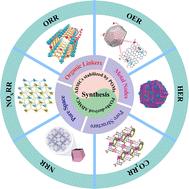
The transition to renewable energy sources and the need for efficient energy conversion technologies have led to the development of various types of catalysts, among which atomically dispersed metal catalysts (ADMCs) supported by porous organic materials (POMs) have attracted attention for their high catalytic efficiency and stability. This review focuses on the development and application of ADMCs supported by POMs, such as MOFs, COFs, and HOFs, which offer catalytic performance due to their high atomic utilization, stability, and selectivity. This paper systematically explores various strategies for synthesizing ADMCs, including the use of organic linkers, metal nodes, and pore spaces within POMs to stabilize metal atoms and prevent aggregation. Key applications highlighted include energy conversion and storage technologies, such as fuel cells, water splitting, CO2 reduction and nitrogen reduction, where ADMCs demonstrate the potential to replace noble metals. Despite the progress, challenges remain in achieving high metal loading, long-term stability, and cost-effective large-scale production. This study underscores the importance of advanced characterization techniques and computational models to deepen the understanding of ADMCs’ catalytic mechanisms and guide future material design, paving the way for their broader application in sustainable energy technologies.
期刊介绍:
Energy & Environmental Science, a peer-reviewed scientific journal, publishes original research and review articles covering interdisciplinary topics in the (bio)chemical and (bio)physical sciences, as well as chemical engineering disciplines. Published monthly by the Royal Society of Chemistry (RSC), a not-for-profit publisher, Energy & Environmental Science is recognized as a leading journal. It boasts an impressive impact factor of 8.500 as of 2009, ranking 8th among 140 journals in the category "Chemistry, Multidisciplinary," second among 71 journals in "Energy & Fuels," second among 128 journals in "Engineering, Chemical," and first among 181 scientific journals in "Environmental Sciences."
Energy & Environmental Science publishes various types of articles, including Research Papers (original scientific work), Review Articles, Perspectives, and Minireviews (feature review-type articles of broad interest), Communications (original scientific work of an urgent nature), Opinions (personal, often speculative viewpoints or hypotheses on current topics), and Analysis Articles (in-depth examination of energy-related issues).



 京公网安备 11010802042870号
京ICP备2023020795号-1
京公网安备 11010802042870号
京ICP备2023020795号-1

 分享
分享
 求助内容:
求助内容: 应助结果提醒方式:
 扫码关注我们
