Effect of disruption in the intestinal barrier function during the transgenerational process on nanoplastic toxicity induction in Caenorhabditis elegans†
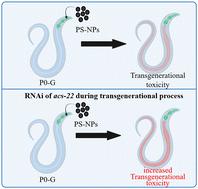
{"title":"Effect of disruption in the intestinal barrier function during the transgenerational process on nanoplastic toxicity induction in Caenorhabditis elegans†","authors":"Yuxing Wang and Dayong Wang","doi":"10.1039/D5EN00149H","DOIUrl":null,"url":null,"abstract":"<p >After exposure at the parental generation (P0-G), nanoplastics can induce transgenerational toxicity. However, it remains unclear whether changes in intestinal barrier function during the transgenerational process affect the induction of nanoplastic toxicity. In this study, polystyrene nanoparticles (PS-NPs) were used as a representative nanoplastic. Exposure to PS-NPs (1 and 10 μg L<small><sup>−1</sup></small>) caused transgenerational toxicity, impacting locomotion behavior, brood size, and intestinal permeability. After exposure to PS-NPs (1 and 10 μg L<small><sup>−1</sup></small>) at P0-G, PS-NP accumulation was only observed at both P0-G and F1-G. RNA interference (RNAi) of <em>acs-22</em> resulted in enhanced intestinal permeability, and exposure to PS-NPs (10 μg L<small><sup>−1</sup></small>) led to suppressed <em>acs-22</em> expression from P0-G to F3-G. After RNAi of <em>acs-22</em> at P0-G and F1-G, transgenerational toxicity of PS-NP (10 μg L<small><sup>−1</sup></small>) was prolonged by more than two generations, while PS-NP accumulation persisted until F2-G. After RNAi of <em>acs-22</em> at F2-G, transgenerational toxicity of PS-NP (10 μg L<small><sup>−1</sup></small>) could be extended by more than two generations. Moreover, RNAi of <em>acs-22</em> at F4-G prolonged transgenerational PS-NP (10 μg L<small><sup>−1</sup></small>) toxicity until F5-G. These findings indicate that transgenerational nanoplastic toxicity can be influenced by intestinal barrier dysfunction induced by <em>acs-22</em> RNAi during the transgenerational process in organisms.</p>","PeriodicalId":73,"journal":{"name":"Environmental Science: Nano","volume":" 5","pages":" 2741-2749"},"PeriodicalIF":5.1000,"publicationDate":"2025-03-26","publicationTypes":"Journal Article","fieldsOfStudy":null,"isOpenAccess":false,"openAccessPdf":"","citationCount":"0","resultStr":null,"platform":"Semanticscholar","paperid":null,"PeriodicalName":"Environmental Science: Nano","FirstCategoryId":"6","ListUrlMain":"https://pubs.rsc.org/en/content/articlelanding/2025/en/d5en00149h","RegionNum":2,"RegionCategory":"环境科学与生态学","ArticlePicture":[],"TitleCN":null,"AbstractTextCN":null,"PMCID":null,"EPubDate":"","PubModel":"","JCR":"Q1","JCRName":"CHEMISTRY, MULTIDISCIPLINARY","Score":null,"Total":0}
引用次数: 0
Abstract
After exposure at the parental generation (P0-G), nanoplastics can induce transgenerational toxicity. However, it remains unclear whether changes in intestinal barrier function during the transgenerational process affect the induction of nanoplastic toxicity. In this study, polystyrene nanoparticles (PS-NPs) were used as a representative nanoplastic. Exposure to PS-NPs (1 and 10 μg L−1) caused transgenerational toxicity, impacting locomotion behavior, brood size, and intestinal permeability. After exposure to PS-NPs (1 and 10 μg L−1) at P0-G, PS-NP accumulation was only observed at both P0-G and F1-G. RNA interference (RNAi) of acs-22 resulted in enhanced intestinal permeability, and exposure to PS-NPs (10 μg L−1) led to suppressed acs-22 expression from P0-G to F3-G. After RNAi of acs-22 at P0-G and F1-G, transgenerational toxicity of PS-NP (10 μg L−1) was prolonged by more than two generations, while PS-NP accumulation persisted until F2-G. After RNAi of acs-22 at F2-G, transgenerational toxicity of PS-NP (10 μg L−1) could be extended by more than two generations. Moreover, RNAi of acs-22 at F4-G prolonged transgenerational PS-NP (10 μg L−1) toxicity until F5-G. These findings indicate that transgenerational nanoplastic toxicity can be influenced by intestinal barrier dysfunction induced by acs-22 RNAi during the transgenerational process in organisms.
期刊介绍:
Environmental Science: Nano serves as a comprehensive and high-impact peer-reviewed source of information on the design and demonstration of engineered nanomaterials for environment-based applications. It also covers the interactions between engineered, natural, and incidental nanomaterials with biological and environmental systems. This scope includes, but is not limited to, the following topic areas:
Novel nanomaterial-based applications for water, air, soil, food, and energy sustainability
Nanomaterial interactions with biological systems and nanotoxicology
Environmental fate, reactivity, and transformations of nanoscale materials
Nanoscale processes in the environment
Sustainable nanotechnology including rational nanomaterial design, life cycle assessment, risk/benefit analysis



 京公网安备 11010802042870号
京ICP备2023020795号-1
京公网安备 11010802042870号
京ICP备2023020795号-1

 分享
分享
 求助内容:
求助内容: 应助结果提醒方式:
 扫码关注我们
