Xuanjie Wang, Jintong Gao, Yipu Wang, Yayuan Liu, Xinyue Liu and Lenan Zhang
{"title":"Over 12% efficiency solar-powered green hydrogen production from seawater†","authors":"Xuanjie Wang, Jintong Gao, Yipu Wang, Yayuan Liu, Xinyue Liu and Lenan Zhang","doi":"10.1039/D4EE06203E","DOIUrl":null,"url":null,"abstract":"<p >Solar-powered water electrolysis holds significant promise for the mass production of green hydrogen. However, the substantial water consumption associated with electrolysis not only increases the cost of green hydrogen but also raises critical concerns about accelerating water scarcity. Although seawater can serve as an infinite water supply for green hydrogen production, its complex composition poses substantial challenges to efficient and reliable electrolysis. Here, we demonstrate a high-efficiency solar-powered green hydrogen production from seawater. Our approach takes advantage of the full-spectrum utilization of solar energy. Photovoltaic electricity is used to drive the electrolysis, whereas the waste heat from solar cells is harnessed to produce clean water through seawater distillation. With natural sunlight and real seawater as the sole inputs, we experimentally demonstrate a 12.6% solar-to-hydrogen conversion efficiency and a 35.9 L m<small><sup>−2</sup></small> h<small><sup>−1</sup></small> production rate of green hydrogen under one-sun illumination, where additional 1.2 L m<small><sup>−2</sup></small> h<small><sup>−1</sup></small> clean water is obtained as a byproduct. By reducing reliance on clean water and electricity supplies, this work provides a fully sustainable strategy to access green hydrogen with favorable energy efficiency and technoeconomic feasibility.</p>","PeriodicalId":72,"journal":{"name":"Energy & Environmental Science","volume":" 11","pages":" 5264-5276"},"PeriodicalIF":30.8000,"publicationDate":"2025-03-25","publicationTypes":"Journal Article","fieldsOfStudy":null,"isOpenAccess":false,"openAccessPdf":"https://pubs.rsc.org/en/content/articlepdf/2025/ee/d4ee06203e?page=search","citationCount":"0","resultStr":null,"platform":"Semanticscholar","paperid":null,"PeriodicalName":"Energy & Environmental Science","FirstCategoryId":"88","ListUrlMain":"https://pubs.rsc.org/en/content/articlelanding/2025/ee/d4ee06203e","RegionNum":1,"RegionCategory":"材料科学","ArticlePicture":[],"TitleCN":null,"AbstractTextCN":null,"PMCID":null,"EPubDate":"","PubModel":"","JCR":"Q1","JCRName":"CHEMISTRY, MULTIDISCIPLINARY","Score":null,"Total":0}
引用次数: 0
Abstract
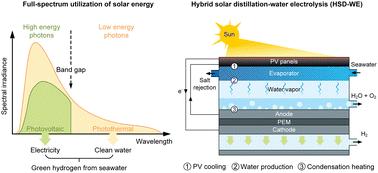
Solar-powered water electrolysis holds significant promise for the mass production of green hydrogen. However, the substantial water consumption associated with electrolysis not only increases the cost of green hydrogen but also raises critical concerns about accelerating water scarcity. Although seawater can serve as an infinite water supply for green hydrogen production, its complex composition poses substantial challenges to efficient and reliable electrolysis. Here, we demonstrate a high-efficiency solar-powered green hydrogen production from seawater. Our approach takes advantage of the full-spectrum utilization of solar energy. Photovoltaic electricity is used to drive the electrolysis, whereas the waste heat from solar cells is harnessed to produce clean water through seawater distillation. With natural sunlight and real seawater as the sole inputs, we experimentally demonstrate a 12.6% solar-to-hydrogen conversion efficiency and a 35.9 L m−2 h−1 production rate of green hydrogen under one-sun illumination, where additional 1.2 L m−2 h−1 clean water is obtained as a byproduct. By reducing reliance on clean water and electricity supplies, this work provides a fully sustainable strategy to access green hydrogen with favorable energy efficiency and technoeconomic feasibility.
期刊介绍:
Energy & Environmental Science, a peer-reviewed scientific journal, publishes original research and review articles covering interdisciplinary topics in the (bio)chemical and (bio)physical sciences, as well as chemical engineering disciplines. Published monthly by the Royal Society of Chemistry (RSC), a not-for-profit publisher, Energy & Environmental Science is recognized as a leading journal. It boasts an impressive impact factor of 8.500 as of 2009, ranking 8th among 140 journals in the category "Chemistry, Multidisciplinary," second among 71 journals in "Energy & Fuels," second among 128 journals in "Engineering, Chemical," and first among 181 scientific journals in "Environmental Sciences."
Energy & Environmental Science publishes various types of articles, including Research Papers (original scientific work), Review Articles, Perspectives, and Minireviews (feature review-type articles of broad interest), Communications (original scientific work of an urgent nature), Opinions (personal, often speculative viewpoints or hypotheses on current topics), and Analysis Articles (in-depth examination of energy-related issues).



 京公网安备 11010802042870号
京ICP备2023020795号-1
京公网安备 11010802042870号
京ICP备2023020795号-1

 分享
分享
 求助内容:
求助内容: 应助结果提醒方式:
 扫码关注我们
