Dongsheng Wen , Victoria Tucker , Michael S. Titus
{"title":"A layer model for the kinetics of segregation in planar defects in multi-component materials","authors":"Dongsheng Wen , Victoria Tucker , Michael S. Titus","doi":"10.1016/j.actamat.2025.120948","DOIUrl":null,"url":null,"abstract":"<div><div>Suzuki segregation and local phase transformations are widely observed across materials with extended planar defects, offering opportunities to design novel high-temperature and functional materials enabled by the nanoscale two-dimensional defects. However, the kinetics of the segregation process are not well understood despite intensive efforts have been made to investigate the segregation profiles at equilibrium and non-equilibrium conditions. In this work, a new model is proposed to study the temperature- and time-dependent segregation process to facilitate the research of this phenomenon. The model is established from the segregation energy landscape across the planar defects and the interlayer diffusion process. The model is applied to the Co-Ni binary alloys, Co-based superalloys, and Ni-based superalloys to understand the characteristics of segregation at equilibrium, the timescale required to reach equilibrium, and the influence of solute–solute interactions in the process. The kinetic model can be implemented with the thermodynamic models of segregation energy, which is demonstrated for a Ni-Co-Cr system. Based on the findings, a time–temperature–segregation diagram is proposed to determine the heat treatment parameters or thermal exposure profiles to achieve Suzuki segregation and local phase transformation for material design.</div></div>","PeriodicalId":238,"journal":{"name":"Acta Materialia","volume":"290 ","pages":"Article 120948"},"PeriodicalIF":9.3000,"publicationDate":"2025-05-15","publicationTypes":"Journal Article","fieldsOfStudy":null,"isOpenAccess":false,"openAccessPdf":"","citationCount":"0","resultStr":null,"platform":"Semanticscholar","paperid":null,"PeriodicalName":"Acta Materialia","FirstCategoryId":"88","ListUrlMain":"https://www.sciencedirect.com/science/article/pii/S135964542500240X","RegionNum":1,"RegionCategory":"材料科学","ArticlePicture":[],"TitleCN":null,"AbstractTextCN":null,"PMCID":null,"EPubDate":"2025/3/25 0:00:00","PubModel":"Epub","JCR":"Q1","JCRName":"MATERIALS SCIENCE, MULTIDISCIPLINARY","Score":null,"Total":0}
引用次数: 0
Abstract
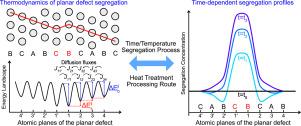
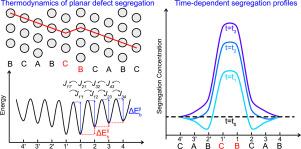
Suzuki segregation and local phase transformations are widely observed across materials with extended planar defects, offering opportunities to design novel high-temperature and functional materials enabled by the nanoscale two-dimensional defects. However, the kinetics of the segregation process are not well understood despite intensive efforts have been made to investigate the segregation profiles at equilibrium and non-equilibrium conditions. In this work, a new model is proposed to study the temperature- and time-dependent segregation process to facilitate the research of this phenomenon. The model is established from the segregation energy landscape across the planar defects and the interlayer diffusion process. The model is applied to the Co-Ni binary alloys, Co-based superalloys, and Ni-based superalloys to understand the characteristics of segregation at equilibrium, the timescale required to reach equilibrium, and the influence of solute–solute interactions in the process. The kinetic model can be implemented with the thermodynamic models of segregation energy, which is demonstrated for a Ni-Co-Cr system. Based on the findings, a time–temperature–segregation diagram is proposed to determine the heat treatment parameters or thermal exposure profiles to achieve Suzuki segregation and local phase transformation for material design.
期刊介绍:
Acta Materialia serves as a platform for publishing full-length, original papers and commissioned overviews that contribute to a profound understanding of the correlation between the processing, structure, and properties of inorganic materials. The journal seeks papers with high impact potential or those that significantly propel the field forward. The scope includes the atomic and molecular arrangements, chemical and electronic structures, and microstructure of materials, focusing on their mechanical or functional behavior across all length scales, including nanostructures.



 京公网安备 11010802042870号
京ICP备2023020795号-1
京公网安备 11010802042870号
京ICP备2023020795号-1

 分享
分享
 求助内容:
求助内容: 应助结果提醒方式:
 扫码关注我们
