Hui Ma , Ruijing Meng , Haohao Hou , Hongfu Zhou , Xiangdong Wang , Yafeng Deng
{"title":"F-POSS nanofillers modified PVDF foam with excellent mechanical and thermal insulation properties","authors":"Hui Ma , Ruijing Meng , Haohao Hou , Hongfu Zhou , Xiangdong Wang , Yafeng Deng","doi":"10.1016/j.polymer.2025.128316","DOIUrl":null,"url":null,"abstract":"<div><div>Polyvinylidene fluoride (PVDF) foam, known for its low density, high strength, and inherent flame retardancy, has demonstrated significant advantages in various applications. Fluorinated polyhedral oligomeric silsesquioxane (F-POSS), recognized as an ideal nanofiller, contributes to the manufacture of lightweight, high-performance PVDF insulating foam. PVDF/F-POSS composite foams were successfully prepared in this work, employing melt blending and supercritical CO<sub>2</sub> (scCO<sub>2</sub>) autoclave foaming techniques that exhibited excellent mechanical performance and thermal insulation capabilities. Crystallization behavior research findings indicated that F-POSS increased the crystallinity of PVDF, functioning as a crystallization nucleating agent. Concurrently, the use of scCO<sub>2</sub> foaming technology promoted phase transitions, increasing the content of β-phase. Scanning electron microscopy (SEM) observations revealed that F-POSS could also serve as a cell nucleating agent, which increased cell density and formed a more uniform cell structure. At 1 wt% of F-POSS, the foams demonstrated excellent compressive mechanical properties, which compressive specific modulus and compressive specific strength increased by 76.9 % and 197.5 %, respectively. In addition, the composite foams exhibited an outstanding low thermal conductivity value of 0.0305 W m<sup>−1</sup> K<sup>−1</sup>. This study provides a simple, efficient and green way for preparing thermal insulation foams consisting of fluorinated polymers and fluorinated nanofillers.</div></div>","PeriodicalId":405,"journal":{"name":"Polymer","volume":"326 ","pages":"Article 128316"},"PeriodicalIF":4.5000,"publicationDate":"2025-05-09","publicationTypes":"Journal Article","fieldsOfStudy":null,"isOpenAccess":false,"openAccessPdf":"","citationCount":"0","resultStr":null,"platform":"Semanticscholar","paperid":null,"PeriodicalName":"Polymer","FirstCategoryId":"92","ListUrlMain":"https://www.sciencedirect.com/science/article/pii/S0032386125003027","RegionNum":2,"RegionCategory":"化学","ArticlePicture":[],"TitleCN":null,"AbstractTextCN":null,"PMCID":null,"EPubDate":"2025/3/26 0:00:00","PubModel":"Epub","JCR":"Q2","JCRName":"POLYMER SCIENCE","Score":null,"Total":0}
引用次数: 0
Abstract
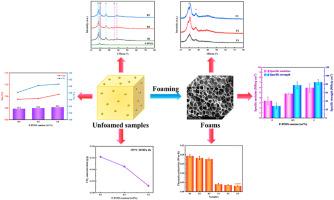
Polyvinylidene fluoride (PVDF) foam, known for its low density, high strength, and inherent flame retardancy, has demonstrated significant advantages in various applications. Fluorinated polyhedral oligomeric silsesquioxane (F-POSS), recognized as an ideal nanofiller, contributes to the manufacture of lightweight, high-performance PVDF insulating foam. PVDF/F-POSS composite foams were successfully prepared in this work, employing melt blending and supercritical CO2 (scCO2) autoclave foaming techniques that exhibited excellent mechanical performance and thermal insulation capabilities. Crystallization behavior research findings indicated that F-POSS increased the crystallinity of PVDF, functioning as a crystallization nucleating agent. Concurrently, the use of scCO2 foaming technology promoted phase transitions, increasing the content of β-phase. Scanning electron microscopy (SEM) observations revealed that F-POSS could also serve as a cell nucleating agent, which increased cell density and formed a more uniform cell structure. At 1 wt% of F-POSS, the foams demonstrated excellent compressive mechanical properties, which compressive specific modulus and compressive specific strength increased by 76.9 % and 197.5 %, respectively. In addition, the composite foams exhibited an outstanding low thermal conductivity value of 0.0305 W m−1 K−1. This study provides a simple, efficient and green way for preparing thermal insulation foams consisting of fluorinated polymers and fluorinated nanofillers.
期刊介绍:
Polymer is an interdisciplinary journal dedicated to publishing innovative and significant advances in Polymer Physics, Chemistry and Technology. We welcome submissions on polymer hybrids, nanocomposites, characterisation and self-assembly. Polymer also publishes work on the technological application of polymers in energy and optoelectronics.
The main scope is covered but not limited to the following core areas:
Polymer Materials
Nanocomposites and hybrid nanomaterials
Polymer blends, films, fibres, networks and porous materials
Physical Characterization
Characterisation, modelling and simulation* of molecular and materials properties in bulk, solution, and thin films
Polymer Engineering
Advanced multiscale processing methods
Polymer Synthesis, Modification and Self-assembly
Including designer polymer architectures, mechanisms and kinetics, and supramolecular polymerization
Technological Applications
Polymers for energy generation and storage
Polymer membranes for separation technology
Polymers for opto- and microelectronics.




 京公网安备 11010802042870号
京ICP备2023020795号-1
京公网安备 11010802042870号
京ICP备2023020795号-1

 分享
分享
 求助内容:
求助内容: 应助结果提醒方式:
 扫码关注我们
