{"title":"Optimization of Cu doping in BNNF: A new strategy to enhance the flame retardancy, mechanical properties and smoke toxicity suppression of epoxy resin","authors":"Yumeng Cui, Yunhong Jiao, Yuying Yang, Qiuting Lu, Quan Li, Jing Zhang, Hongqiang Qu, Jianzhong Xu","doi":"10.1016/j.polymer.2025.128312","DOIUrl":null,"url":null,"abstract":"<div><div>Boron nitride nanofibres (Cu@BNNF) flame retardants different copper doping was successfully synthesized by calcination. It was then applied to epoxy resin (EP), where uniform dispersion of Cu could be achieved by BN loading, and good flame retardant, mechanical and smoke toxicity inhibition properties were achieved at a low addition amount. Dense residual char was obtained from EP/0.6 Cu–BNNF (4 phr) composites, which could decrease the PHRR and PSPR by 63.45 % and 43.75 %, respectively, indicating that EP/Cu–BNNF composites have excellent fire protection properties. DSC analysis results showed that BNNF and Cu had a synergistic effect on the thermo-mechanical properties of EP composites, and the appropriate amount of Cu played a catalytic role in the cross-linking of EP. Thermogravimetric infrared (TG-FTIR) results showed that by controlling the doping amount of Cu, the generation of gas-phase hazardous products such as CO, aromatic compounds and flammable small molecule alkenes was significantly reduced, and the flame-retardant and smoke-eliminating properties of EP were improved. The analysis of the residual char after combustion shows that the incorporation of Cu–BNNF improves the densification. Based on the analysis of the gaseous and condensed phases to illustrate how BNNF and Cu play a role in burning EP nanocomposites.</div></div>","PeriodicalId":405,"journal":{"name":"Polymer","volume":"326 ","pages":"Article 128312"},"PeriodicalIF":4.5000,"publicationDate":"2025-05-09","publicationTypes":"Journal Article","fieldsOfStudy":null,"isOpenAccess":false,"openAccessPdf":"","citationCount":"0","resultStr":null,"platform":"Semanticscholar","paperid":null,"PeriodicalName":"Polymer","FirstCategoryId":"92","ListUrlMain":"https://www.sciencedirect.com/science/article/pii/S0032386125002988","RegionNum":2,"RegionCategory":"化学","ArticlePicture":[],"TitleCN":null,"AbstractTextCN":null,"PMCID":null,"EPubDate":"2025/3/26 0:00:00","PubModel":"Epub","JCR":"Q2","JCRName":"POLYMER SCIENCE","Score":null,"Total":0}
引用次数: 0
Abstract
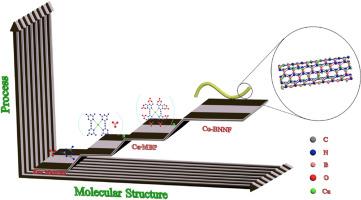
Boron nitride nanofibres (Cu@BNNF) flame retardants different copper doping was successfully synthesized by calcination. It was then applied to epoxy resin (EP), where uniform dispersion of Cu could be achieved by BN loading, and good flame retardant, mechanical and smoke toxicity inhibition properties were achieved at a low addition amount. Dense residual char was obtained from EP/0.6 Cu–BNNF (4 phr) composites, which could decrease the PHRR and PSPR by 63.45 % and 43.75 %, respectively, indicating that EP/Cu–BNNF composites have excellent fire protection properties. DSC analysis results showed that BNNF and Cu had a synergistic effect on the thermo-mechanical properties of EP composites, and the appropriate amount of Cu played a catalytic role in the cross-linking of EP. Thermogravimetric infrared (TG-FTIR) results showed that by controlling the doping amount of Cu, the generation of gas-phase hazardous products such as CO, aromatic compounds and flammable small molecule alkenes was significantly reduced, and the flame-retardant and smoke-eliminating properties of EP were improved. The analysis of the residual char after combustion shows that the incorporation of Cu–BNNF improves the densification. Based on the analysis of the gaseous and condensed phases to illustrate how BNNF and Cu play a role in burning EP nanocomposites.
通过煅烧成功合成了掺杂不同铜的氮化硼纳米纤维(Cu@BNNF)阻燃剂。将其应用于环氧树脂(EP)中,通过添加 BN 实现了铜的均匀分散,并在较低的添加量下获得了良好的阻燃、机械和烟毒抑制性能。EP/0.6 Cu-BNNF (4 phr) 复合材料得到了致密的残炭,使 PHRR 和 PSPR 分别降低了 63.45% 和 43.75%,表明 EP/Cu-BNNF 复合材料具有优异的防火性能。DSC 分析结果表明,BNNF 和 Cu 对 EP 复合材料的热机械性能有协同作用,适量的 Cu 对 EP 的交联起催化作用。热重红外(TG-FTIR)结果表明,通过控制 Cu 的掺杂量,可显著减少 CO、芳香族化合物和易燃小分子烯烃等气相有害产物的生成,提高 EP 的阻燃性和消烟性能。对燃烧后残炭的分析表明,Cu-BNNF 的加入提高了致密性。根据对气相和凝结相的分析,说明了 BNNF 和 Cu 在燃烧 EP 纳米复合材料中的作用。
期刊介绍:
Polymer is an interdisciplinary journal dedicated to publishing innovative and significant advances in Polymer Physics, Chemistry and Technology. We welcome submissions on polymer hybrids, nanocomposites, characterisation and self-assembly. Polymer also publishes work on the technological application of polymers in energy and optoelectronics.
The main scope is covered but not limited to the following core areas:
Polymer Materials
Nanocomposites and hybrid nanomaterials
Polymer blends, films, fibres, networks and porous materials
Physical Characterization
Characterisation, modelling and simulation* of molecular and materials properties in bulk, solution, and thin films
Polymer Engineering
Advanced multiscale processing methods
Polymer Synthesis, Modification and Self-assembly
Including designer polymer architectures, mechanisms and kinetics, and supramolecular polymerization
Technological Applications
Polymers for energy generation and storage
Polymer membranes for separation technology
Polymers for opto- and microelectronics.




 京公网安备 11010802042870号
京ICP备2023020795号-1
京公网安备 11010802042870号
京ICP备2023020795号-1

 分享
分享
 求助内容:
求助内容: 应助结果提醒方式:
 扫码关注我们
