Xiaotao Wang , Chuan Xu , Yonggui Liao , Ruilin Wang , Zhihao Bi , Wing-Cheung Law , Chak-Yin Tang
{"title":"Smart upconversion nanocapsules: Harnessing photodegradation and glutathione responsiveness of polymers for controlled release of Payloads","authors":"Xiaotao Wang , Chuan Xu , Yonggui Liao , Ruilin Wang , Zhihao Bi , Wing-Cheung Law , Chak-Yin Tang","doi":"10.1016/j.polymer.2025.128314","DOIUrl":null,"url":null,"abstract":"<div><div>Responsive drug transportation, release efficiency, and low toxicity of drug delivery are important factors in the controlled release area. The conventional drug release system is hard to balance all the factors in a complex environment. In this study, we present a novel approach for synthesizing rare earth upconversion nanoparticles (UCNPs) based nanocapsules with core-shell structures, capable of emitting visible light and ultraviolet (UV) light for photodegradation under irradiation with 980 nm near-infrared (NIR) light. The hydrophilicity of the UCNPs was significantly enhanced using the hydrochloric acid pickling method. We employed a sol-gel technique with tetraethoxysilane (TEOS) and bis[γ-(triethoxysilyl)propyl]-tetrasulfide (BTES) as mixed organosilicon sources to directly coat the UCNPs, forming UCNP@(s-s)mSiO2 nanocapsules. The degradation of these nanocapsules by glutathione (GSH) was systematically studied using the molybdosilicic blue method. Doxorubicin (DOX) was subsequently loaded into the nanocapsules, achieving a drug loading efficiency of 5.12 %. To prevent premature drug release, a polyethylene glycol (PEG) layer was coated onto the nanoparticle surface via modification and click chemistry, resulting in composite drug-loaded nanocapsules with dual responsiveness to light and GSH. Under neutral conditions, the nanocapsules exhibited minimal drug leakage. Upon NIR light stimulation, 1-(5-methoxy-2-nitro-4-prop-2-ynyloxy-phenyl)ethyl-N-succinimidyl carbonate (MNPSC) underwent photolysis, causing the PEG layer to detach and trigger drug release. In a simulated high concentration of intratumoral glutathione environment, the mesoporous organosilica degraded, further facilitating the drug release. The ultimate drug release rate reached an impressive 92 %. This smart dual-responsive nanocapsule system offers a promising strategy for controlled drug delivery, combining the advantages of NIR-triggered release and GSH-responsive degradation for enhanced therapeutic efficacy.</div></div>","PeriodicalId":405,"journal":{"name":"Polymer","volume":"326 ","pages":"Article 128314"},"PeriodicalIF":4.5000,"publicationDate":"2025-05-09","publicationTypes":"Journal Article","fieldsOfStudy":null,"isOpenAccess":false,"openAccessPdf":"","citationCount":"0","resultStr":null,"platform":"Semanticscholar","paperid":null,"PeriodicalName":"Polymer","FirstCategoryId":"92","ListUrlMain":"https://www.sciencedirect.com/science/article/pii/S0032386125003003","RegionNum":2,"RegionCategory":"化学","ArticlePicture":[],"TitleCN":null,"AbstractTextCN":null,"PMCID":null,"EPubDate":"2025/3/26 0:00:00","PubModel":"Epub","JCR":"Q2","JCRName":"POLYMER SCIENCE","Score":null,"Total":0}
引用次数: 0
Abstract
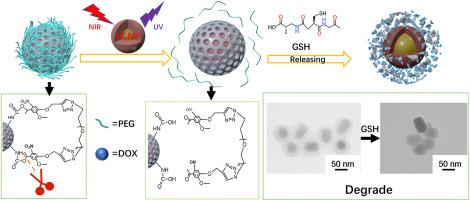
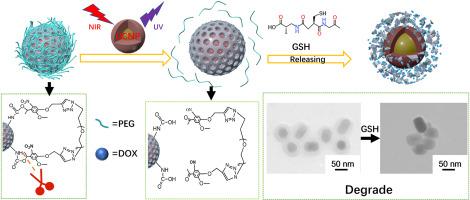
Responsive drug transportation, release efficiency, and low toxicity of drug delivery are important factors in the controlled release area. The conventional drug release system is hard to balance all the factors in a complex environment. In this study, we present a novel approach for synthesizing rare earth upconversion nanoparticles (UCNPs) based nanocapsules with core-shell structures, capable of emitting visible light and ultraviolet (UV) light for photodegradation under irradiation with 980 nm near-infrared (NIR) light. The hydrophilicity of the UCNPs was significantly enhanced using the hydrochloric acid pickling method. We employed a sol-gel technique with tetraethoxysilane (TEOS) and bis[γ-(triethoxysilyl)propyl]-tetrasulfide (BTES) as mixed organosilicon sources to directly coat the UCNPs, forming UCNP@(s-s)mSiO2 nanocapsules. The degradation of these nanocapsules by glutathione (GSH) was systematically studied using the molybdosilicic blue method. Doxorubicin (DOX) was subsequently loaded into the nanocapsules, achieving a drug loading efficiency of 5.12 %. To prevent premature drug release, a polyethylene glycol (PEG) layer was coated onto the nanoparticle surface via modification and click chemistry, resulting in composite drug-loaded nanocapsules with dual responsiveness to light and GSH. Under neutral conditions, the nanocapsules exhibited minimal drug leakage. Upon NIR light stimulation, 1-(5-methoxy-2-nitro-4-prop-2-ynyloxy-phenyl)ethyl-N-succinimidyl carbonate (MNPSC) underwent photolysis, causing the PEG layer to detach and trigger drug release. In a simulated high concentration of intratumoral glutathione environment, the mesoporous organosilica degraded, further facilitating the drug release. The ultimate drug release rate reached an impressive 92 %. This smart dual-responsive nanocapsule system offers a promising strategy for controlled drug delivery, combining the advantages of NIR-triggered release and GSH-responsive degradation for enhanced therapeutic efficacy.
期刊介绍:
Polymer is an interdisciplinary journal dedicated to publishing innovative and significant advances in Polymer Physics, Chemistry and Technology. We welcome submissions on polymer hybrids, nanocomposites, characterisation and self-assembly. Polymer also publishes work on the technological application of polymers in energy and optoelectronics.
The main scope is covered but not limited to the following core areas:
Polymer Materials
Nanocomposites and hybrid nanomaterials
Polymer blends, films, fibres, networks and porous materials
Physical Characterization
Characterisation, modelling and simulation* of molecular and materials properties in bulk, solution, and thin films
Polymer Engineering
Advanced multiscale processing methods
Polymer Synthesis, Modification and Self-assembly
Including designer polymer architectures, mechanisms and kinetics, and supramolecular polymerization
Technological Applications
Polymers for energy generation and storage
Polymer membranes for separation technology
Polymers for opto- and microelectronics.



 京公网安备 11010802042870号
京ICP备2023020795号-1
京公网安备 11010802042870号
京ICP备2023020795号-1

 分享
分享
 求助内容:
求助内容: 应助结果提醒方式:
 扫码关注我们
