{"title":"Critical Role of Carrier Cooling Mechanism in WS2/CsPbBr3 Hybrid Nanocomposites for Enhanced Photodetector Performances","authors":"Sudhanshu Kumar Nayak, Chinmay Barman, Lavadiya Sireesha, Arunkumar Sakthivel, Sree Satya Bharati Moram, Subbiah Alwarappan, Venugopal Rao Soma, Sai Santosh Kumar Raavi","doi":"10.1002/smll.202410099","DOIUrl":null,"url":null,"abstract":"<p>Heterostructures and nanocomposites comprising transition metal dichalcogenides (TMDCs) and halide perovskite nanocrystals (NCs) are prominently used in several optoelectronic devices. Hot carriers (HCs) are the charge carriers possessing higher kinetic energy than surrounded thermal distributions. Properly utilizing these HCs by slowing down their cooling mechanism reduces the energy losses in optoelectronic devices. Herein, employing the femtosecond transient absorption spectroscopy (fs-TAS) technique, the slowdown processes of HC relaxations are reported in WS<sub>2</sub>/CsPbBr<sub>3</sub> hybrid-nanocomposites due to the hot-phonon bottleneck. HCs relaxation time increases from ≈6 ps in CsPbBr<sub>3</sub> NCs to ≈10 ps in WS<sub>2</sub>/CsPbBr<sub>3</sub> nanocomposites at an excitation fluence of 17.7 µJ cm<sup>−2</sup>. The maximum HCs temperature T<sub>C</sub> increased to 1181 K in WS<sub>2</sub>/CsPbBr<sub>3</sub> nanocomposites with an observed T<sub>C</sub> of 856 K in pristine NCs. The electron transfer process from NCs to WS<sub>2</sub> nanosheets has been observed in these nanocomposites with time component <i>t</i><sub>2</sub> ≈38.0-102.4 ps in pristine NCs and 20.9–66.9 ps in nanocomposites, became faster at excitation-fluence of 17.7–99.8 µJ cm<sup>−2</sup>. Furthermore, a significant enhancement in nanocomposite-based photodetector confirmed the efficient charge transfer at the heterojunction, resulting ≈400%, ≈420%, and ≈200% increase in the photocurrent, responsivity, and detectivity, respectively, compared to the pristine devices.</p>","PeriodicalId":228,"journal":{"name":"Small","volume":"21 18","pages":""},"PeriodicalIF":12.1000,"publicationDate":"2025-03-26","publicationTypes":"Journal Article","fieldsOfStudy":null,"isOpenAccess":false,"openAccessPdf":"","citationCount":"0","resultStr":null,"platform":"Semanticscholar","paperid":null,"PeriodicalName":"Small","FirstCategoryId":"88","ListUrlMain":"https://onlinelibrary.wiley.com/doi/10.1002/smll.202410099","RegionNum":2,"RegionCategory":"材料科学","ArticlePicture":[],"TitleCN":null,"AbstractTextCN":null,"PMCID":null,"EPubDate":"","PubModel":"","JCR":"Q1","JCRName":"CHEMISTRY, MULTIDISCIPLINARY","Score":null,"Total":0}
引用次数: 0
Abstract
Heterostructures and nanocomposites comprising transition metal dichalcogenides (TMDCs) and halide perovskite nanocrystals (NCs) are prominently used in several optoelectronic devices. Hot carriers (HCs) are the charge carriers possessing higher kinetic energy than surrounded thermal distributions. Properly utilizing these HCs by slowing down their cooling mechanism reduces the energy losses in optoelectronic devices. Herein, employing the femtosecond transient absorption spectroscopy (fs-TAS) technique, the slowdown processes of HC relaxations are reported in WS2/CsPbBr3 hybrid-nanocomposites due to the hot-phonon bottleneck. HCs relaxation time increases from ≈6 ps in CsPbBr3 NCs to ≈10 ps in WS2/CsPbBr3 nanocomposites at an excitation fluence of 17.7 µJ cm−2. The maximum HCs temperature TC increased to 1181 K in WS2/CsPbBr3 nanocomposites with an observed TC of 856 K in pristine NCs. The electron transfer process from NCs to WS2 nanosheets has been observed in these nanocomposites with time component t2 ≈38.0-102.4 ps in pristine NCs and 20.9–66.9 ps in nanocomposites, became faster at excitation-fluence of 17.7–99.8 µJ cm−2. Furthermore, a significant enhancement in nanocomposite-based photodetector confirmed the efficient charge transfer at the heterojunction, resulting ≈400%, ≈420%, and ≈200% increase in the photocurrent, responsivity, and detectivity, respectively, compared to the pristine devices.
期刊介绍:
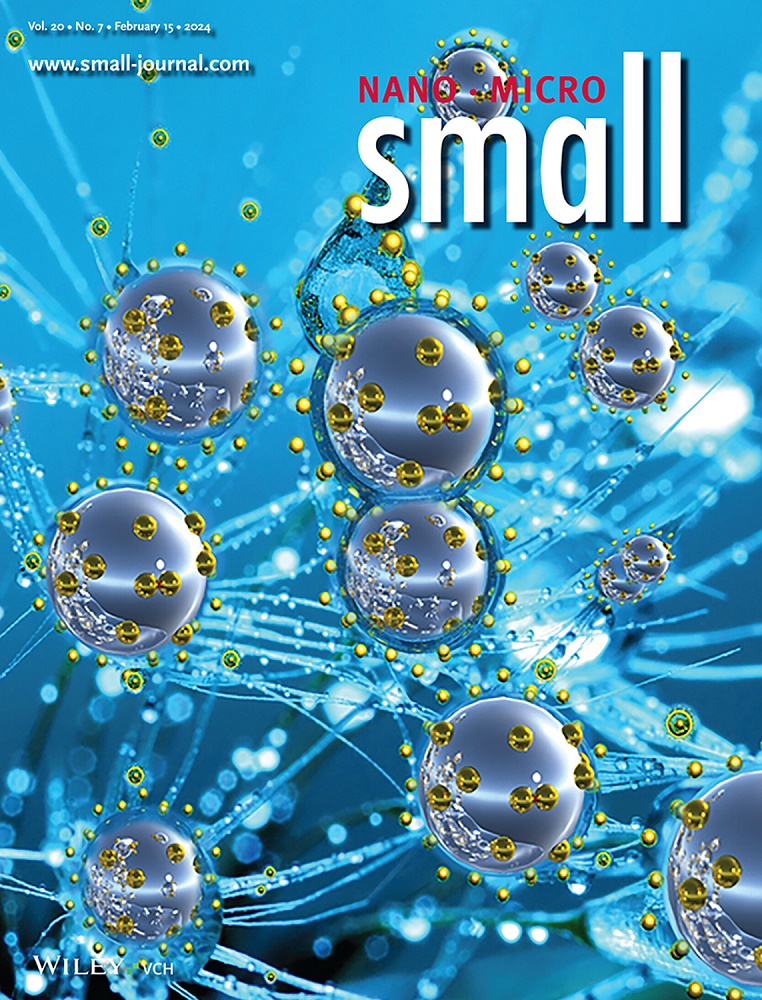
Small serves as an exceptional platform for both experimental and theoretical studies in fundamental and applied interdisciplinary research at the nano- and microscale. The journal offers a compelling mix of peer-reviewed Research Articles, Reviews, Perspectives, and Comments.
With a remarkable 2022 Journal Impact Factor of 13.3 (Journal Citation Reports from Clarivate Analytics, 2023), Small remains among the top multidisciplinary journals, covering a wide range of topics at the interface of materials science, chemistry, physics, engineering, medicine, and biology.
Small's readership includes biochemists, biologists, biomedical scientists, chemists, engineers, information technologists, materials scientists, physicists, and theoreticians alike.




 京公网安备 11010802042870号
京ICP备2023020795号-1
京公网安备 11010802042870号
京ICP备2023020795号-1

 分享
分享
 求助内容:
求助内容: 应助结果提醒方式:
 扫码关注我们
