Noninvasive Diagnosis of Early-Stage Chronic Kidney Disease and Monitoring of the Hemodialysis Process in Clinical Practice via Exhaled Breath Analysis Using an Ultrasensitive Flexible NH3 Sensor Assisted by Pattern Recognition
Xin Zhao, Xiaoyu You, Zhenzhen Wang, Yanjie Liu, Huaian Fu, Ge Li, Wenxiang Zheng, Shanshan Yu, Zhipeng Tang, Kai Zhang, Fei Song, Jie Zhao, Jinshun Wang, Yuhao Pang, Chen Yang, Qiuxia Li, Lixin Zhang, Hongbo Ma, Xiaodong Zhao, Xinxin Xiang, Yanzhang Hao, Qiang Jing, Yaning Wang, Bo Liu
{"title":"Noninvasive Diagnosis of Early-Stage Chronic Kidney Disease and Monitoring of the Hemodialysis Process in Clinical Practice via Exhaled Breath Analysis Using an Ultrasensitive Flexible NH3 Sensor Assisted by Pattern Recognition","authors":"Xin Zhao, Xiaoyu You, Zhenzhen Wang, Yanjie Liu, Huaian Fu, Ge Li, Wenxiang Zheng, Shanshan Yu, Zhipeng Tang, Kai Zhang, Fei Song, Jie Zhao, Jinshun Wang, Yuhao Pang, Chen Yang, Qiuxia Li, Lixin Zhang, Hongbo Ma, Xiaodong Zhao, Xinxin Xiang, Yanzhang Hao, Qiang Jing, Yaning Wang, Bo Liu","doi":"10.1021/acssensors.4c03583","DOIUrl":null,"url":null,"abstract":"To achieve the early diagnosis of chronic kidney disease (CKD), noninvasive hemodialysis monitoring, and accurate determination of dialysis duration and adequacy, a noninvasive, point-of-care, user-friendly device should be developed. Here, a flexible, room temperature NH<sub>3</sub> gas sensor sensitive to the key breath biomarkers of CKD─NH<sub>3</sub> and creatinine─was fabricated. The sensor had detection limits of 100 ppb for NH<sub>3</sub> and 1 ppm for creatinine. Clinically, a total of 96 exhaled breath samples, half from 39 CKD patients and the other half from 48 healthy controls were collected and analyzed. With the assistance of a pattern recognition algorithm , the early diagnosis of CKD was achieved by the sensor, with PCA being used due to sensor’s cross-sensitivity to CKD biomarkers. Diagnostic models distinguishing CKD versus non-CKD and early-stage CKD versus advanced-stage CKD were constructed using the SVM algorithm, achieving an overall accuracy of 0.93 and 0.94, with area under the curve (AUC) values of 0.97 and 0.99 for all subjects in receiver operating characteristic (ROC) analysis, respectively. The hemodialysis processes of patients were monitored in real-time, with the sensor response values exhibiting ideal exponential decay over time. The sensor response values showed a strong positive correlation with serum creatinine levels (<i>r</i> = 0.85) and a moderate positive correlation with blood urea nitrogen levels (<i>r</i> = 0.62), both of which are key clinical diagnostic indicators for CKD. These are good results, as 54% of CKD samples are from early-stage CKD patients. These results suggest that the sensor could serve as a noninvasive alternative to traditional blood tests for renal function evaluation and CKD diagnosis. Overall, this sensor demonstrates great potential in clinical practice for early diagnosis of CKD, monitoring the daily health status of CKD patients, optimizing the dialysis schedule, and monitoring the dialysis process in real-time.","PeriodicalId":24,"journal":{"name":"ACS Sensors","volume":"33 1","pages":""},"PeriodicalIF":9.1000,"publicationDate":"2025-03-25","publicationTypes":"Journal Article","fieldsOfStudy":null,"isOpenAccess":false,"openAccessPdf":"","citationCount":"0","resultStr":null,"platform":"Semanticscholar","paperid":null,"PeriodicalName":"ACS Sensors","FirstCategoryId":"92","ListUrlMain":"https://doi.org/10.1021/acssensors.4c03583","RegionNum":1,"RegionCategory":"化学","ArticlePicture":[],"TitleCN":null,"AbstractTextCN":null,"PMCID":null,"EPubDate":"","PubModel":"","JCR":"Q1","JCRName":"CHEMISTRY, ANALYTICAL","Score":null,"Total":0}
引用次数: 0
Abstract
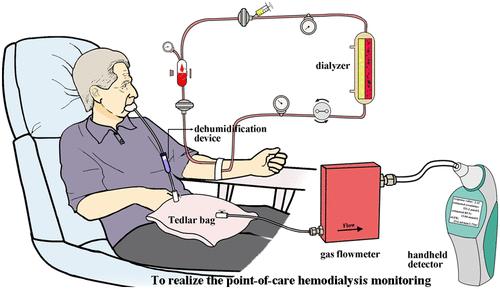
To achieve the early diagnosis of chronic kidney disease (CKD), noninvasive hemodialysis monitoring, and accurate determination of dialysis duration and adequacy, a noninvasive, point-of-care, user-friendly device should be developed. Here, a flexible, room temperature NH3 gas sensor sensitive to the key breath biomarkers of CKD─NH3 and creatinine─was fabricated. The sensor had detection limits of 100 ppb for NH3 and 1 ppm for creatinine. Clinically, a total of 96 exhaled breath samples, half from 39 CKD patients and the other half from 48 healthy controls were collected and analyzed. With the assistance of a pattern recognition algorithm , the early diagnosis of CKD was achieved by the sensor, with PCA being used due to sensor’s cross-sensitivity to CKD biomarkers. Diagnostic models distinguishing CKD versus non-CKD and early-stage CKD versus advanced-stage CKD were constructed using the SVM algorithm, achieving an overall accuracy of 0.93 and 0.94, with area under the curve (AUC) values of 0.97 and 0.99 for all subjects in receiver operating characteristic (ROC) analysis, respectively. The hemodialysis processes of patients were monitored in real-time, with the sensor response values exhibiting ideal exponential decay over time. The sensor response values showed a strong positive correlation with serum creatinine levels (r = 0.85) and a moderate positive correlation with blood urea nitrogen levels (r = 0.62), both of which are key clinical diagnostic indicators for CKD. These are good results, as 54% of CKD samples are from early-stage CKD patients. These results suggest that the sensor could serve as a noninvasive alternative to traditional blood tests for renal function evaluation and CKD diagnosis. Overall, this sensor demonstrates great potential in clinical practice for early diagnosis of CKD, monitoring the daily health status of CKD patients, optimizing the dialysis schedule, and monitoring the dialysis process in real-time.
期刊介绍:
ACS Sensors is a peer-reviewed research journal that focuses on the dissemination of new and original knowledge in the field of sensor science, particularly those that selectively sense chemical or biological species or processes. The journal covers a broad range of topics, including but not limited to biosensors, chemical sensors, gas sensors, intracellular sensors, single molecule sensors, cell chips, and microfluidic devices. It aims to publish articles that address conceptual advances in sensing technology applicable to various types of analytes or application papers that report on the use of existing sensing concepts in new ways or for new analytes.



 京公网安备 11010802042870号
京ICP备2023020795号-1
京公网安备 11010802042870号
京ICP备2023020795号-1

 分享
分享
 求助内容:
求助内容: 应助结果提醒方式:
 扫码关注我们
