{"title":"Tyrosinase-Activated MRI and PET Probes for Selective Melanoma Imaging","authors":"Zuhua Zeng, Ying Tan, Tiantian Luo, Zhengwei Li, Guihao Hu, Yao Liu, Ling He, Haiyu Wang, Lei Zhong, Haiying Wang, Tianwei Liu, Jiang Zhu","doi":"10.1021/acssensors.5c00058","DOIUrl":null,"url":null,"abstract":"Melanoma is one of the most aggressive forms of skin cancer. Accurate and early diagnosis of melanoma is crucial for improving patient outcomes. This study develops two TYR-activatable molecular probes, Mn-TyrEDTA and Al-<sup>18</sup>F-TyrEDTA, for the selective detection of melanoma <i>in vivo</i>. <i>In vitro</i> studies reveal that Mn-TyrEDTA exhibits TYR activity-dependent relaxivity enhancement, undergoing TYR-mediated oxidative polymerization, resulting in the formation of paramagnetic oligomers. UV–vis analysis supports this mechanism, showing time- and TYR concentration-dependent increases in broad band absorbance in the UV–vis region, specifically around 475 nm, due to the formation of <i>o</i>-quinone intermediates and melanin-like oligomers. HPLC analysis further confirmed the presence of polar oligomeric products in Mn-TyrEDTA solutions incubated with TYR/O<sub>2</sub>. MRI studies demonstrate Mn-TyrEDTA’s selective retention and signal enhancement in TYR-expressing melanoma tissues. Furthermore, PET imaging with Al-<sup>18</sup>F-TyrEDTA conducted using a dual-xenograft mouse model reveals significantly higher uptake and retention of Al-<sup>18</sup>F-TyrEDTA in TYR-expressing melanoma compared to TYR-negative tumors. This selective retention could be attributed to a TYR-mediated proximity labeling mechanism, where highly reactive quinones form covalent bonds with nearby tumor proteins. In summary, our findings establish Mn-TyrEDTA and Al-<sup>18</sup>F-TyrEDTA as promising TYR-activatable imaging probes, offering a novel strategy for the early diagnosis and prognosis of melanoma.","PeriodicalId":24,"journal":{"name":"ACS Sensors","volume":"9 1","pages":""},"PeriodicalIF":9.1000,"publicationDate":"2025-03-25","publicationTypes":"Journal Article","fieldsOfStudy":null,"isOpenAccess":false,"openAccessPdf":"","citationCount":"0","resultStr":null,"platform":"Semanticscholar","paperid":null,"PeriodicalName":"ACS Sensors","FirstCategoryId":"92","ListUrlMain":"https://doi.org/10.1021/acssensors.5c00058","RegionNum":1,"RegionCategory":"化学","ArticlePicture":[],"TitleCN":null,"AbstractTextCN":null,"PMCID":null,"EPubDate":"","PubModel":"","JCR":"Q1","JCRName":"CHEMISTRY, ANALYTICAL","Score":null,"Total":0}
引用次数: 0
Abstract
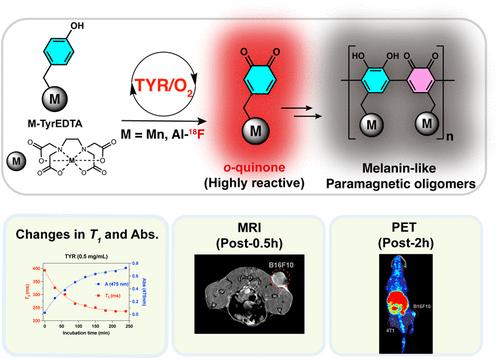
Melanoma is one of the most aggressive forms of skin cancer. Accurate and early diagnosis of melanoma is crucial for improving patient outcomes. This study develops two TYR-activatable molecular probes, Mn-TyrEDTA and Al-18F-TyrEDTA, for the selective detection of melanoma in vivo. In vitro studies reveal that Mn-TyrEDTA exhibits TYR activity-dependent relaxivity enhancement, undergoing TYR-mediated oxidative polymerization, resulting in the formation of paramagnetic oligomers. UV–vis analysis supports this mechanism, showing time- and TYR concentration-dependent increases in broad band absorbance in the UV–vis region, specifically around 475 nm, due to the formation of o-quinone intermediates and melanin-like oligomers. HPLC analysis further confirmed the presence of polar oligomeric products in Mn-TyrEDTA solutions incubated with TYR/O2. MRI studies demonstrate Mn-TyrEDTA’s selective retention and signal enhancement in TYR-expressing melanoma tissues. Furthermore, PET imaging with Al-18F-TyrEDTA conducted using a dual-xenograft mouse model reveals significantly higher uptake and retention of Al-18F-TyrEDTA in TYR-expressing melanoma compared to TYR-negative tumors. This selective retention could be attributed to a TYR-mediated proximity labeling mechanism, where highly reactive quinones form covalent bonds with nearby tumor proteins. In summary, our findings establish Mn-TyrEDTA and Al-18F-TyrEDTA as promising TYR-activatable imaging probes, offering a novel strategy for the early diagnosis and prognosis of melanoma.
期刊介绍:
ACS Sensors is a peer-reviewed research journal that focuses on the dissemination of new and original knowledge in the field of sensor science, particularly those that selectively sense chemical or biological species or processes. The journal covers a broad range of topics, including but not limited to biosensors, chemical sensors, gas sensors, intracellular sensors, single molecule sensors, cell chips, and microfluidic devices. It aims to publish articles that address conceptual advances in sensing technology applicable to various types of analytes or application papers that report on the use of existing sensing concepts in new ways or for new analytes.



 京公网安备 11010802042870号
京ICP备2023020795号-1
京公网安备 11010802042870号
京ICP备2023020795号-1

 分享
分享
 求助内容:
求助内容: 应助结果提醒方式:
 扫码关注我们
