{"title":"Straw Returning Amount and Duration Influence Paddy Soil Organic Carbon Sequestration by Regulating Plant- and Microbe-Derived Carbon Accumulation","authors":"Xiaowei Chen, Gongwen Luo, Ruibin Zhu, Yuping Zhang, Yangji Huang, Chaolin Liao","doi":"10.1002/ldr.5595","DOIUrl":null,"url":null,"abstract":"<div>\n \n <p>Straw-returning-driven sequestration of soil organic carbon (SOC) is critical for cropland carbon (C) storage and stability. However, the effects of plant- and microbe-derived C accumulation in SOC sequestration remain unclear in rice systems. Herein, this study synthetically explored the response of soil microbial necromass and lignin phenols to straw return and assessed their contributions to SOC under two application amounts and durations. The field-based experiment was established in 1982. The results indicated that returning straw to paddy fields significantly increased SOC content by 7%–46%, with a higher return rate and longer duration yielding greater increases. Fungal necromass C (FNC) in paddy soil showed a higher content (3.8–5.9 g kg<sup>−1</sup>) and a higher proportion to SOC (20%–25%) than bacterial necromass C (BNC; 1.6–2.5 g kg<sup>−1</sup> and 9%–11%). However, the amount and duration of straw returns had a small influence on the proportions of the FNC and BNC to SOC. Accumulation of lignin phenols (0.2–0.8 g kg<sup>−1</sup>) in paddy soils and their proportions to SOC (1%–3%) were lower than those of amino sugars (0.7–1.1 g kg<sup>−1</sup> and 3.8%–4.5%) and were not significantly affected by the straw return amount or duration. Soil FNC content was closely associated with soil available nitrogen (AN), microbial biomass C (MBC), and microbial biomass nitrogen (MBN) contents, whereas soil BNC content showed a strong link with AN and MBC contents. Soil lignin phenol content was significantly related to soil AN, available potassium, and MBC contents. Soil FNC and BNC accumulations positively contributed to SOC, whereas soil AN, MBC, and MBN contents indirectly affected SOC by regulating microbial necromass C. These results highlight the benefits of straw return on paddy SOC sequestration, linked to the positive response of plant- and microbe-derived C accumulation.</p>\n </div>","PeriodicalId":203,"journal":{"name":"Land Degradation & Development","volume":"36 11","pages":"3729-3741"},"PeriodicalIF":3.7000,"publicationDate":"2025-03-25","publicationTypes":"Journal Article","fieldsOfStudy":null,"isOpenAccess":false,"openAccessPdf":"","citationCount":"0","resultStr":null,"platform":"Semanticscholar","paperid":null,"PeriodicalName":"Land Degradation & Development","FirstCategoryId":"97","ListUrlMain":"https://onlinelibrary.wiley.com/doi/10.1002/ldr.5595","RegionNum":2,"RegionCategory":"农林科学","ArticlePicture":[],"TitleCN":null,"AbstractTextCN":null,"PMCID":null,"EPubDate":"","PubModel":"","JCR":"Q2","JCRName":"ENVIRONMENTAL SCIENCES","Score":null,"Total":0}
引用次数: 0
Abstract
Straw-returning-driven sequestration of soil organic carbon (SOC) is critical for cropland carbon (C) storage and stability. However, the effects of plant- and microbe-derived C accumulation in SOC sequestration remain unclear in rice systems. Herein, this study synthetically explored the response of soil microbial necromass and lignin phenols to straw return and assessed their contributions to SOC under two application amounts and durations. The field-based experiment was established in 1982. The results indicated that returning straw to paddy fields significantly increased SOC content by 7%–46%, with a higher return rate and longer duration yielding greater increases. Fungal necromass C (FNC) in paddy soil showed a higher content (3.8–5.9 g kg−1) and a higher proportion to SOC (20%–25%) than bacterial necromass C (BNC; 1.6–2.5 g kg−1 and 9%–11%). However, the amount and duration of straw returns had a small influence on the proportions of the FNC and BNC to SOC. Accumulation of lignin phenols (0.2–0.8 g kg−1) in paddy soils and their proportions to SOC (1%–3%) were lower than those of amino sugars (0.7–1.1 g kg−1 and 3.8%–4.5%) and were not significantly affected by the straw return amount or duration. Soil FNC content was closely associated with soil available nitrogen (AN), microbial biomass C (MBC), and microbial biomass nitrogen (MBN) contents, whereas soil BNC content showed a strong link with AN and MBC contents. Soil lignin phenol content was significantly related to soil AN, available potassium, and MBC contents. Soil FNC and BNC accumulations positively contributed to SOC, whereas soil AN, MBC, and MBN contents indirectly affected SOC by regulating microbial necromass C. These results highlight the benefits of straw return on paddy SOC sequestration, linked to the positive response of plant- and microbe-derived C accumulation.
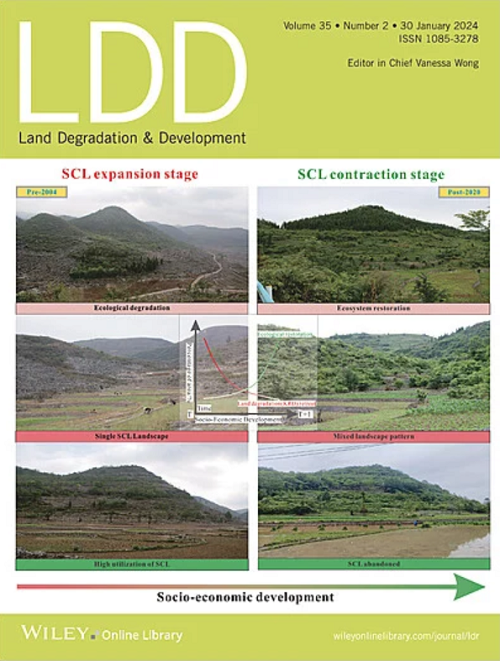
期刊介绍:
Land Degradation & Development is an international journal which seeks to promote rational study of the recognition, monitoring, control and rehabilitation of degradation in terrestrial environments. The journal focuses on:
- what land degradation is;
- what causes land degradation;
- the impacts of land degradation
- the scale of land degradation;
- the history, current status or future trends of land degradation;
- avoidance, mitigation and control of land degradation;
- remedial actions to rehabilitate or restore degraded land;
- sustainable land management.



 京公网安备 11010802042870号
京ICP备2023020795号-1
京公网安备 11010802042870号
京ICP备2023020795号-1

 分享
分享
 求助内容:
求助内容: 应助结果提醒方式:
 扫码关注我们
