Novel Primer Design for Significantly Reducing Fluorescent Interferences in the Synthesis of DNA-Templated Copper Nanoclusters for the Detection of the HLA-B*5801 Gene
Ke-Peng Lai, Bo-Yu Liu, Wei-Lung Tseng, Hwang-Shang Kou, Chun-Chi Wang
{"title":"Novel Primer Design for Significantly Reducing Fluorescent Interferences in the Synthesis of DNA-Templated Copper Nanoclusters for the Detection of the HLA-B*5801 Gene","authors":"Ke-Peng Lai, Bo-Yu Liu, Wei-Lung Tseng, Hwang-Shang Kou, Chun-Chi Wang","doi":"10.1021/acssensors.4c03116","DOIUrl":null,"url":null,"abstract":"The optimal sequence for synthesizing copper nanoclusters is a promising research area. Initially, random dsDNA sequences yielded low fluorescence intensity, which constrained visual detection under UV light. Poly-AT dsDNA sequences later produced visible fluorescence, but it caused significant interference in negative samples when combined with gene amplification techniques. This interference occurs because the single-stranded poly-AT primer can self-anneal into a double-stranded AT sequence, efficiently synthesizing copper nanoclusters. To mitigate this, we designed a poly-AAT sequence at the primer’s 5′ end, creating a single base pair mismatch every three nucleotides during self-annealing. This adjustment reduced synthesis efficiency of copper nanoclusters in negative samples, improving the visual distinction between negative and positive results. We applied this method to identify the <i>HLA-B*</i>5801 gene, thereby demonstrating its efficacy even within a GC-rich region of human genomic DNA. Our method showed 100% agreement with a commercial qPCR kit, with results distinguishable under UV light. We conclude that the poly-AAT sequence is more suitable for integrating copper nanoclusters synthesis with nucleic acid amplification detection techniques, with potential applications in microelectronics, biosensing, and catalysis.","PeriodicalId":24,"journal":{"name":"ACS Sensors","volume":"61 1","pages":""},"PeriodicalIF":9.1000,"publicationDate":"2025-03-25","publicationTypes":"Journal Article","fieldsOfStudy":null,"isOpenAccess":false,"openAccessPdf":"","citationCount":"0","resultStr":null,"platform":"Semanticscholar","paperid":null,"PeriodicalName":"ACS Sensors","FirstCategoryId":"92","ListUrlMain":"https://doi.org/10.1021/acssensors.4c03116","RegionNum":1,"RegionCategory":"化学","ArticlePicture":[],"TitleCN":null,"AbstractTextCN":null,"PMCID":null,"EPubDate":"","PubModel":"","JCR":"Q1","JCRName":"CHEMISTRY, ANALYTICAL","Score":null,"Total":0}
引用次数: 0
Abstract
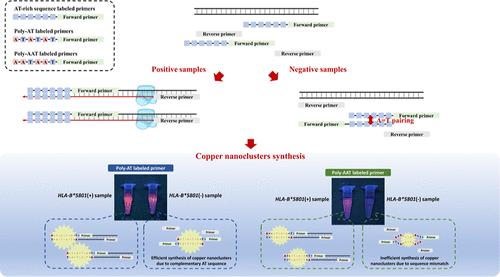
The optimal sequence for synthesizing copper nanoclusters is a promising research area. Initially, random dsDNA sequences yielded low fluorescence intensity, which constrained visual detection under UV light. Poly-AT dsDNA sequences later produced visible fluorescence, but it caused significant interference in negative samples when combined with gene amplification techniques. This interference occurs because the single-stranded poly-AT primer can self-anneal into a double-stranded AT sequence, efficiently synthesizing copper nanoclusters. To mitigate this, we designed a poly-AAT sequence at the primer’s 5′ end, creating a single base pair mismatch every three nucleotides during self-annealing. This adjustment reduced synthesis efficiency of copper nanoclusters in negative samples, improving the visual distinction between negative and positive results. We applied this method to identify the HLA-B*5801 gene, thereby demonstrating its efficacy even within a GC-rich region of human genomic DNA. Our method showed 100% agreement with a commercial qPCR kit, with results distinguishable under UV light. We conclude that the poly-AAT sequence is more suitable for integrating copper nanoclusters synthesis with nucleic acid amplification detection techniques, with potential applications in microelectronics, biosensing, and catalysis.
期刊介绍:
ACS Sensors is a peer-reviewed research journal that focuses on the dissemination of new and original knowledge in the field of sensor science, particularly those that selectively sense chemical or biological species or processes. The journal covers a broad range of topics, including but not limited to biosensors, chemical sensors, gas sensors, intracellular sensors, single molecule sensors, cell chips, and microfluidic devices. It aims to publish articles that address conceptual advances in sensing technology applicable to various types of analytes or application papers that report on the use of existing sensing concepts in new ways or for new analytes.




 京公网安备 11010802042870号
京ICP备2023020795号-1
京公网安备 11010802042870号
京ICP备2023020795号-1

 分享
分享
 求助内容:
求助内容: 应助结果提醒方式:
 扫码关注我们
