Wei Sun, Xudong Zheng, Biao Ji, Zihuai Xu, Sifan Bao, Zhouzhou Yang, Jinfeng Mei, Jian Rong, Zhongyu Li
{"title":"Nitrogen Self-Doping Hierarchical Pore Biochar for Enhanced CO2 Capture: Modulation of Pore Structure and Surface Properties","authors":"Wei Sun, Xudong Zheng, Biao Ji, Zihuai Xu, Sifan Bao, Zhouzhou Yang, Jinfeng Mei, Jian Rong, Zhongyu Li","doi":"10.1021/acs.langmuir.5c00227","DOIUrl":null,"url":null,"abstract":"Negative emission technology aims to remove greenhouse gases such as CO<sub>2</sub> from the atmosphere, which is an important way to achieve efficient carbon reduction. The use of biochar materials as adsorbents can significantly reduce the cost while effectively capturing CO<sub>2</sub>. In this work, carp fish scales were used as biomass raw materials, a small amount of KOH was used as an activator to provide ionic active sites, and the activation ion K<sup>+</sup> was uniformly introduced into the material through a premixed hydrothermal reaction, followed by a single-step carbonization and activation process at a moderate temperature, along with an acid wash, to produce a N self-doping, layered-structured biochar with high porosity and uniform pore channels. A series of hierarchical biochars with dissimilar physicochemical properties were prepared by varying the carbonization temperature. Among them, the sample prepared at 700 °C (AF-700) has an ultrahigh specific surface area of 1371 m<sup>2</sup> g<sup>–1</sup>, a pore volume of 0.85 cm<sup>3</sup> g<sup>–1</sup>, and showed the highest adsorption performance of 3.34 mmol g<sup>–1</sup> (0 °C, 1 bar). We also fitted the adsorption curves of the biochar using the Langmuir–Freundlich isotherm model and calculated the adsorption selectivity of the material for CO<sub>2</sub> (N<sub>2</sub> and Ar) with ideal adsorption solution theory. The results indicate that N self-doped hierarchical structure biochar exhibits high CO<sub>2</sub> adsorption efficiency and is composited in an economical and simple way, thus holding great potential for the large-scale production of efficient CO<sub>2</sub> adsorbents.","PeriodicalId":50,"journal":{"name":"Langmuir","volume":"25 1","pages":""},"PeriodicalIF":3.9000,"publicationDate":"2025-03-26","publicationTypes":"Journal Article","fieldsOfStudy":null,"isOpenAccess":false,"openAccessPdf":"","citationCount":"0","resultStr":null,"platform":"Semanticscholar","paperid":null,"PeriodicalName":"Langmuir","FirstCategoryId":"92","ListUrlMain":"https://doi.org/10.1021/acs.langmuir.5c00227","RegionNum":2,"RegionCategory":"化学","ArticlePicture":[],"TitleCN":null,"AbstractTextCN":null,"PMCID":null,"EPubDate":"","PubModel":"","JCR":"Q2","JCRName":"CHEMISTRY, MULTIDISCIPLINARY","Score":null,"Total":0}
引用次数: 0
Abstract
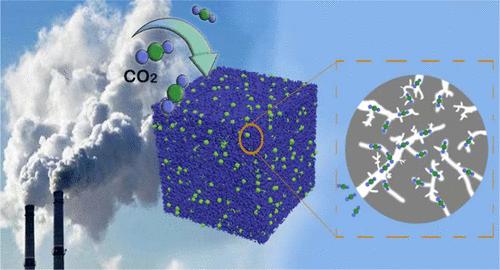
Negative emission technology aims to remove greenhouse gases such as CO2 from the atmosphere, which is an important way to achieve efficient carbon reduction. The use of biochar materials as adsorbents can significantly reduce the cost while effectively capturing CO2. In this work, carp fish scales were used as biomass raw materials, a small amount of KOH was used as an activator to provide ionic active sites, and the activation ion K+ was uniformly introduced into the material through a premixed hydrothermal reaction, followed by a single-step carbonization and activation process at a moderate temperature, along with an acid wash, to produce a N self-doping, layered-structured biochar with high porosity and uniform pore channels. A series of hierarchical biochars with dissimilar physicochemical properties were prepared by varying the carbonization temperature. Among them, the sample prepared at 700 °C (AF-700) has an ultrahigh specific surface area of 1371 m2 g–1, a pore volume of 0.85 cm3 g–1, and showed the highest adsorption performance of 3.34 mmol g–1 (0 °C, 1 bar). We also fitted the adsorption curves of the biochar using the Langmuir–Freundlich isotherm model and calculated the adsorption selectivity of the material for CO2 (N2 and Ar) with ideal adsorption solution theory. The results indicate that N self-doped hierarchical structure biochar exhibits high CO2 adsorption efficiency and is composited in an economical and simple way, thus holding great potential for the large-scale production of efficient CO2 adsorbents.
期刊介绍:
Langmuir is an interdisciplinary journal publishing articles in the following subject categories:
Colloids: surfactants and self-assembly, dispersions, emulsions, foams
Interfaces: adsorption, reactions, films, forces
Biological Interfaces: biocolloids, biomolecular and biomimetic materials
Materials: nano- and mesostructured materials, polymers, gels, liquid crystals
Electrochemistry: interfacial charge transfer, charge transport, electrocatalysis, electrokinetic phenomena, bioelectrochemistry
Devices and Applications: sensors, fluidics, patterning, catalysis, photonic crystals
However, when high-impact, original work is submitted that does not fit within the above categories, decisions to accept or decline such papers will be based on one criteria: What Would Irving Do?
Langmuir ranks #2 in citations out of 136 journals in the category of Physical Chemistry with 113,157 total citations. The journal received an Impact Factor of 4.384*.
This journal is also indexed in the categories of Materials Science (ranked #1) and Multidisciplinary Chemistry (ranked #5).




 京公网安备 11010802042870号
京ICP备2023020795号-1
京公网安备 11010802042870号
京ICP备2023020795号-1

 分享
分享
 求助内容:
求助内容: 应助结果提醒方式:
 扫码关注我们
