Natasha Kovacevic , Amir Meghdadi , Chris Berka , Ziad S. Saad , Hartmuth C. Kolb , Peter de Boer , Maura Furey , Silke Miller
{"title":"Differences in resting state and task-based EEG measures between patients with major depressive disorder and healthy controls","authors":"Natasha Kovacevic , Amir Meghdadi , Chris Berka , Ziad S. Saad , Hartmuth C. Kolb , Peter de Boer , Maura Furey , Silke Miller","doi":"10.1016/j.clinph.2025.03.022","DOIUrl":null,"url":null,"abstract":"<div><h3>Objective</h3><div>Assessing depression in psychiatry relies on subjective measures that may not adequately reflect the disorder’s biology. Electroencephalography offers an objective and scalable approach for gathering data with potential for characterizing major depressive disorder. We explore the potential of a combination of EEG-based neurocognitive measures for the characterization of depression.</div></div><div><h3>Methods</h3><div>Resting state measures and electrophysiological responses during emotional faces recognition and a three-choice vigilance task, were examined in a sample of depressed patients and healthy controls.</div></div><div><h3>Results</h3><div>The findings revealed differences in resting state spectral power measures in the theta, alpha, and beta ranges. Relative alpha power in eyes open condition was decreased in patients and the degree of reduction was correlated with the severity of both anxiety and depressive symptoms. The N170 face component of the evoked responses to emotional faces captured depression-related emotional bias towards sad faces. The three-choice vigilance task demonstrated depression-related attentional behavioral deficits, and an increase in P200 amplitude which was also associated with greater depression severity.</div></div><div><h3>Conclusions</h3><div>The three paradigms revealed distinct and complementary EEG signatures of depression.</div></div><div><h3>Significance</h3><div>Our findings suggest the benefits of utilizing objective measures for enhancing our understanding and treatment of the disorder.</div></div>","PeriodicalId":10671,"journal":{"name":"Clinical Neurophysiology","volume":"173 ","pages":"Pages 190-198"},"PeriodicalIF":3.6000,"publicationDate":"2025-05-01","publicationTypes":"Journal Article","fieldsOfStudy":null,"isOpenAccess":false,"openAccessPdf":"","citationCount":"0","resultStr":null,"platform":"Semanticscholar","paperid":null,"PeriodicalName":"Clinical Neurophysiology","FirstCategoryId":"3","ListUrlMain":"https://www.sciencedirect.com/science/article/pii/S1388245725004389","RegionNum":3,"RegionCategory":"医学","ArticlePicture":[],"TitleCN":null,"AbstractTextCN":null,"PMCID":null,"EPubDate":"2025/3/24 0:00:00","PubModel":"Epub","JCR":"Q1","JCRName":"CLINICAL NEUROLOGY","Score":null,"Total":0}
引用次数: 0
Abstract
Objective
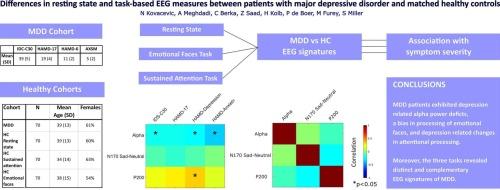
Assessing depression in psychiatry relies on subjective measures that may not adequately reflect the disorder’s biology. Electroencephalography offers an objective and scalable approach for gathering data with potential for characterizing major depressive disorder. We explore the potential of a combination of EEG-based neurocognitive measures for the characterization of depression.
Methods
Resting state measures and electrophysiological responses during emotional faces recognition and a three-choice vigilance task, were examined in a sample of depressed patients and healthy controls.
Results
The findings revealed differences in resting state spectral power measures in the theta, alpha, and beta ranges. Relative alpha power in eyes open condition was decreased in patients and the degree of reduction was correlated with the severity of both anxiety and depressive symptoms. The N170 face component of the evoked responses to emotional faces captured depression-related emotional bias towards sad faces. The three-choice vigilance task demonstrated depression-related attentional behavioral deficits, and an increase in P200 amplitude which was also associated with greater depression severity.
Conclusions
The three paradigms revealed distinct and complementary EEG signatures of depression.
Significance
Our findings suggest the benefits of utilizing objective measures for enhancing our understanding and treatment of the disorder.
期刊介绍:
As of January 1999, The journal Electroencephalography and Clinical Neurophysiology, and its two sections Electromyography and Motor Control and Evoked Potentials have amalgamated to become this journal - Clinical Neurophysiology.
Clinical Neurophysiology is the official journal of the International Federation of Clinical Neurophysiology, the Brazilian Society of Clinical Neurophysiology, the Czech Society of Clinical Neurophysiology, the Italian Clinical Neurophysiology Society and the International Society of Intraoperative Neurophysiology.The journal is dedicated to fostering research and disseminating information on all aspects of both normal and abnormal functioning of the nervous system. The key aim of the publication is to disseminate scholarly reports on the pathophysiology underlying diseases of the central and peripheral nervous system of human patients. Clinical trials that use neurophysiological measures to document change are encouraged, as are manuscripts reporting data on integrated neuroimaging of central nervous function including, but not limited to, functional MRI, MEG, EEG, PET and other neuroimaging modalities.




 京公网安备 11010802042870号
京ICP备2023020795号-1
京公网安备 11010802042870号
京ICP备2023020795号-1

 分享
分享
 求助内容:
求助内容: 应助结果提醒方式:
 扫码关注我们
