Development of a highly selective and sensitive colorimetric detection of manganese(II) ion in environmental water using 3-(4-hydroxy-3-methoxyphenyl)-2,3-dihydropyrazolo [3, 4-b] indole-1(4H)-carbothioamide modified gold nanoparticles: A CIE L*a*b*/Yxy colour space study
{"title":"Development of a highly selective and sensitive colorimetric detection of manganese(II) ion in environmental water using 3-(4-hydroxy-3-methoxyphenyl)-2,3-dihydropyrazolo [3, 4-b] indole-1(4H)-carbothioamide modified gold nanoparticles: A CIE L*a*b*/Yxy colour space study","authors":"Sindisiwe Fortunate Shange , Penuel Nkanyezi Kubheka , Talent Raymond Makhanya , Phumlani Selby Mdluli , Nirmala Deenadayalu","doi":"10.1016/j.molliq.2025.127447","DOIUrl":null,"url":null,"abstract":"<div><div>This study proposes a sensitive, selective and efficient novel colorimetric probe for the detection of manganese ion (Mn(II)) using 3-(4-hydroxy-3-methoxyphenyl)-2,3-dihydropyrazolo [3, 4-b] indole-1(4H)-carbothioamide (TRPIDA_V) modified gold nanoparticles (TRPIDA_V-AuNPs). TRPIDA_V-AuNPs aggregated upon introduction of 2 mg/L of Mn(II), which led to a change in colour of the dispersed TRPIDA_V-AuNPs suspensions from red to blue and a decrease of the surface plasmon absorption intensity at 520 nm resulting in the formation of a second peak at 655 nm. The colorimetric probe showed high selectivity to Mn(II) and was not selective to other investigated anion and cations as there was no aggregation induced upon addition of 2 mg/L of other anions and cations. Furthermore, the colour change from wine red to blue was only observed in the introduction of 2 mg/L Mn(II) resulting in a second absorption peak at 655 nm. Additionally, the colorimetric probe yielded a detection limit of 0.00233 mg/L with a linear range of 0.5–10 mg/L, showing excellent sensitivity towards Mn(II). The obtained XYZ values displayed similar trends as the RGB values where a rapid decrease in the X values was observed from 1 to 2 mg/L, the Y values increased from 0 to 1 mg/L and decreased significantly at 2 mg/L followed by an increase from 3 to 10 mg/L and the Z values increased rapidly from 0 to 4 mg/L then a decrease at 5 mg/L was observed followed by a rapid increase from 6 to 10 mg/L. It was observed that the colour difference values increased with increasing Mn(II) standard concentration. Hue decreased as the Mn(II) concentration increased and the chroma decrease significantly from 1 to 2 mg/L indicating the TRPIDA_V-AuNPs in the presence of Mn(II) standards solutions changed from vivid to dull as the Mn(II) increases. The obtained results proved the developed colorimetric probe to be highly robust and efficient for the detection of Mn(II) in water samples.</div></div>","PeriodicalId":371,"journal":{"name":"Journal of Molecular Liquids","volume":"427 ","pages":"Article 127447"},"PeriodicalIF":5.2000,"publicationDate":"2025-06-01","publicationTypes":"Journal Article","fieldsOfStudy":null,"isOpenAccess":false,"openAccessPdf":"","citationCount":"0","resultStr":null,"platform":"Semanticscholar","paperid":null,"PeriodicalName":"Journal of Molecular Liquids","FirstCategoryId":"92","ListUrlMain":"https://www.sciencedirect.com/science/article/pii/S0167732225006142","RegionNum":2,"RegionCategory":"化学","ArticlePicture":[],"TitleCN":null,"AbstractTextCN":null,"PMCID":null,"EPubDate":"2025/3/23 0:00:00","PubModel":"Epub","JCR":"Q2","JCRName":"CHEMISTRY, PHYSICAL","Score":null,"Total":0}
引用次数: 0
Abstract
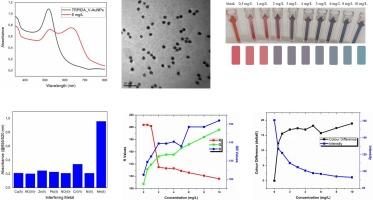
This study proposes a sensitive, selective and efficient novel colorimetric probe for the detection of manganese ion (Mn(II)) using 3-(4-hydroxy-3-methoxyphenyl)-2,3-dihydropyrazolo [3, 4-b] indole-1(4H)-carbothioamide (TRPIDA_V) modified gold nanoparticles (TRPIDA_V-AuNPs). TRPIDA_V-AuNPs aggregated upon introduction of 2 mg/L of Mn(II), which led to a change in colour of the dispersed TRPIDA_V-AuNPs suspensions from red to blue and a decrease of the surface plasmon absorption intensity at 520 nm resulting in the formation of a second peak at 655 nm. The colorimetric probe showed high selectivity to Mn(II) and was not selective to other investigated anion and cations as there was no aggregation induced upon addition of 2 mg/L of other anions and cations. Furthermore, the colour change from wine red to blue was only observed in the introduction of 2 mg/L Mn(II) resulting in a second absorption peak at 655 nm. Additionally, the colorimetric probe yielded a detection limit of 0.00233 mg/L with a linear range of 0.5–10 mg/L, showing excellent sensitivity towards Mn(II). The obtained XYZ values displayed similar trends as the RGB values where a rapid decrease in the X values was observed from 1 to 2 mg/L, the Y values increased from 0 to 1 mg/L and decreased significantly at 2 mg/L followed by an increase from 3 to 10 mg/L and the Z values increased rapidly from 0 to 4 mg/L then a decrease at 5 mg/L was observed followed by a rapid increase from 6 to 10 mg/L. It was observed that the colour difference values increased with increasing Mn(II) standard concentration. Hue decreased as the Mn(II) concentration increased and the chroma decrease significantly from 1 to 2 mg/L indicating the TRPIDA_V-AuNPs in the presence of Mn(II) standards solutions changed from vivid to dull as the Mn(II) increases. The obtained results proved the developed colorimetric probe to be highly robust and efficient for the detection of Mn(II) in water samples.
期刊介绍:
The journal includes papers in the following areas:
– Simple organic liquids and mixtures
– Ionic liquids
– Surfactant solutions (including micelles and vesicles) and liquid interfaces
– Colloidal solutions and nanoparticles
– Thermotropic and lyotropic liquid crystals
– Ferrofluids
– Water, aqueous solutions and other hydrogen-bonded liquids
– Lubricants, polymer solutions and melts
– Molten metals and salts
– Phase transitions and critical phenomena in liquids and confined fluids
– Self assembly in complex liquids.– Biomolecules in solution
The emphasis is on the molecular (or microscopic) understanding of particular liquids or liquid systems, especially concerning structure, dynamics and intermolecular forces. The experimental techniques used may include:
– Conventional spectroscopy (mid-IR and far-IR, Raman, NMR, etc.)
– Non-linear optics and time resolved spectroscopy (psec, fsec, asec, ISRS, etc.)
– Light scattering (Rayleigh, Brillouin, PCS, etc.)
– Dielectric relaxation
– X-ray and neutron scattering and diffraction.
Experimental studies, computer simulations (MD or MC) and analytical theory will be considered for publication; papers just reporting experimental results that do not contribute to the understanding of the fundamentals of molecular and ionic liquids will not be accepted. Only papers of a non-routine nature and advancing the field will be considered for publication.



 京公网安备 11010802042870号
京ICP备2023020795号-1
京公网安备 11010802042870号
京ICP备2023020795号-1

 分享
分享
 求助内容:
求助内容: 应助结果提醒方式:
 扫码关注我们
