Saima Jan , Ajit Sharma , Amar Srivastava , Van-Duong Dao , Rashmi Sanghi
{"title":"Enhanced photocatalytic ciprofloxacin degradation in industrial aquatic waste using CdS/Cs3Bi2Br9 nanocomposite synthesized by microwave energy","authors":"Saima Jan , Ajit Sharma , Amar Srivastava , Van-Duong Dao , Rashmi Sanghi","doi":"10.1016/j.molliq.2025.127450","DOIUrl":null,"url":null,"abstract":"<div><div>For degradation of ciprofloxacin the as-prepared material was synthesized by microwave process. This study shows how to synthesize a hybrid heterojunction between Cs<sub>3</sub>Bi<sub>2</sub>Br<sub>9</sub> and CdS at various ratios. SEM-EDX pictures were used to assess morphological investigations and the composition of the dopants, demonstrating the existence of CdS in Cs<sub>3</sub>Bi<sub>2</sub>Br<sub>9</sub> nanostructured hybrid. Powder XRD was used to confirm the crystalline structures of CdS, Cs<sub>3</sub>Bi<sub>2</sub>Br<sub>9</sub> and CdS/Cs<sub>3</sub>Bi<sub>2</sub>Br<sub>9</sub> nanocomposites with crystalline size of 16.8 nm, 11.7 nm and 7.02 nm respectively. The bandgap energies for CdS, Cs<sub>3</sub>Bi<sub>2</sub>Br<sub>9</sub> and CdS/Cs<sub>3</sub>Bi<sub>2</sub>Br<sub>9</sub> is 3.4 eV, 3.5 eV and 3 eV respectively. The as-prepared material CdS, Cs<sub>3</sub>Bi<sub>2</sub>Br<sub>9</sub> and CdS/Cs<sub>3</sub>Bi<sub>2</sub>Br<sub>9</sub> photocatalysts were used to study the degradation of ciprofloxacin (CIP) at the irradiation time, ideal pH, H<sub>2</sub>O<sub>2</sub> conc. catalytic dosage and effect of temperature. Unexpectedly, at an ideal pH of 8, CdS, Cs<sub>3</sub>Bi<sub>2</sub>Br<sub>9</sub> and 5 %CdS/Cs<sub>3</sub>Bi<sub>2</sub>Br<sub>9</sub> demonstrated maximum degradation efficiency of 80 %, 65.5 % and 98.4 % respectively as compared to Solgel method based CdS which is 60 %, with a catalytic dosage of 10 mg and an irradiation period of three hours.</div></div>","PeriodicalId":371,"journal":{"name":"Journal of Molecular Liquids","volume":"427 ","pages":"Article 127450"},"PeriodicalIF":5.2000,"publicationDate":"2025-03-23","publicationTypes":"Journal Article","fieldsOfStudy":null,"isOpenAccess":false,"openAccessPdf":"","citationCount":"0","resultStr":null,"platform":"Semanticscholar","paperid":null,"PeriodicalName":"Journal of Molecular Liquids","FirstCategoryId":"92","ListUrlMain":"https://www.sciencedirect.com/science/article/pii/S0167732225006178","RegionNum":2,"RegionCategory":"化学","ArticlePicture":[],"TitleCN":null,"AbstractTextCN":null,"PMCID":null,"EPubDate":"","PubModel":"","JCR":"Q2","JCRName":"CHEMISTRY, PHYSICAL","Score":null,"Total":0}
引用次数: 0
Abstract
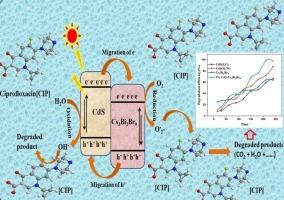
For degradation of ciprofloxacin the as-prepared material was synthesized by microwave process. This study shows how to synthesize a hybrid heterojunction between Cs3Bi2Br9 and CdS at various ratios. SEM-EDX pictures were used to assess morphological investigations and the composition of the dopants, demonstrating the existence of CdS in Cs3Bi2Br9 nanostructured hybrid. Powder XRD was used to confirm the crystalline structures of CdS, Cs3Bi2Br9 and CdS/Cs3Bi2Br9 nanocomposites with crystalline size of 16.8 nm, 11.7 nm and 7.02 nm respectively. The bandgap energies for CdS, Cs3Bi2Br9 and CdS/Cs3Bi2Br9 is 3.4 eV, 3.5 eV and 3 eV respectively. The as-prepared material CdS, Cs3Bi2Br9 and CdS/Cs3Bi2Br9 photocatalysts were used to study the degradation of ciprofloxacin (CIP) at the irradiation time, ideal pH, H2O2 conc. catalytic dosage and effect of temperature. Unexpectedly, at an ideal pH of 8, CdS, Cs3Bi2Br9 and 5 %CdS/Cs3Bi2Br9 demonstrated maximum degradation efficiency of 80 %, 65.5 % and 98.4 % respectively as compared to Solgel method based CdS which is 60 %, with a catalytic dosage of 10 mg and an irradiation period of three hours.
期刊介绍:
The journal includes papers in the following areas:
– Simple organic liquids and mixtures
– Ionic liquids
– Surfactant solutions (including micelles and vesicles) and liquid interfaces
– Colloidal solutions and nanoparticles
– Thermotropic and lyotropic liquid crystals
– Ferrofluids
– Water, aqueous solutions and other hydrogen-bonded liquids
– Lubricants, polymer solutions and melts
– Molten metals and salts
– Phase transitions and critical phenomena in liquids and confined fluids
– Self assembly in complex liquids.– Biomolecules in solution
The emphasis is on the molecular (or microscopic) understanding of particular liquids or liquid systems, especially concerning structure, dynamics and intermolecular forces. The experimental techniques used may include:
– Conventional spectroscopy (mid-IR and far-IR, Raman, NMR, etc.)
– Non-linear optics and time resolved spectroscopy (psec, fsec, asec, ISRS, etc.)
– Light scattering (Rayleigh, Brillouin, PCS, etc.)
– Dielectric relaxation
– X-ray and neutron scattering and diffraction.
Experimental studies, computer simulations (MD or MC) and analytical theory will be considered for publication; papers just reporting experimental results that do not contribute to the understanding of the fundamentals of molecular and ionic liquids will not be accepted. Only papers of a non-routine nature and advancing the field will be considered for publication.



 京公网安备 11010802042870号
京ICP备2023020795号-1
京公网安备 11010802042870号
京ICP备2023020795号-1

 分享
分享
 求助内容:
求助内容: 应助结果提醒方式:
 扫码关注我们
