Ashkan Mohammad Beygian , Eskandar Keshavarz Alamdari , Ali Kargari
{"title":"Ion concentrations models utilizing convenient pH and electrical conductivity measurements","authors":"Ashkan Mohammad Beygian , Eskandar Keshavarz Alamdari , Ali Kargari","doi":"10.1016/j.molliq.2025.127444","DOIUrl":null,"url":null,"abstract":"<div><div>The online analysis of industrial process solutions, such as copper sulfate/acid electrolytes, is challenging due to challenges and high costs of real-time characterization methods, highlighting the need for accurate, cost-effective, and rapid-response techniques. This study models the concentrations of key ions [H<sup>+</sup>], [HSO<sub>4</sub><sup>−</sup>], [SO<sub>4</sub><sup>2−</sup>], and [Cu<sup>2+</sup>] using convenient pH and electrical conductivity (EC) measurements in copper sulfate/acid electrolytes. Initial ion concentrations are determined through thermodynamic equilibrium simulations, and data from 100 ambient temperature trials is used to train the models across a wide range of conditions. Two approaches are explored, first a set of direct empirical equations, which effectively estimate ion concentrations but exhibit higher-order errors at certain data points for [Cu<sup>2+</sup>], and second a system of equations method that integrates pH and EC models with equilibrium and mass balance equations, achieving near-perfect precision with at least 97 % confidence. Additionally, the activity coefficient of [H<sup>+</sup>] is modeled. The findings have significant practical applications in electrolyte concentration determination, as well as kinetic and extraction studies in Lewic cell and membrane modules, particularly for copper Pregnant Leach Solution (PLS) with pH values ranging from 1 to 2.4.</div></div>","PeriodicalId":371,"journal":{"name":"Journal of Molecular Liquids","volume":"427 ","pages":"Article 127444"},"PeriodicalIF":5.2000,"publicationDate":"2025-06-01","publicationTypes":"Journal Article","fieldsOfStudy":null,"isOpenAccess":false,"openAccessPdf":"","citationCount":"0","resultStr":null,"platform":"Semanticscholar","paperid":null,"PeriodicalName":"Journal of Molecular Liquids","FirstCategoryId":"92","ListUrlMain":"https://www.sciencedirect.com/science/article/pii/S0167732225006117","RegionNum":2,"RegionCategory":"化学","ArticlePicture":[],"TitleCN":null,"AbstractTextCN":null,"PMCID":null,"EPubDate":"2025/3/23 0:00:00","PubModel":"Epub","JCR":"Q2","JCRName":"CHEMISTRY, PHYSICAL","Score":null,"Total":0}
引用次数: 0
Abstract
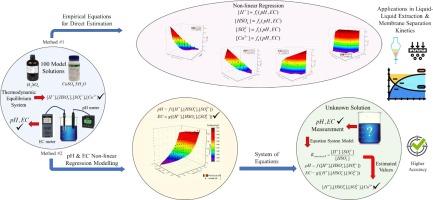
The online analysis of industrial process solutions, such as copper sulfate/acid electrolytes, is challenging due to challenges and high costs of real-time characterization methods, highlighting the need for accurate, cost-effective, and rapid-response techniques. This study models the concentrations of key ions [H+], [HSO4−], [SO42−], and [Cu2+] using convenient pH and electrical conductivity (EC) measurements in copper sulfate/acid electrolytes. Initial ion concentrations are determined through thermodynamic equilibrium simulations, and data from 100 ambient temperature trials is used to train the models across a wide range of conditions. Two approaches are explored, first a set of direct empirical equations, which effectively estimate ion concentrations but exhibit higher-order errors at certain data points for [Cu2+], and second a system of equations method that integrates pH and EC models with equilibrium and mass balance equations, achieving near-perfect precision with at least 97 % confidence. Additionally, the activity coefficient of [H+] is modeled. The findings have significant practical applications in electrolyte concentration determination, as well as kinetic and extraction studies in Lewic cell and membrane modules, particularly for copper Pregnant Leach Solution (PLS) with pH values ranging from 1 to 2.4.
期刊介绍:
The journal includes papers in the following areas:
– Simple organic liquids and mixtures
– Ionic liquids
– Surfactant solutions (including micelles and vesicles) and liquid interfaces
– Colloidal solutions and nanoparticles
– Thermotropic and lyotropic liquid crystals
– Ferrofluids
– Water, aqueous solutions and other hydrogen-bonded liquids
– Lubricants, polymer solutions and melts
– Molten metals and salts
– Phase transitions and critical phenomena in liquids and confined fluids
– Self assembly in complex liquids.– Biomolecules in solution
The emphasis is on the molecular (or microscopic) understanding of particular liquids or liquid systems, especially concerning structure, dynamics and intermolecular forces. The experimental techniques used may include:
– Conventional spectroscopy (mid-IR and far-IR, Raman, NMR, etc.)
– Non-linear optics and time resolved spectroscopy (psec, fsec, asec, ISRS, etc.)
– Light scattering (Rayleigh, Brillouin, PCS, etc.)
– Dielectric relaxation
– X-ray and neutron scattering and diffraction.
Experimental studies, computer simulations (MD or MC) and analytical theory will be considered for publication; papers just reporting experimental results that do not contribute to the understanding of the fundamentals of molecular and ionic liquids will not be accepted. Only papers of a non-routine nature and advancing the field will be considered for publication.




 京公网安备 11010802042870号
京ICP备2023020795号-1
京公网安备 11010802042870号
京ICP备2023020795号-1

 分享
分享
 求助内容:
求助内容: 应助结果提醒方式:
 扫码关注我们
