{"title":"Combined collector based on N-propyl-N-allyl-o-isobutyl thiocarbamate improving the flotation of pentlandite","authors":"Mengyao Zhou , Zhen Wang , Kaile Zhao , Chen Yao , Renfan Chen , Xiaolong Huang , Sayfidin Shahobidinovich Safarov , Kholmahmad Isroilovich Kholov","doi":"10.1016/j.mineng.2025.109256","DOIUrl":null,"url":null,"abstract":"<div><div>The main source of nickel ore resources is pentlandite. However, the flotation recovery effect of pentlandite in this type of ore is not satisfactory. Currently, the content ratio of copper and nickel increases during production, but the recovery of nickel remains unchanged. To tackle this issue, a new ester collector (NAOITC) was introduced into the collector system by combining it with sodium butyl xanthate (NaBX) to form a combined collector. Micro-flotation experiments demonstrated that under relatively alkaline conditions with NAOITC added at around from 70% to 60%, the flotation recovery of pentlandite is significantly improved compared to using NABX alone. According to the analytical test results of contact angle measurement, adsorption capacity analysis, atomic force microscopy, and adsorption distance analysis, it was observed that the utilization of the combined collector led to an increase in collector adsorption on the pentlandite surface. At the same time, the adsorption distance was reduced while surface roughness and hydrophobicity were enhanced compared to using the collector alone. Fourier transform infrared spectroscopy and X-ray photoelectron spectroscopy further confirmed the stable adsorption of combined collector systems onto pentlandite surfaces. Consequently, this resulted in improved hydrophobicity and flotation efficiency for pentlandite. Therefore, incorporating a combined collector can effectively enhance the flotation performance of pentlandite.</div></div>","PeriodicalId":18594,"journal":{"name":"Minerals Engineering","volume":"227 ","pages":"Article 109256"},"PeriodicalIF":5.0000,"publicationDate":"2025-03-26","publicationTypes":"Journal Article","fieldsOfStudy":null,"isOpenAccess":false,"openAccessPdf":"","citationCount":"0","resultStr":null,"platform":"Semanticscholar","paperid":null,"PeriodicalName":"Minerals Engineering","FirstCategoryId":"5","ListUrlMain":"https://www.sciencedirect.com/science/article/pii/S0892687525000846","RegionNum":2,"RegionCategory":"工程技术","ArticlePicture":[],"TitleCN":null,"AbstractTextCN":null,"PMCID":null,"EPubDate":"","PubModel":"","JCR":"Q1","JCRName":"ENGINEERING, CHEMICAL","Score":null,"Total":0}
引用次数: 0
Abstract
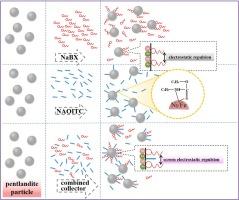
The main source of nickel ore resources is pentlandite. However, the flotation recovery effect of pentlandite in this type of ore is not satisfactory. Currently, the content ratio of copper and nickel increases during production, but the recovery of nickel remains unchanged. To tackle this issue, a new ester collector (NAOITC) was introduced into the collector system by combining it with sodium butyl xanthate (NaBX) to form a combined collector. Micro-flotation experiments demonstrated that under relatively alkaline conditions with NAOITC added at around from 70% to 60%, the flotation recovery of pentlandite is significantly improved compared to using NABX alone. According to the analytical test results of contact angle measurement, adsorption capacity analysis, atomic force microscopy, and adsorption distance analysis, it was observed that the utilization of the combined collector led to an increase in collector adsorption on the pentlandite surface. At the same time, the adsorption distance was reduced while surface roughness and hydrophobicity were enhanced compared to using the collector alone. Fourier transform infrared spectroscopy and X-ray photoelectron spectroscopy further confirmed the stable adsorption of combined collector systems onto pentlandite surfaces. Consequently, this resulted in improved hydrophobicity and flotation efficiency for pentlandite. Therefore, incorporating a combined collector can effectively enhance the flotation performance of pentlandite.
期刊介绍:
The purpose of the journal is to provide for the rapid publication of topical papers featuring the latest developments in the allied fields of mineral processing and extractive metallurgy. Its wide ranging coverage of research and practical (operating) topics includes physical separation methods, such as comminution, flotation concentration and dewatering, chemical methods such as bio-, hydro-, and electro-metallurgy, analytical techniques, process control, simulation and instrumentation, and mineralogical aspects of processing. Environmental issues, particularly those pertaining to sustainable development, will also be strongly covered.



 京公网安备 11010802042870号
京ICP备2023020795号-1
京公网安备 11010802042870号
京ICP备2023020795号-1

 分享
分享
 求助内容:
求助内容: 应助结果提醒方式:
 扫码关注我们
