Electroconductive gelatin/hyaluronic acid/hydroxyapatite scaffolds for enhanced cell proliferation and osteogenic differentiation in bone tissue engineering
Phanindra Babu Kasi , Aleksandra Serafin , Liam O'Brien , Nick Moghbel , Lev N. Novikov , Peyman Kelk , Maurice N. Collins
{"title":"Electroconductive gelatin/hyaluronic acid/hydroxyapatite scaffolds for enhanced cell proliferation and osteogenic differentiation in bone tissue engineering","authors":"Phanindra Babu Kasi , Aleksandra Serafin , Liam O'Brien , Nick Moghbel , Lev N. Novikov , Peyman Kelk , Maurice N. Collins","doi":"10.1016/j.bioadv.2025.214286","DOIUrl":null,"url":null,"abstract":"<div><div>Addressing the challenge of bone tissue regeneration requires creating an optimal microenvironment that promotes both osteogenesis and angiogenesis. Electroconductive scaffolds have emerged as promising solutions for bone regeneration; however, existing conductive polymers often lack biofunctionality and biocompatibility. In this study, we synthesized poly(3,4-ethylenedioxythiophene) nanoparticles (PEDOT NPs) using chemical oxidation polymerization and incorporated them into gelatin/hyaluronic acid/hydroxyapatite (Gel:HA:HAp) scaffolds to develop Gel:HA:HAp:PEDOT-NP scaffolds. Morphological analysis by scanning electron microscopy (SEM) showed a honeycomb-like structure with pores of 228–250 μm in diameter. The addition of the synthesized PEDOT NPs increased the conductive capabilities of the scaffolds to 1 × 10<sup>−6</sup> ± 1.3 × 10<sup>−7</sup> S/cm. Biological assessment of PEDOT NP scaffolds using human foetal osteoblastic 1.19 cells (hFOB), and human bone marrow-derived mesenchymal stem cells (hBMSCs) revealed enhanced cell proliferation and viability compared to control scaffold without NPs, along with increased osteogenic differentiation, evidenced by higher levels of alkaline phosphatase activity, osteopontin (OPN), alkaline phosphatase (ALP), and osteocalcin (OCN) expression, as observed through immunofluorescence, and enhanced expression of osteogenic-related genes. The conductive scaffold shows interesting mineralization capacity, as shown by Alizarin red and Osteoimage staining. Furthermore, PEDOT-NP scaffolds promoted angiogenesis, as indicated by improved tube formation abilities of human umbilical vein endothelial cells (HUVECs), especially at the higher concentrations of NPs. Overall, our findings demonstrate that the integration of PEDOT NPs scaffold enhances their conductive properties and promotes cell proliferation, osteogenic differentiation, and angiogenesis. Gel:HA:HAp:PEDOT-NP scaffolds exhibit promising potential as efficient biomaterials for bone tissue regeneration, offering a potential engineered platform for clinical applications.</div></div>","PeriodicalId":51111,"journal":{"name":"Materials Science & Engineering C-Materials for Biological Applications","volume":"173 ","pages":"Article 214286"},"PeriodicalIF":6.0000,"publicationDate":"2025-08-01","publicationTypes":"Journal Article","fieldsOfStudy":null,"isOpenAccess":false,"openAccessPdf":"","citationCount":"0","resultStr":null,"platform":"Semanticscholar","paperid":null,"PeriodicalName":"Materials Science & Engineering C-Materials for Biological Applications","FirstCategoryId":"1085","ListUrlMain":"https://www.sciencedirect.com/science/article/pii/S277295082500113X","RegionNum":2,"RegionCategory":"医学","ArticlePicture":[],"TitleCN":null,"AbstractTextCN":null,"PMCID":null,"EPubDate":"2025/3/24 0:00:00","PubModel":"Epub","JCR":"Q2","JCRName":"MATERIALS SCIENCE, BIOMATERIALS","Score":null,"Total":0}
引用次数: 0
Abstract
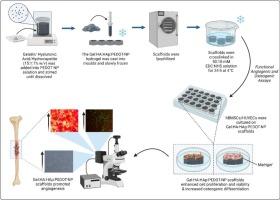
Addressing the challenge of bone tissue regeneration requires creating an optimal microenvironment that promotes both osteogenesis and angiogenesis. Electroconductive scaffolds have emerged as promising solutions for bone regeneration; however, existing conductive polymers often lack biofunctionality and biocompatibility. In this study, we synthesized poly(3,4-ethylenedioxythiophene) nanoparticles (PEDOT NPs) using chemical oxidation polymerization and incorporated them into gelatin/hyaluronic acid/hydroxyapatite (Gel:HA:HAp) scaffolds to develop Gel:HA:HAp:PEDOT-NP scaffolds. Morphological analysis by scanning electron microscopy (SEM) showed a honeycomb-like structure with pores of 228–250 μm in diameter. The addition of the synthesized PEDOT NPs increased the conductive capabilities of the scaffolds to 1 × 10⁻⁶ ± 1.3 × 10⁻⁷ S/cm. Biological assessment of PEDOT NP scaffolds using human foetal osteoblastic 1.19 cells (hFOB), and human bone marrow-derived mesenchymal stem cells (hBMSCs) revealed enhanced cell proliferation and viability compared to control scaffold without NPs, along with increased osteogenic differentiation, evidenced by higher levels of alkaline phosphatase activity, osteopontin (OPN), alkaline phosphatase (ALP), and osteocalcin (OCN) expression, as observed through immunofluorescence, and enhanced expression of osteogenic-related genes. The conductive scaffold shows interesting mineralization capacity, as shown by Alizarin red and Osteoimage staining. Furthermore, PEDOT-NP scaffolds promoted angiogenesis, as indicated by improved tube formation abilities of human umbilical vein endothelial cells (HUVECs), especially at the higher concentrations of NPs. Overall, our findings demonstrate that the integration of PEDOT NPs scaffold enhances their conductive properties and promotes cell proliferation, osteogenic differentiation, and angiogenesis. Gel:HA:HAp:PEDOT-NP scaffolds exhibit promising potential as efficient biomaterials for bone tissue regeneration, offering a potential engineered platform for clinical applications.
期刊介绍:
Biomaterials Advances, previously known as Materials Science and Engineering: C-Materials for Biological Applications (P-ISSN: 0928-4931, E-ISSN: 1873-0191). Includes topics at the interface of the biomedical sciences and materials engineering. These topics include:
• Bioinspired and biomimetic materials for medical applications
• Materials of biological origin for medical applications
• Materials for "active" medical applications
• Self-assembling and self-healing materials for medical applications
• "Smart" (i.e., stimulus-response) materials for medical applications
• Ceramic, metallic, polymeric, and composite materials for medical applications
• Materials for in vivo sensing
• Materials for in vivo imaging
• Materials for delivery of pharmacologic agents and vaccines
• Novel approaches for characterizing and modeling materials for medical applications
Manuscripts on biological topics without a materials science component, or manuscripts on materials science without biological applications, will not be considered for publication in Materials Science and Engineering C. New submissions are first assessed for language, scope and originality (plagiarism check) and can be desk rejected before review if they need English language improvements, are out of scope or present excessive duplication with published sources.
Biomaterials Advances sits within Elsevier''s biomaterials science portfolio alongside Biomaterials, Materials Today Bio and Biomaterials and Biosystems. As part of the broader Materials Today family, Biomaterials Advances offers authors rigorous peer review, rapid decisions, and high visibility. We look forward to receiving your submissions!



 京公网安备 11010802042870号
京ICP备2023020795号-1
京公网安备 11010802042870号
京ICP备2023020795号-1

 分享
分享
 求助内容:
求助内容: 应助结果提醒方式:
 扫码关注我们
