Mechanical properties and microstructure analysis of laser welded hybrid parts made of additively and conventionally manufactured 1.4313 soft martensitic steel
Indira Dey , Raphael Floeder , Karsten Kunze , Christian Roth , Konrad Wegener
{"title":"Mechanical properties and microstructure analysis of laser welded hybrid parts made of additively and conventionally manufactured 1.4313 soft martensitic steel","authors":"Indira Dey , Raphael Floeder , Karsten Kunze , Christian Roth , Konrad Wegener","doi":"10.1016/j.matdes.2025.113858","DOIUrl":null,"url":null,"abstract":"<div><div>This study investigates laser welding of additively (AM) and conventionally manufactured (CM) parts, aiming to enhance cost and energy efficiency for a diverse product range. In this context, hybrid specimens combining AM/CM subparts were produced, where AM subparts were created using DED, CM parts by hot forming, and the two were joined using laser welding. The material analysed is soft martensitic stainless steel. Mechanical characterisation was performed through tensile testing and hardness measurements and microstructure characterisation through EBSD, SEM, EDS, and light microscopy. The study reveals the presence of ultra-fine grains in the heat treated laser weld segments which suggests grain subdivision due to martensite deformation. As built hybrid specimens exhibited lower toughness due to the laser welds and lower strength due to the CM segments. The weakest point after the heat treatment was the HAZ of the CM segment. The best mechanical performance was observed in homogeneously heat-treated AM specimens. Moreover, the variability in grain size were examined but did not conform grain boundary strengthening, particularly after the heat treatment. This study highlights the critical influence of microstructural variations on the mechanical properties of hybrid welds, emphasizing the need for further investigation into strengthening mechanisms and individual heat treatments.</div></div>","PeriodicalId":383,"journal":{"name":"Materials & Design","volume":"253 ","pages":"Article 113858"},"PeriodicalIF":7.9000,"publicationDate":"2025-05-01","publicationTypes":"Journal Article","fieldsOfStudy":null,"isOpenAccess":false,"openAccessPdf":"","citationCount":"0","resultStr":null,"platform":"Semanticscholar","paperid":null,"PeriodicalName":"Materials & Design","FirstCategoryId":"88","ListUrlMain":"https://www.sciencedirect.com/science/article/pii/S0264127525002783","RegionNum":2,"RegionCategory":"材料科学","ArticlePicture":[],"TitleCN":null,"AbstractTextCN":null,"PMCID":null,"EPubDate":"2025/3/22 0:00:00","PubModel":"Epub","JCR":"Q1","JCRName":"MATERIALS SCIENCE, MULTIDISCIPLINARY","Score":null,"Total":0}
引用次数: 0
Abstract
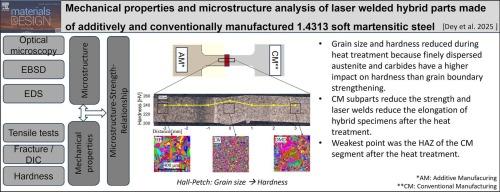
This study investigates laser welding of additively (AM) and conventionally manufactured (CM) parts, aiming to enhance cost and energy efficiency for a diverse product range. In this context, hybrid specimens combining AM/CM subparts were produced, where AM subparts were created using DED, CM parts by hot forming, and the two were joined using laser welding. The material analysed is soft martensitic stainless steel. Mechanical characterisation was performed through tensile testing and hardness measurements and microstructure characterisation through EBSD, SEM, EDS, and light microscopy. The study reveals the presence of ultra-fine grains in the heat treated laser weld segments which suggests grain subdivision due to martensite deformation. As built hybrid specimens exhibited lower toughness due to the laser welds and lower strength due to the CM segments. The weakest point after the heat treatment was the HAZ of the CM segment. The best mechanical performance was observed in homogeneously heat-treated AM specimens. Moreover, the variability in grain size were examined but did not conform grain boundary strengthening, particularly after the heat treatment. This study highlights the critical influence of microstructural variations on the mechanical properties of hybrid welds, emphasizing the need for further investigation into strengthening mechanisms and individual heat treatments.
期刊介绍:
Materials and Design is a multi-disciplinary journal that publishes original research reports, review articles, and express communications. The journal focuses on studying the structure and properties of inorganic and organic materials, advancements in synthesis, processing, characterization, and testing, the design of materials and engineering systems, and their applications in technology. It aims to bring together various aspects of materials science, engineering, physics, and chemistry.
The journal explores themes ranging from materials to design and aims to reveal the connections between natural and artificial materials, as well as experiment and modeling. Manuscripts submitted to Materials and Design should contain elements of discovery and surprise, as they often contribute new insights into the architecture and function of matter.



 京公网安备 11010802042870号
京ICP备2023020795号-1
京公网安备 11010802042870号
京ICP备2023020795号-1

 分享
分享
 求助内容:
求助内容: 应助结果提醒方式:
 扫码关注我们
