Wang Chen , Pengfei Shen , Wei Li , Shuailing Ma , Min Lian , Xinmiao Wei , Yaqian Dan , Xingbin Zhao , Mengyao Qi , Tian Cui , Ralf Riedel
{"title":"Pressure-driven grain fusion and mechanical properties improvement of high-entropy (Ti0.2Zr0.2Nb0.2Hf0.2Ta0.2)C ceramics","authors":"Wang Chen , Pengfei Shen , Wei Li , Shuailing Ma , Min Lian , Xinmiao Wei , Yaqian Dan , Xingbin Zhao , Mengyao Qi , Tian Cui , Ralf Riedel","doi":"10.1016/j.matdes.2025.113870","DOIUrl":null,"url":null,"abstract":"<div><div>Dense and fine-grained high entropy transition metal carbides are considered as one of the most promising materials with superior hardness, fracture toughness and electrical conductivity. However, the difficulty in preparing high-quality fine-grained samples limits their wide applications. In this work, fully dense and fine-grained (Ti<sub>0.2</sub>Zr<sub>0.2</sub>Nb<sub>0.2</sub>Hf<sub>0.2</sub>Ta<sub>0.2</sub>)C ceramics were prepared by high temperature and high pressure technique. Ultra-high pressure significantly accelerates the densification process and significantly lowers the sintering temperature due to the pressure-induced grain fusion and grain growth suppression effect. The monolith sintered at 1200 ℃ and 15 GPa exhibits a Vickers hardness of 27.9 GPa (9.8 N), and a high fracture toughness of 8.9 MPa·m<sup>1/2</sup>, both of which are the highest values for the reported high-entropy carbide ceramics. Advanced characterization demonstrates that high hardness and toughness are closely related to the high dislocation density, fine grain size, and the high relative density. Additionally, the sintering temperature is significantly reduced by applying pressure, which provides a general route for preparing advanced polycrystalline high-entropy carbide ceramics for more superior mechanical properties.</div></div>","PeriodicalId":383,"journal":{"name":"Materials & Design","volume":"253 ","pages":"Article 113870"},"PeriodicalIF":7.9000,"publicationDate":"2025-05-01","publicationTypes":"Journal Article","fieldsOfStudy":null,"isOpenAccess":false,"openAccessPdf":"","citationCount":"0","resultStr":null,"platform":"Semanticscholar","paperid":null,"PeriodicalName":"Materials & Design","FirstCategoryId":"88","ListUrlMain":"https://www.sciencedirect.com/science/article/pii/S0264127525002904","RegionNum":2,"RegionCategory":"材料科学","ArticlePicture":[],"TitleCN":null,"AbstractTextCN":null,"PMCID":null,"EPubDate":"2025/3/22 0:00:00","PubModel":"Epub","JCR":"Q1","JCRName":"MATERIALS SCIENCE, MULTIDISCIPLINARY","Score":null,"Total":0}
引用次数: 0
Abstract
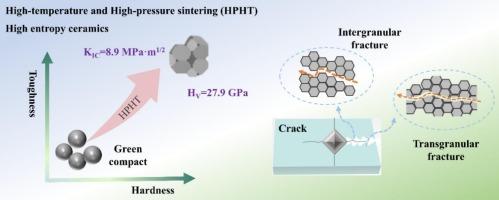
Dense and fine-grained high entropy transition metal carbides are considered as one of the most promising materials with superior hardness, fracture toughness and electrical conductivity. However, the difficulty in preparing high-quality fine-grained samples limits their wide applications. In this work, fully dense and fine-grained (Ti0.2Zr0.2Nb0.2Hf0.2Ta0.2)C ceramics were prepared by high temperature and high pressure technique. Ultra-high pressure significantly accelerates the densification process and significantly lowers the sintering temperature due to the pressure-induced grain fusion and grain growth suppression effect. The monolith sintered at 1200 ℃ and 15 GPa exhibits a Vickers hardness of 27.9 GPa (9.8 N), and a high fracture toughness of 8.9 MPa·m1/2, both of which are the highest values for the reported high-entropy carbide ceramics. Advanced characterization demonstrates that high hardness and toughness are closely related to the high dislocation density, fine grain size, and the high relative density. Additionally, the sintering temperature is significantly reduced by applying pressure, which provides a general route for preparing advanced polycrystalline high-entropy carbide ceramics for more superior mechanical properties.
期刊介绍:
Materials and Design is a multi-disciplinary journal that publishes original research reports, review articles, and express communications. The journal focuses on studying the structure and properties of inorganic and organic materials, advancements in synthesis, processing, characterization, and testing, the design of materials and engineering systems, and their applications in technology. It aims to bring together various aspects of materials science, engineering, physics, and chemistry.
The journal explores themes ranging from materials to design and aims to reveal the connections between natural and artificial materials, as well as experiment and modeling. Manuscripts submitted to Materials and Design should contain elements of discovery and surprise, as they often contribute new insights into the architecture and function of matter.



 京公网安备 11010802042870号
京ICP备2023020795号-1
京公网安备 11010802042870号
京ICP备2023020795号-1

 分享
分享
 求助内容:
求助内容: 应助结果提醒方式:
 扫码关注我们
