Xun Zhang , Shiming Cheng , Fang Wu , Mingqi Yue , Xiansheng Liu , Dongfang Zhao , Xinrong Yan
{"title":"Characterization of pollutant discharges from ships within 100 nautical miles of China's coastline and certain inland river ports, 2022","authors":"Xun Zhang , Shiming Cheng , Fang Wu , Mingqi Yue , Xiansheng Liu , Dongfang Zhao , Xinrong Yan","doi":"10.1016/j.marpolbul.2025.117876","DOIUrl":null,"url":null,"abstract":"<div><div>With the rapid development of global maritime trade, the impact of ship emissions on the environment and public health has become increasingly severe, making the construction of an accurate ship emission inventory an important research focus in the field of marine environmental protection. Currently, most of the relevant studies in China are limited to a single port scale and lack a systematic analysis of a large-scale region. Therefore, this study breaks through regional limitations and focuses on the important economic and maritime hub of the eastern coastal region of China. Using AIS data and employing a “bottom-up” approach, it constructs a ship pollutant emission estimation model in 2022 within 100 nautical miles of China's coastline and certain inland river ports, and further analyzes the characteristics of the pollutants. The results show that the total ship emissions in the study area for NO<sub>X</sub>, SO<sub>2</sub>, CO, PM<sub>2.5</sub>, HC, and VOCs were 4.87 × 10<sup>5</sup> t, 1.33 × 10<sup>5</sup> t, 4.55 × 10<sup>4</sup> t, 1.52 × 10<sup>4</sup> t, 2.34 × 10<sup>4</sup> t, and 2.35 × 10<sup>4</sup> t, respectively, with NO<sub>X</sub> and SO<sub>2</sub> emissions dominating. The Yangtze River Delta, Pearl River Delta, and Bohai Bay are major emission hotspots, and the emission intensity of some inland river ports is higher than that of coastal ports. Ship emissions show obvious seasonality and daily regularity, and the contribution of pollutant emissions from cargo ships is >50 %, with main engine emissions dominating. Based on these analyses, this study puts forward targeted emission reduction proposals, which provide an important reference basis for the formulation of environmental protection policies.</div></div>","PeriodicalId":18215,"journal":{"name":"Marine pollution bulletin","volume":"215 ","pages":"Article 117876"},"PeriodicalIF":4.9000,"publicationDate":"2025-06-01","publicationTypes":"Journal Article","fieldsOfStudy":null,"isOpenAccess":false,"openAccessPdf":"","citationCount":"0","resultStr":null,"platform":"Semanticscholar","paperid":null,"PeriodicalName":"Marine pollution bulletin","FirstCategoryId":"93","ListUrlMain":"https://www.sciencedirect.com/science/article/pii/S0025326X25003510","RegionNum":3,"RegionCategory":"环境科学与生态学","ArticlePicture":[],"TitleCN":null,"AbstractTextCN":null,"PMCID":null,"EPubDate":"2025/3/26 0:00:00","PubModel":"Epub","JCR":"Q1","JCRName":"ENVIRONMENTAL SCIENCES","Score":null,"Total":0}
引用次数: 0
Abstract
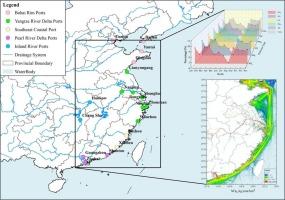
With the rapid development of global maritime trade, the impact of ship emissions on the environment and public health has become increasingly severe, making the construction of an accurate ship emission inventory an important research focus in the field of marine environmental protection. Currently, most of the relevant studies in China are limited to a single port scale and lack a systematic analysis of a large-scale region. Therefore, this study breaks through regional limitations and focuses on the important economic and maritime hub of the eastern coastal region of China. Using AIS data and employing a “bottom-up” approach, it constructs a ship pollutant emission estimation model in 2022 within 100 nautical miles of China's coastline and certain inland river ports, and further analyzes the characteristics of the pollutants. The results show that the total ship emissions in the study area for NOX, SO2, CO, PM2.5, HC, and VOCs were 4.87 × 10⁵ t, 1.33 × 10⁵ t, 4.55 × 10⁴ t, 1.52 × 10⁴ t, 2.34 × 10⁴ t, and 2.35 × 10⁴ t, respectively, with NOX and SO2 emissions dominating. The Yangtze River Delta, Pearl River Delta, and Bohai Bay are major emission hotspots, and the emission intensity of some inland river ports is higher than that of coastal ports. Ship emissions show obvious seasonality and daily regularity, and the contribution of pollutant emissions from cargo ships is >50 %, with main engine emissions dominating. Based on these analyses, this study puts forward targeted emission reduction proposals, which provide an important reference basis for the formulation of environmental protection policies.
期刊介绍:
Marine Pollution Bulletin is concerned with the rational use of maritime and marine resources in estuaries, the seas and oceans, as well as with documenting marine pollution and introducing new forms of measurement and analysis. A wide range of topics are discussed as news, comment, reviews and research reports, not only on effluent disposal and pollution control, but also on the management, economic aspects and protection of the marine environment in general.




 京公网安备 11010802042870号
京ICP备2023020795号-1
京公网安备 11010802042870号
京ICP备2023020795号-1

 分享
分享
 求助内容:
求助内容: 应助结果提醒方式:
 扫码关注我们
