An environmentally friendly strategy for the preparation of high-purity quartz using combined collector reverse flotation coupled with acid-leaching technology
Ke Rong , Dawei Luo , Jiabao Deng , Shengnan Sun , Shasha Song , Bowen Jiang , Zhongxiang Yu , Ke Zhao
{"title":"An environmentally friendly strategy for the preparation of high-purity quartz using combined collector reverse flotation coupled with acid-leaching technology","authors":"Ke Rong , Dawei Luo , Jiabao Deng , Shengnan Sun , Shasha Song , Bowen Jiang , Zhongxiang Yu , Ke Zhao","doi":"10.1016/j.mineng.2025.109274","DOIUrl":null,"url":null,"abstract":"<div><div>High-purity quartz sand is an important raw material in the high-end silicon industry and is globally recognised as a key strategic resource. Currently, the problems of high energy consumption, long cycle time, low yield, and serious environmental pollution caused by by-products of the production process remain to be solved. In this study, a reverse-flotation anionic/cationic combined collector coupled with an acid-leaching process was developed to prepare high-purity quartz sand from vein-like quartz ores as raw materials. First, quartz with a purity of 99.9338% SiO<sub>2</sub> was pretreated. Subsequently, iron and silicate impurities, such as feldspar and mica, were removed from the ore by reverse flotation using an anionic/cationic combined collector, and the lattice impurity ions were removed by utilising a low-fluorine hot-pressure rotary acid-leaching process. Under the optimal process conditions, the purity of SiO<sub>2</sub> in the product reached 99.9980%. A complete set of reversed-flotation anionic/cationic collector–acid-leaching systems were constructed to purify Asian vein quartz into high-purity quartz sand for industrial application in photovoltaics and semiconductors.</div></div>","PeriodicalId":18594,"journal":{"name":"Minerals Engineering","volume":"227 ","pages":"Article 109274"},"PeriodicalIF":5.0000,"publicationDate":"2025-07-15","publicationTypes":"Journal Article","fieldsOfStudy":null,"isOpenAccess":false,"openAccessPdf":"","citationCount":"0","resultStr":null,"platform":"Semanticscholar","paperid":null,"PeriodicalName":"Minerals Engineering","FirstCategoryId":"5","ListUrlMain":"https://www.sciencedirect.com/science/article/pii/S0892687525001025","RegionNum":2,"RegionCategory":"工程技术","ArticlePicture":[],"TitleCN":null,"AbstractTextCN":null,"PMCID":null,"EPubDate":"2025/3/27 0:00:00","PubModel":"Epub","JCR":"Q1","JCRName":"ENGINEERING, CHEMICAL","Score":null,"Total":0}
引用次数: 0
Abstract
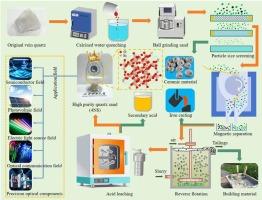
High-purity quartz sand is an important raw material in the high-end silicon industry and is globally recognised as a key strategic resource. Currently, the problems of high energy consumption, long cycle time, low yield, and serious environmental pollution caused by by-products of the production process remain to be solved. In this study, a reverse-flotation anionic/cationic combined collector coupled with an acid-leaching process was developed to prepare high-purity quartz sand from vein-like quartz ores as raw materials. First, quartz with a purity of 99.9338% SiO2 was pretreated. Subsequently, iron and silicate impurities, such as feldspar and mica, were removed from the ore by reverse flotation using an anionic/cationic combined collector, and the lattice impurity ions were removed by utilising a low-fluorine hot-pressure rotary acid-leaching process. Under the optimal process conditions, the purity of SiO2 in the product reached 99.9980%. A complete set of reversed-flotation anionic/cationic collector–acid-leaching systems were constructed to purify Asian vein quartz into high-purity quartz sand for industrial application in photovoltaics and semiconductors.
期刊介绍:
The purpose of the journal is to provide for the rapid publication of topical papers featuring the latest developments in the allied fields of mineral processing and extractive metallurgy. Its wide ranging coverage of research and practical (operating) topics includes physical separation methods, such as comminution, flotation concentration and dewatering, chemical methods such as bio-, hydro-, and electro-metallurgy, analytical techniques, process control, simulation and instrumentation, and mineralogical aspects of processing. Environmental issues, particularly those pertaining to sustainable development, will also be strongly covered.



 京公网安备 11010802042870号
京ICP备2023020795号-1
京公网安备 11010802042870号
京ICP备2023020795号-1

 分享
分享
 求助内容:
求助内容: 应助结果提醒方式:
 扫码关注我们
