Mohammed Alktranee , Qudama Al-Yasiri , Karrar Saeed Mohammed , Müslüm Arıcı , Márta Szabó , Péter Bencs
{"title":"Energy, exergy, and economic analysis of indirect solar dryer integrated phase change material cans","authors":"Mohammed Alktranee , Qudama Al-Yasiri , Karrar Saeed Mohammed , Müslüm Arıcı , Márta Szabó , Péter Bencs","doi":"10.1016/j.ecmx.2025.100986","DOIUrl":null,"url":null,"abstract":"<div><div>The efficiency of solar dryers fluctuates as the solar radiation declines, influencing the removed water content from products. Therefore, continuous heat delivery with a stable temperature range for a longer time using energy storage materials is an efficient way to enhance the drying process from energy and exergy prospects. To this aim, a solar dryer integrated with phase change material (PCM) was designed and examined in harsh weather conditions. The solar dryer performance with 1 and 2 kg of PCM (equipped in 6 and 12 cans, respectively) was analyzed against an identical reference dryer assessing numerous energy, exergy, and economic parameters. Research outcomes revealed that PCM cans have sustained the drying process, stabilized drying temperature and functioned as an extra heat source during the daytime. Furthermore, the modified solar dryer achieved an average moisture content removal of 86.5 % and 89.7 % by employing 6 and 12 PCM cans, compared to 82.5 % in the reference dryer. Energy analysis displayed that the useful heat gain was maximized by up to 3.9 % and 9.5 % integrating 6 and 12 PCM cans, respectively. Moreover, the thermal efficiency achieved by the modified dryers was about 2.5 % and 6.8 %, respectively. Exergy analysis indicated remarkable exergy gain, exergy efficiency, and sustainability index for the solar dryer modified with 12 PCM cans, achieving a maximum of 593 W, 20 %, and 46 %. Economic analysis exhibited that the solar dryer energy payback period with 6 and 12 PCM cans was shorter than that of the reference dryer by 33.7 % and 35.1 %, respectively.</div></div>","PeriodicalId":37131,"journal":{"name":"Energy Conversion and Management-X","volume":"26 ","pages":"Article 100986"},"PeriodicalIF":7.6000,"publicationDate":"2025-04-01","publicationTypes":"Journal Article","fieldsOfStudy":null,"isOpenAccess":false,"openAccessPdf":"","citationCount":"0","resultStr":null,"platform":"Semanticscholar","paperid":null,"PeriodicalName":"Energy Conversion and Management-X","FirstCategoryId":"1085","ListUrlMain":"https://www.sciencedirect.com/science/article/pii/S2590174525001187","RegionNum":0,"RegionCategory":null,"ArticlePicture":[],"TitleCN":null,"AbstractTextCN":null,"PMCID":null,"EPubDate":"2025/3/21 0:00:00","PubModel":"Epub","JCR":"Q1","JCRName":"ENERGY & FUELS","Score":null,"Total":0}
引用次数: 0
Abstract
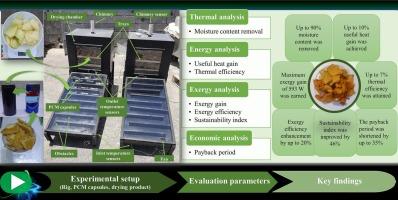
The efficiency of solar dryers fluctuates as the solar radiation declines, influencing the removed water content from products. Therefore, continuous heat delivery with a stable temperature range for a longer time using energy storage materials is an efficient way to enhance the drying process from energy and exergy prospects. To this aim, a solar dryer integrated with phase change material (PCM) was designed and examined in harsh weather conditions. The solar dryer performance with 1 and 2 kg of PCM (equipped in 6 and 12 cans, respectively) was analyzed against an identical reference dryer assessing numerous energy, exergy, and economic parameters. Research outcomes revealed that PCM cans have sustained the drying process, stabilized drying temperature and functioned as an extra heat source during the daytime. Furthermore, the modified solar dryer achieved an average moisture content removal of 86.5 % and 89.7 % by employing 6 and 12 PCM cans, compared to 82.5 % in the reference dryer. Energy analysis displayed that the useful heat gain was maximized by up to 3.9 % and 9.5 % integrating 6 and 12 PCM cans, respectively. Moreover, the thermal efficiency achieved by the modified dryers was about 2.5 % and 6.8 %, respectively. Exergy analysis indicated remarkable exergy gain, exergy efficiency, and sustainability index for the solar dryer modified with 12 PCM cans, achieving a maximum of 593 W, 20 %, and 46 %. Economic analysis exhibited that the solar dryer energy payback period with 6 and 12 PCM cans was shorter than that of the reference dryer by 33.7 % and 35.1 %, respectively.
期刊介绍:
Energy Conversion and Management: X is the open access extension of the reputable journal Energy Conversion and Management, serving as a platform for interdisciplinary research on a wide array of critical energy subjects. The journal is dedicated to publishing original contributions and in-depth technical review articles that present groundbreaking research on topics spanning energy generation, utilization, conversion, storage, transmission, conservation, management, and sustainability.
The scope of Energy Conversion and Management: X encompasses various forms of energy, including mechanical, thermal, nuclear, chemical, electromagnetic, magnetic, and electric energy. It addresses all known energy resources, highlighting both conventional sources like fossil fuels and nuclear power, as well as renewable resources such as solar, biomass, hydro, wind, geothermal, and ocean energy.



 京公网安备 11010802042870号
京ICP备2023020795号-1
京公网安备 11010802042870号
京ICP备2023020795号-1

 分享
分享
 求助内容:
求助内容: 应助结果提醒方式:
 扫码关注我们
