Optimizing the properties of CdS nanoparticles through niobium incorporation: A study on their potential applications in industrial effluent remediation
Haewon Byeon , Subita Bhagat , Hitendra Kumar Lautre , Megala Rajendran , A. Prakash , A. Haiter Lenin , J. Sunil
{"title":"Optimizing the properties of CdS nanoparticles through niobium incorporation: A study on their potential applications in industrial effluent remediation","authors":"Haewon Byeon , Subita Bhagat , Hitendra Kumar Lautre , Megala Rajendran , A. Prakash , A. Haiter Lenin , J. Sunil","doi":"10.1016/j.rechem.2025.102211","DOIUrl":null,"url":null,"abstract":"<div><div>This study effectively displays the physiochemical properties influenced by niobium (Nb) doping into Cadmium sulfide (CdS) nanostructures (NSs). The study employed a green template approach for synthesizing nanoparticles via <em>Syzygium cumini</em> seed extract as a natural reducing and stabilizing agent. The influence of Nb doping into CdS NPs can initially be observed, with the crystalline properties confirmed through XRD. Furthermore, a transition of morphology was observed from irregular structures to fine rod structures when the Nb concentration was increased from 1 % to 3 %. Additionally, the electronic structure and optical properties of CdS NPs significantly improved with the addition of Nb, thereby reducing the recombination rate of photogenerated electrons. The prepared nanoparticles have shown remarkable degradation efficiency over textile dye pollutants such as Alizarin red and Malachite green. Notably, this study employed real-world degradation testing by performing mineralization of direct textile effluent water collected from the riverside. The 3 % Nb-doped CdS NPs have shown a maximum degradation efficiency over Alizarin red and Malachite green, which reaches maximum degradation of more than 90 % within 90 min of sunlight irradiation. The prepared catalyst also has shown 90.1 % degradation efficiency with direct industrial effluent over 360 min of irradiation. Furthermore, the prepared NSs possess significant antibacterial and antioxidant efficacy, which promotes the usage of prepared nanocatalysts in water treatment applications.</div></div>","PeriodicalId":420,"journal":{"name":"Results in Chemistry","volume":"15 ","pages":"Article 102211"},"PeriodicalIF":4.2000,"publicationDate":"2025-05-01","publicationTypes":"Journal Article","fieldsOfStudy":null,"isOpenAccess":false,"openAccessPdf":"","citationCount":"0","resultStr":null,"platform":"Semanticscholar","paperid":null,"PeriodicalName":"Results in Chemistry","FirstCategoryId":"1085","ListUrlMain":"https://www.sciencedirect.com/science/article/pii/S2211715625001948","RegionNum":0,"RegionCategory":null,"ArticlePicture":[],"TitleCN":null,"AbstractTextCN":null,"PMCID":null,"EPubDate":"2025/3/22 0:00:00","PubModel":"Epub","JCR":"Q2","JCRName":"CHEMISTRY, MULTIDISCIPLINARY","Score":null,"Total":0}
引用次数: 0
Abstract
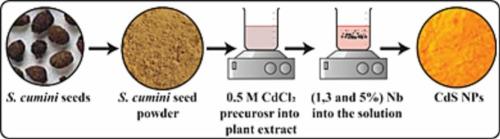
This study effectively displays the physiochemical properties influenced by niobium (Nb) doping into Cadmium sulfide (CdS) nanostructures (NSs). The study employed a green template approach for synthesizing nanoparticles via Syzygium cumini seed extract as a natural reducing and stabilizing agent. The influence of Nb doping into CdS NPs can initially be observed, with the crystalline properties confirmed through XRD. Furthermore, a transition of morphology was observed from irregular structures to fine rod structures when the Nb concentration was increased from 1 % to 3 %. Additionally, the electronic structure and optical properties of CdS NPs significantly improved with the addition of Nb, thereby reducing the recombination rate of photogenerated electrons. The prepared nanoparticles have shown remarkable degradation efficiency over textile dye pollutants such as Alizarin red and Malachite green. Notably, this study employed real-world degradation testing by performing mineralization of direct textile effluent water collected from the riverside. The 3 % Nb-doped CdS NPs have shown a maximum degradation efficiency over Alizarin red and Malachite green, which reaches maximum degradation of more than 90 % within 90 min of sunlight irradiation. The prepared catalyst also has shown 90.1 % degradation efficiency with direct industrial effluent over 360 min of irradiation. Furthermore, the prepared NSs possess significant antibacterial and antioxidant efficacy, which promotes the usage of prepared nanocatalysts in water treatment applications.




 京公网安备 11010802042870号
京ICP备2023020795号-1
京公网安备 11010802042870号
京ICP备2023020795号-1

 分享
分享
 求助内容:
求助内容: 应助结果提醒方式:
 扫码关注我们
