Kathryn S. Chen, Colleen M. Petrik, Rebecca G. Asch, Andrew R. Thompson, Toby D. Auth
{"title":"Continuing Long-Term Shifts in Larval Fish Phenology in the Southern California Current Ecosystem Are Matched by Rapid Advances in the North","authors":"Kathryn S. Chen, Colleen M. Petrik, Rebecca G. Asch, Andrew R. Thompson, Toby D. Auth","doi":"10.1111/gcb.70141","DOIUrl":null,"url":null,"abstract":"<p>Changing environmental conditions are leading to shifts in the timing of seasonal events globally. In the ocean, environmental cues affecting larval fish (ichthyoplankton) abundance may not be synchronized with factors optimizing larval and juvenile survival, making the study of ichthyoplankton phenology in the context of a changing environment critical. In the southern California Current Ecosystem (CCE), a major eastern boundary current upwelling system, significant long-term shifts in larval fish phenology have been previously observed. To assess the stability of these estimates and extend them to the northern CCE, we evaluated multidecadal trends in ichthyoplankton abundance for 57 species from the California Cooperative Oceanic Fisheries Investigations (CalCOFI) and 25 species from the Newport Hydrographic Line (NH Line). We show that on average, larval fish phenology in the southern CCE has continued to advance with an estimated rate of −0.18 ± 0.05 day year<sup>−1</sup> from 1951 to 2022, while phenology in the northern CCE has advanced at a rate of −0.48 ± 0.26 day year<sup>−1</sup> from 1996 to 2023. Thirty-nine percent of species showed significant advancing phenology, 12% exhibited delayed phenology, and 49% showed no long-term linear change. A comparison analysis showed that species in these groups had similar rates of change between the two locations for the 1997–2017 period. Phenological shifts in the southern CCE tracked changes in the phenology of upper ocean temperature, zooplankton, and upwelling. These variables poorly explained shifts in the northern CCE, where short-term effects of the El Niño–Southern Oscillation and the 2014–2016 marine heatwave on ichthyoplankton phenology were observed for some species. This research highlights regional variability and continuing phenological shifts in one of the world's most productive marine ecosystems.</p>","PeriodicalId":175,"journal":{"name":"Global Change Biology","volume":"31 3","pages":""},"PeriodicalIF":12.0000,"publicationDate":"2025-03-27","publicationTypes":"Journal Article","fieldsOfStudy":null,"isOpenAccess":false,"openAccessPdf":"https://onlinelibrary.wiley.com/doi/epdf/10.1111/gcb.70141","citationCount":"0","resultStr":null,"platform":"Semanticscholar","paperid":null,"PeriodicalName":"Global Change Biology","FirstCategoryId":"93","ListUrlMain":"https://onlinelibrary.wiley.com/doi/10.1111/gcb.70141","RegionNum":1,"RegionCategory":"环境科学与生态学","ArticlePicture":[],"TitleCN":null,"AbstractTextCN":null,"PMCID":null,"EPubDate":"","PubModel":"","JCR":"Q1","JCRName":"BIODIVERSITY CONSERVATION","Score":null,"Total":0}
引用次数: 0
Abstract
Changing environmental conditions are leading to shifts in the timing of seasonal events globally. In the ocean, environmental cues affecting larval fish (ichthyoplankton) abundance may not be synchronized with factors optimizing larval and juvenile survival, making the study of ichthyoplankton phenology in the context of a changing environment critical. In the southern California Current Ecosystem (CCE), a major eastern boundary current upwelling system, significant long-term shifts in larval fish phenology have been previously observed. To assess the stability of these estimates and extend them to the northern CCE, we evaluated multidecadal trends in ichthyoplankton abundance for 57 species from the California Cooperative Oceanic Fisheries Investigations (CalCOFI) and 25 species from the Newport Hydrographic Line (NH Line). We show that on average, larval fish phenology in the southern CCE has continued to advance with an estimated rate of −0.18 ± 0.05 day year−1 from 1951 to 2022, while phenology in the northern CCE has advanced at a rate of −0.48 ± 0.26 day year−1 from 1996 to 2023. Thirty-nine percent of species showed significant advancing phenology, 12% exhibited delayed phenology, and 49% showed no long-term linear change. A comparison analysis showed that species in these groups had similar rates of change between the two locations for the 1997–2017 period. Phenological shifts in the southern CCE tracked changes in the phenology of upper ocean temperature, zooplankton, and upwelling. These variables poorly explained shifts in the northern CCE, where short-term effects of the El Niño–Southern Oscillation and the 2014–2016 marine heatwave on ichthyoplankton phenology were observed for some species. This research highlights regional variability and continuing phenological shifts in one of the world's most productive marine ecosystems.
期刊介绍:
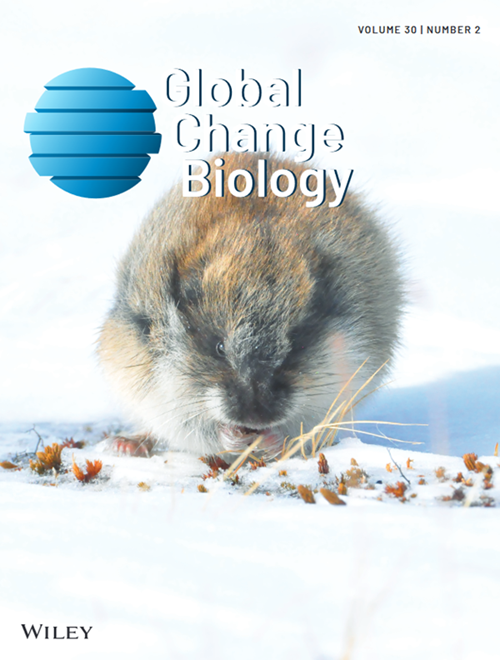
Global Change Biology is an environmental change journal committed to shaping the future and addressing the world's most pressing challenges, including sustainability, climate change, environmental protection, food and water safety, and global health.
Dedicated to fostering a profound understanding of the impacts of global change on biological systems and offering innovative solutions, the journal publishes a diverse range of content, including primary research articles, technical advances, research reviews, reports, opinions, perspectives, commentaries, and letters. Starting with the 2024 volume, Global Change Biology will transition to an online-only format, enhancing accessibility and contributing to the evolution of scholarly communication.




 京公网安备 11010802042870号
京ICP备2023020795号-1
京公网安备 11010802042870号
京ICP备2023020795号-1

 分享
分享
 求助内容:
求助内容: 应助结果提醒方式:
 扫码关注我们
