Hongdong Song, Lei Xue, Zhuwei Shao, Qiuyun Fu, Hongwei Cao, Kai Huang and Xiao Guan
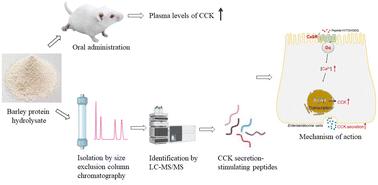
{"title":"Bioactive peptides from barley protein hydrolysate stimulate cholecystokinin secretion via calcium-sensing receptor signaling in enteroendocrine cells","authors":"Hongdong Song, Lei Xue, Zhuwei Shao, Qiuyun Fu, Hongwei Cao, Kai Huang and Xiao Guan","doi":"10.1039/D5FO00298B","DOIUrl":null,"url":null,"abstract":"<p >Anorexigenic hormone cholecystokinin (CCK), secreted by enteroendocrine cells (EECs), is known for its inhibitory role in appetite. The secretion of CCK is greatly affected by dietary ingredients. The search for functional components in food that stimulate CCK secretion is of great significance for weight control. Our previous study has demonstrated that barley protein hydrolysate (BPH) strongly stimulates CCK secretion from EECs <em>in vitro</em>, but the structural characteristics of the responsible components and their underlying mechanism of action have not yet been elucidated. Here, we monitor the plasma levels of CCK in mice after ingestion of BPH to demonstrate its <em>in vivo</em> activity in stimulating CCK secretion. Using size exclusion column chromatography and liquid chromatography-tandem mass spectrometry, we isolate and identify three novel CCK secretion-stimulating peptides, including VQVQIPF, VVTGVGGQ and PQQPQPFFQ. Among them, the peptide VVTGVGGQ exhibits the strongest activity in stimulating CCK secretion. Inhibition experiments show that the calcium-sensing receptor (CaSR) is required for VVTGVGGQ to increase CCK gene transcription and secretion. Blockage of CaSR by NPS-2143 completely abolishes the activity of VVTGVGGQ. Moreover, the downstream signaling molecules including CaSR coupled G-protein subtype G<small><sub>q</sub></small> and intracellular Ca<small><sup>2+</sup></small> are also involved in VVTGVGGQ-stimulated CCK secretion. Inhibition of G<small><sub>q</sub></small> and intracellular Ca<small><sup>2+</sup></small> completely and partially abolish this peptide-induced CCK secretion, respectively. Our findings highlight the potential of barley protein-derived hydrolysate and peptides as functional food ingredients for CCK secretion stimulation and weight control.</p>","PeriodicalId":77,"journal":{"name":"Food & Function","volume":" 8","pages":" 3018-3027"},"PeriodicalIF":5.4000,"publicationDate":"2025-03-26","publicationTypes":"Journal Article","fieldsOfStudy":null,"isOpenAccess":false,"openAccessPdf":"","citationCount":"0","resultStr":null,"platform":"Semanticscholar","paperid":null,"PeriodicalName":"Food & Function","FirstCategoryId":"97","ListUrlMain":"https://pubs.rsc.org/en/content/articlelanding/2025/fo/d5fo00298b","RegionNum":1,"RegionCategory":"农林科学","ArticlePicture":[],"TitleCN":null,"AbstractTextCN":null,"PMCID":null,"EPubDate":"","PubModel":"","JCR":"Q1","JCRName":"BIOCHEMISTRY & MOLECULAR BIOLOGY","Score":null,"Total":0}
引用次数: 0
Abstract
Anorexigenic hormone cholecystokinin (CCK), secreted by enteroendocrine cells (EECs), is known for its inhibitory role in appetite. The secretion of CCK is greatly affected by dietary ingredients. The search for functional components in food that stimulate CCK secretion is of great significance for weight control. Our previous study has demonstrated that barley protein hydrolysate (BPH) strongly stimulates CCK secretion from EECs in vitro, but the structural characteristics of the responsible components and their underlying mechanism of action have not yet been elucidated. Here, we monitor the plasma levels of CCK in mice after ingestion of BPH to demonstrate its in vivo activity in stimulating CCK secretion. Using size exclusion column chromatography and liquid chromatography-tandem mass spectrometry, we isolate and identify three novel CCK secretion-stimulating peptides, including VQVQIPF, VVTGVGGQ and PQQPQPFFQ. Among them, the peptide VVTGVGGQ exhibits the strongest activity in stimulating CCK secretion. Inhibition experiments show that the calcium-sensing receptor (CaSR) is required for VVTGVGGQ to increase CCK gene transcription and secretion. Blockage of CaSR by NPS-2143 completely abolishes the activity of VVTGVGGQ. Moreover, the downstream signaling molecules including CaSR coupled G-protein subtype Gq and intracellular Ca2+ are also involved in VVTGVGGQ-stimulated CCK secretion. Inhibition of Gq and intracellular Ca2+ completely and partially abolish this peptide-induced CCK secretion, respectively. Our findings highlight the potential of barley protein-derived hydrolysate and peptides as functional food ingredients for CCK secretion stimulation and weight control.
期刊介绍:
Food & Function provides a unique venue for physicists, chemists, biochemists, nutritionists and other food scientists to publish work at the interface of the chemistry, physics and biology of food. The journal focuses on food and the functions of food in relation to health.



 京公网安备 11010802042870号
京ICP备2023020795号-1
京公网安备 11010802042870号
京ICP备2023020795号-1

 分享
分享
 求助内容:
求助内容: 应助结果提醒方式:
 扫码关注我们
