{"title":"Accuracy of ultrasonographic transcerebellar diameter for dating in third trimester of pregnancy in Nigerian women: a cross-sectional study.","authors":"Okechukwu Uche Ofoegbu, Nicholas Irurhe, Tersur Terry Saalu, Oluwaseun Emmanuel Familusi, Charity Opeoluwapo Maduagu, Lucky Enajite Tietie, Olaniyi Araotan Kusamotu, Ochuwa Adiketu Babah","doi":"10.1186/s12880-025-01634-z","DOIUrl":null,"url":null,"abstract":"<p><strong>Background: </strong>Accurate prediction of foetal gestational age is of critical importance as it can positively affect the outcome of pregnancy. Routine sonographic estimation of gestational age using biparietal diameter, head circumference, abdominal circumference and femur length is popular but has limitations especially when used as a singly or in late pregnancy. Often pregnant women in low-middle-income countries like Nigeria register for antenatal care late in pregnancy, necessitating the need for a single, cost-effective parameter that requires minimal skills to measure gestational age accurately in late pregnancies. This study examined the accuracy of ultrasonographic transcerebellar diameter compared to other foetal biometric parameters for dating in third trimester of pregnancy.</p><p><strong>Methodology: </strong>An analytic cross-sectional study conducted at Lagos University Teaching Hospital, Idi-Araba, Lagos, on 110 pregnant women in their third trimester. Data was collected using an interviewer administered questionnaire. Transabdominal ultrasound scan was done to determine the gestational age by measuring the biparietal diameter, head circumference, abdominal circumference, femur length and transcerebellar diameter. Spearman's correlation coefficient was used to determine the correlation between the biometric measurements; Accuracy was determine using gestational age from menstrual date as gold standard and comparisons made using Chi square test.</p><p><strong>Results: </strong>Mean age of participants was 31.5 ± 5.8 years; mean gestational age 236 ± 25 days. Compared to biparietal diameter, head circumference, abdominal circumference, and femur length, transcerebellar diameter correlates best with gestational age (r = 0.8837, p < 0.001). At an error margin of ± 2weeks, transcerebellar diameter had a high predictive accuracy of 84.6%, though significantly less than that for abdominal circumference alone, 86.4% (p = 0.003), and also less than that for all four well known foetal biometric parameters (biparietal diameter, head circumference, abdominal circumference, and femur length) combined, 85.5% (p < 0.001).</p><p><strong>Conclusion: </strong>Transcerebellar diameter has a better correlation with gestational age than other routine foetal biometric parameters and has high predictive accuracy for dating in third trimester of pregnancy. It may thus play a relevant role in low resource settings where there is shortage of staff and limited skills in obstetric ultrasonography.</p><p><strong>Clinical trial number: </strong>Not applicable for this study.</p>","PeriodicalId":9020,"journal":{"name":"BMC Medical Imaging","volume":"25 1","pages":"100"},"PeriodicalIF":3.2000,"publicationDate":"2025-03-25","publicationTypes":"Journal Article","fieldsOfStudy":null,"isOpenAccess":false,"openAccessPdf":"https://www.ncbi.nlm.nih.gov/pmc/articles/PMC11934699/pdf/","citationCount":"0","resultStr":null,"platform":"Semanticscholar","paperid":null,"PeriodicalName":"BMC Medical Imaging","FirstCategoryId":"3","ListUrlMain":"https://doi.org/10.1186/s12880-025-01634-z","RegionNum":3,"RegionCategory":"医学","ArticlePicture":[],"TitleCN":null,"AbstractTextCN":null,"PMCID":null,"EPubDate":"","PubModel":"","JCR":"Q2","JCRName":"RADIOLOGY, NUCLEAR MEDICINE & MEDICAL IMAGING","Score":null,"Total":0}
引用次数: 0
Abstract
Background: Accurate prediction of foetal gestational age is of critical importance as it can positively affect the outcome of pregnancy. Routine sonographic estimation of gestational age using biparietal diameter, head circumference, abdominal circumference and femur length is popular but has limitations especially when used as a singly or in late pregnancy. Often pregnant women in low-middle-income countries like Nigeria register for antenatal care late in pregnancy, necessitating the need for a single, cost-effective parameter that requires minimal skills to measure gestational age accurately in late pregnancies. This study examined the accuracy of ultrasonographic transcerebellar diameter compared to other foetal biometric parameters for dating in third trimester of pregnancy.
Methodology: An analytic cross-sectional study conducted at Lagos University Teaching Hospital, Idi-Araba, Lagos, on 110 pregnant women in their third trimester. Data was collected using an interviewer administered questionnaire. Transabdominal ultrasound scan was done to determine the gestational age by measuring the biparietal diameter, head circumference, abdominal circumference, femur length and transcerebellar diameter. Spearman's correlation coefficient was used to determine the correlation between the biometric measurements; Accuracy was determine using gestational age from menstrual date as gold standard and comparisons made using Chi square test.
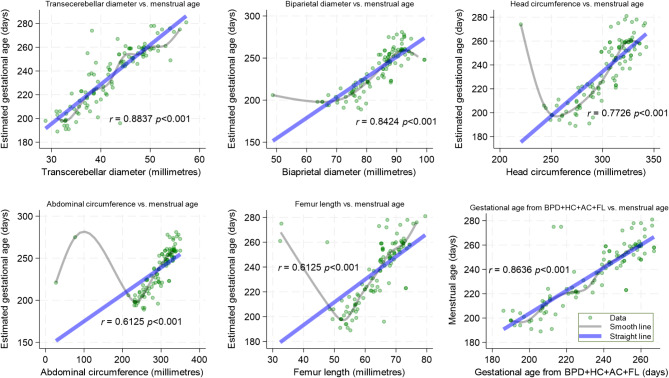
Results: Mean age of participants was 31.5 ± 5.8 years; mean gestational age 236 ± 25 days. Compared to biparietal diameter, head circumference, abdominal circumference, and femur length, transcerebellar diameter correlates best with gestational age (r = 0.8837, p < 0.001). At an error margin of ± 2weeks, transcerebellar diameter had a high predictive accuracy of 84.6%, though significantly less than that for abdominal circumference alone, 86.4% (p = 0.003), and also less than that for all four well known foetal biometric parameters (biparietal diameter, head circumference, abdominal circumference, and femur length) combined, 85.5% (p < 0.001).
Conclusion: Transcerebellar diameter has a better correlation with gestational age than other routine foetal biometric parameters and has high predictive accuracy for dating in third trimester of pregnancy. It may thus play a relevant role in low resource settings where there is shortage of staff and limited skills in obstetric ultrasonography.
Clinical trial number: Not applicable for this study.
期刊介绍:
BMC Medical Imaging is an open access journal publishing original peer-reviewed research articles in the development, evaluation, and use of imaging techniques and image processing tools to diagnose and manage disease.






 京公网安备 11010802042870号
京ICP备2023020795号-1
京公网安备 11010802042870号
京ICP备2023020795号-1

 分享
分享
 求助内容:
求助内容: 应助结果提醒方式:
 扫码关注我们
