{"title":"High-Performance Mo-CoS2 Nanoplates Derived from Metal-Organic Frameworks for Asymmetric Supercapacitor Applications","authors":"Yu-Xuan Lai, Ri-Yu Li, Christine Young","doi":"10.1002/cphc.202400910","DOIUrl":null,"url":null,"abstract":"<p>As global energy and environmental challenges intensify, advancing renewable energy storage technologies is critical. Supercapacitors, known for their rapid charge-discharge rates and exceptional cycling stability, are a promising solution; however, they are constrained by their comparatively low energy density. This study addresses this limitation by developing high-performance Mo-CoS<sub>2</sub> nanoplates derived from metal-organic frameworks for asymmetric supercapacitor applications. Using ZIF-67 nanoplates as precursors, Mo-CoS<sub>2</sub> hybrids were synthesized through a two-step process that included carbonization followed by sulfurization. The Mo-CoS<sub>2</sub> hybrids maintained its plate-like morphology with plentiful active sites, which are crucial for superior electrochemical performance. The Mo-CoS<sub>2</sub> electrode delivers a specific capacitance of 1382.6 F g<sup>−1</sup> at 0.5 A g<sup>−1</sup>, significantly surpassing that of CoS<sub>2</sub> and MoS<sub>2</sub> alone. An asymmetric supercapacitor incorporating Mo-CoS<sub>2</sub> and ZIF-67-derived carbon electrodes demonstrate a remarkable energy density of 49.4 Wh kg<sup>−1</sup> at a power density of 703 W kg<sup>−1</sup>, while retaining 72.09% of their initial performance after 10 000 cycles. The findings underscore the potential of materials derived from metal-organic frameworks (MOFs) in enhancing supercapacitor technology, as they offer a combination of high capacitance and long-term stability.</p>","PeriodicalId":9819,"journal":{"name":"Chemphyschem","volume":"26 12","pages":""},"PeriodicalIF":2.2000,"publicationDate":"2025-03-25","publicationTypes":"Journal Article","fieldsOfStudy":null,"isOpenAccess":false,"openAccessPdf":"","citationCount":"0","resultStr":null,"platform":"Semanticscholar","paperid":null,"PeriodicalName":"Chemphyschem","FirstCategoryId":"92","ListUrlMain":"https://chemistry-europe.onlinelibrary.wiley.com/doi/10.1002/cphc.202400910","RegionNum":3,"RegionCategory":"化学","ArticlePicture":[],"TitleCN":null,"AbstractTextCN":null,"PMCID":null,"EPubDate":"","PubModel":"","JCR":"Q3","JCRName":"CHEMISTRY, PHYSICAL","Score":null,"Total":0}
引用次数: 0
Abstract
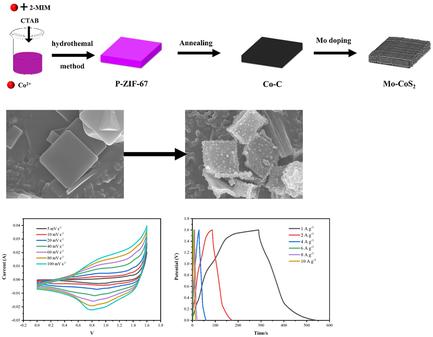
As global energy and environmental challenges intensify, advancing renewable energy storage technologies is critical. Supercapacitors, known for their rapid charge-discharge rates and exceptional cycling stability, are a promising solution; however, they are constrained by their comparatively low energy density. This study addresses this limitation by developing high-performance Mo-CoS2 nanoplates derived from metal-organic frameworks for asymmetric supercapacitor applications. Using ZIF-67 nanoplates as precursors, Mo-CoS2 hybrids were synthesized through a two-step process that included carbonization followed by sulfurization. The Mo-CoS2 hybrids maintained its plate-like morphology with plentiful active sites, which are crucial for superior electrochemical performance. The Mo-CoS2 electrode delivers a specific capacitance of 1382.6 F g−1 at 0.5 A g−1, significantly surpassing that of CoS2 and MoS2 alone. An asymmetric supercapacitor incorporating Mo-CoS2 and ZIF-67-derived carbon electrodes demonstrate a remarkable energy density of 49.4 Wh kg−1 at a power density of 703 W kg−1, while retaining 72.09% of their initial performance after 10 000 cycles. The findings underscore the potential of materials derived from metal-organic frameworks (MOFs) in enhancing supercapacitor technology, as they offer a combination of high capacitance and long-term stability.
随着全球能源和环境挑战的加剧,推进可再生能源存储技术至关重要。超级电容器以其快速的充放电速率和卓越的循环稳定性而闻名,是一个很有前途的解决方案;然而,它们受到相对较低的能量密度的限制。本研究通过开发高性能Mo-CoS2纳米板来解决这一限制,该纳米板来源于金属有机框架,用于不对称超级电容器的应用。以ZIF-67纳米片为前驱体,通过炭化-硫化两步法合成了Mo-CoS2杂化物。Mo-CoS2杂化物保持了具有丰富活性位点的片状形态,这对其优异的电化学性能至关重要。Mo-CoS2电极在0.5 a - g-1下的比电容为1382.6 F -1,明显超过单独使用CoS2和MoS2的比电容。采用Mo-CoS2和zif -67衍生碳电极的非对称超级电容器在功率密度为703 W kg-1时表现出49.4 Wh kg-1的能量密度,并且在10,000次循环后保持了72.09%的初始性能。这些发现强调了金属有机框架(mof)衍生材料在增强超级电容器技术方面的潜力,因为它们提供了高电容和长期稳定性的组合。
期刊介绍:
ChemPhysChem is one of the leading chemistry/physics interdisciplinary journals (ISI Impact Factor 2018: 3.077) for physical chemistry and chemical physics. It is published on behalf of Chemistry Europe, an association of 16 European chemical societies.
ChemPhysChem is an international source for important primary and critical secondary information across the whole field of physical chemistry and chemical physics. It integrates this wide and flourishing field ranging from Solid State and Soft-Matter Research, Electro- and Photochemistry, Femtochemistry and Nanotechnology, Complex Systems, Single-Molecule Research, Clusters and Colloids, Catalysis and Surface Science, Biophysics and Physical Biochemistry, Atmospheric and Environmental Chemistry, and many more topics. ChemPhysChem is peer-reviewed.






 京公网安备 11010802042870号
京ICP备2023020795号-1
京公网安备 11010802042870号
京ICP备2023020795号-1

 分享
分享
 求助内容:
求助内容: 应助结果提醒方式:
 扫码关注我们
