Domen Trampuž, Peter C J I Schielen, Rolf H Zetterström, Maurizio Scarpa, François Feillet, Viktor Kožich, Trine Tangeraas, Ana Drole Torkar, Matej Mlinarič, Daša Perko, Žiga Iztok Remec, Barbka Repič Lampret, Tadej Battelino, Isns Study Group On Pku, Francjan J van Spronsen, James R Bonham, Urh Grošelj
{"title":"International Survey on Phenylketonuria Newborn Screening.","authors":"Domen Trampuž, Peter C J I Schielen, Rolf H Zetterström, Maurizio Scarpa, François Feillet, Viktor Kožich, Trine Tangeraas, Ana Drole Torkar, Matej Mlinarič, Daša Perko, Žiga Iztok Remec, Barbka Repič Lampret, Tadej Battelino, Isns Study Group On Pku, Francjan J van Spronsen, James R Bonham, Urh Grošelj","doi":"10.3390/ijns11010018","DOIUrl":null,"url":null,"abstract":"<p><p>Newborn screening for Phenylketonuria enables early detection and timely treatment with a phenylalanine-restricted diet to prevent severe neurological impairment. Although effective and in use for 60 years, screening, diagnostic, and treatment practices still vary widely across countries and centers. To evaluate the Phenylketonuria newborn screening practices internationally, we designed a survey with questions focusing on the laboratory aspect of the screening system. We analyzed 24 completed surveys from 23 countries. Most participants used the same sampling age range of 48-72 h; they used tandem mass spectrometry and commercial non-derivatized kits to measure phenylalanine (Phe), and had non-negative cut-off values (COV) set mostly at 120 µmol/L of Phe. Participants mostly used genetic analysis of blood and detailed amino acid analysis from blood plasma as their confirmatory methods and set the COV for the initiation of dietary therapy at 360 µmol/L of Phe. There were striking differences in practice as well. While most participants reported a 48-72 h range for age at sampling, that range was overall quite diverse Screening COV varied as well. Additional screening parameters, e.g., the phenylalanine/tyrosine ratio were used by some participants to determine the screening result. Some participants included testing for tetrahydrobiopterin deficiency, or galactosemia in their diagnostic process. Results together showed that there is room to select a best practice from the many practices applied. Such a best practice of PKU-NBS parameters and post-screening parameters could then serve as a generally applicable guideline.</p>","PeriodicalId":14159,"journal":{"name":"International Journal of Neonatal Screening","volume":"11 1","pages":""},"PeriodicalIF":4.0000,"publicationDate":"2025-02-26","publicationTypes":"Journal Article","fieldsOfStudy":null,"isOpenAccess":false,"openAccessPdf":"https://www.ncbi.nlm.nih.gov/pmc/articles/PMC11943362/pdf/","citationCount":"0","resultStr":null,"platform":"Semanticscholar","paperid":null,"PeriodicalName":"International Journal of Neonatal Screening","FirstCategoryId":"1085","ListUrlMain":"https://doi.org/10.3390/ijns11010018","RegionNum":0,"RegionCategory":null,"ArticlePicture":[],"TitleCN":null,"AbstractTextCN":null,"PMCID":null,"EPubDate":"","PubModel":"","JCR":"Q1","JCRName":"GENETICS & HEREDITY","Score":null,"Total":0}
引用次数: 0
Abstract
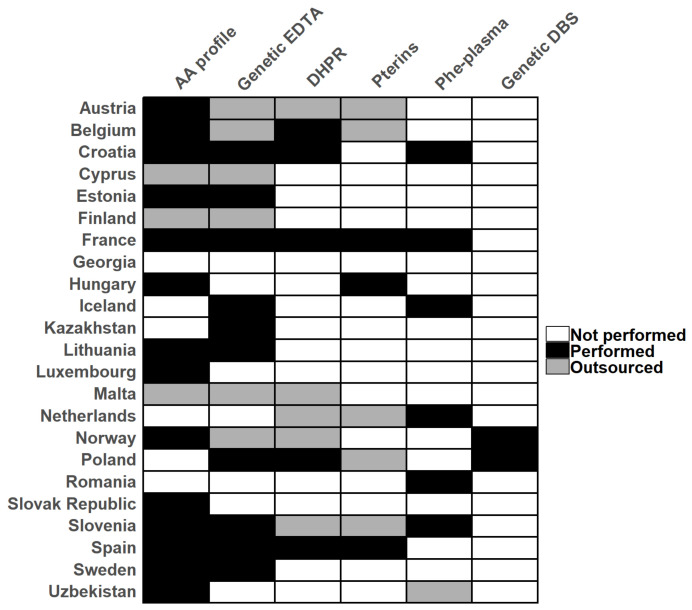
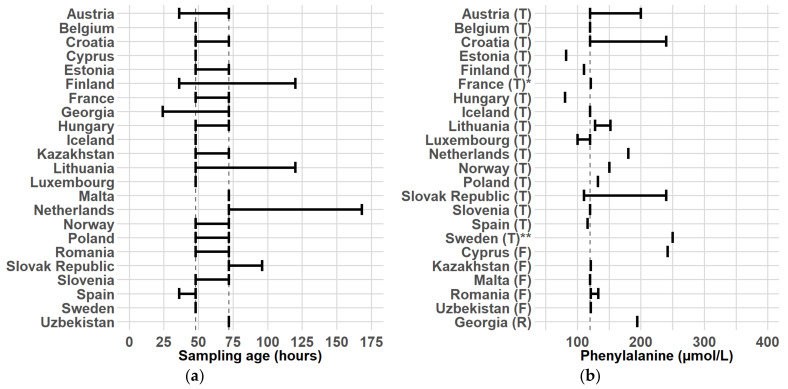
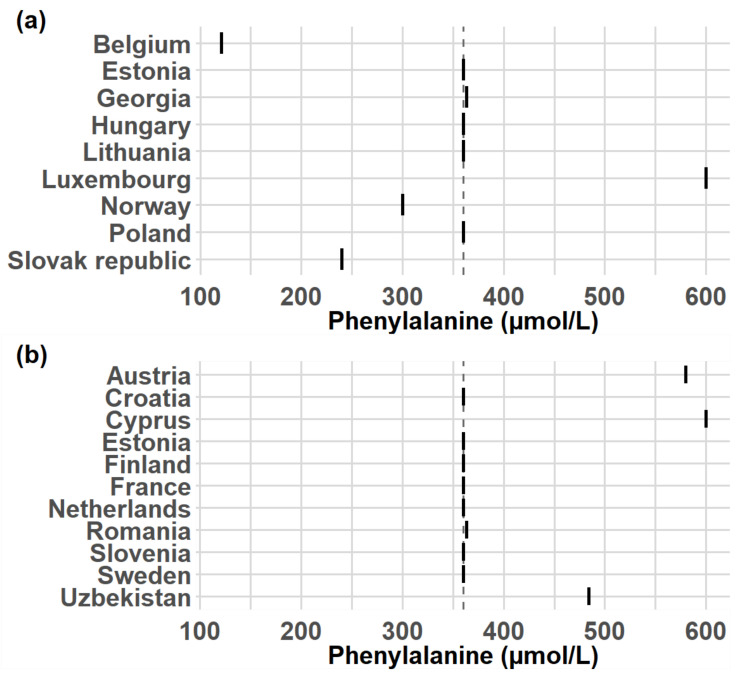
Newborn screening for Phenylketonuria enables early detection and timely treatment with a phenylalanine-restricted diet to prevent severe neurological impairment. Although effective and in use for 60 years, screening, diagnostic, and treatment practices still vary widely across countries and centers. To evaluate the Phenylketonuria newborn screening practices internationally, we designed a survey with questions focusing on the laboratory aspect of the screening system. We analyzed 24 completed surveys from 23 countries. Most participants used the same sampling age range of 48-72 h; they used tandem mass spectrometry and commercial non-derivatized kits to measure phenylalanine (Phe), and had non-negative cut-off values (COV) set mostly at 120 µmol/L of Phe. Participants mostly used genetic analysis of blood and detailed amino acid analysis from blood plasma as their confirmatory methods and set the COV for the initiation of dietary therapy at 360 µmol/L of Phe. There were striking differences in practice as well. While most participants reported a 48-72 h range for age at sampling, that range was overall quite diverse Screening COV varied as well. Additional screening parameters, e.g., the phenylalanine/tyrosine ratio were used by some participants to determine the screening result. Some participants included testing for tetrahydrobiopterin deficiency, or galactosemia in their diagnostic process. Results together showed that there is room to select a best practice from the many practices applied. Such a best practice of PKU-NBS parameters and post-screening parameters could then serve as a generally applicable guideline.





 京公网安备 11010802042870号
京ICP备2023020795号-1
京公网安备 11010802042870号
京ICP备2023020795号-1

 分享
分享
 求助内容:
求助内容: 应助结果提醒方式:
 扫码关注我们
