Impact of a Sensorimotor Integration and Hyperstimulation Program on Global Motor Skills in Moroccan Children With Autism Spectrum Disorder: Exploratory Clinical Quasi-Experimental Study.
Rachid Touali, Jamal Zerouaoui, El Mahjoub Chakir, Hung Tien Bui, Mario Leone, Maxime Allisse
{"title":"Impact of a Sensorimotor Integration and Hyperstimulation Program on Global Motor Skills in Moroccan Children With Autism Spectrum Disorder: Exploratory Clinical Quasi-Experimental Study.","authors":"Rachid Touali, Jamal Zerouaoui, El Mahjoub Chakir, Hung Tien Bui, Mario Leone, Maxime Allisse","doi":"10.2196/65767","DOIUrl":null,"url":null,"abstract":"<p><strong>Background: </strong>Children with autism spectrum disorders (ASDs) often struggle with processing information, which can impact their coordination, balance, and other motor skills. Studies have demonstrated that intervention programs based on sensory integration can enhance motor performance in these children.</p><p><strong>Objective: </strong>The objective of this study is to evaluate the applicability of a standardized battery of gross motor skill tests for Moroccan children aged 6 to 12 years with ASD. The objective is to assess the potential efficacy of an innovative pedagogical approach focused on sensorimotor integration and hyperstimulation. This approach will be compared to traditional physical education (PE) sessions to determine its feasibility and potential to bridge the developmental gaps in motor skills between children with ASD and those with a neurotypical profile.</p><p><strong>Methods: </strong>A convenience sample of 14 Moroccan children with ASD aged 6 to 12 years participated in this exploratory study. Children with ASD were divided into an experimental group (n=7) and a control group (n=7) based on age, sex, motor performance, and socioeconomic status. The control group followed the standard PE program, while the experimental group underwent a specialized program combining sensorimotor integration and hyperstimulation for a period of 15 weeks. All participants were classified as level 2 (moderate) on the Autism Severity Rating Scale based on the Diagnostic and Statistical Manual of Mental Disorders, Fifth Edition, Text Revision (DSM-5-TR) criteria. Gross motor skills were measured at baseline and after 15 weeks of intervention using the UQAC-UQAM (University of Québec in Chicoutimi-University of Québec in Montréal) test battery protocol, which includes 10 items.</p><p><strong>Results: </strong>At baseline (T1), no significant difference was observed between the control and experimental groups of children with ASD. Following the 15-week intervention, the group participating in traditional PE showed an overall improvement in motor skills of approximately 14.5%. Conversely, the results of the ASD experimental group suggest a more substantial improvement of 44.5%. Additionally, the experimental group exhibited significant better performance across all motor skill variables compared to the control group (minimum P values of <.02) with large effect sizes (>0.80). In this regard, a 2-way repeated measures ANOVA confirms the efficiency of the program implemented within the experimental group, demonstrating significant effects associated with both group and time factors as well as a clinically highly significant group×time interaction across all measured variables (η<sup>2</sup>p>0.14).</p><p><strong>Conclusions: </strong>The results of this study suggest that the approach that emphasizes sensorimotor integration and management of hyperstimulation was more effective in improving motor skills in this population. However, other more exhaustive studies will need to be carried out in order to be able to more precisely measure the full potential of this approach.</p>","PeriodicalId":14841,"journal":{"name":"JMIR Formative Research","volume":"9 ","pages":"e65767"},"PeriodicalIF":2.0000,"publicationDate":"2025-03-26","publicationTypes":"Journal Article","fieldsOfStudy":null,"isOpenAccess":false,"openAccessPdf":"https://www.ncbi.nlm.nih.gov/pmc/articles/PMC11982752/pdf/","citationCount":"0","resultStr":null,"platform":"Semanticscholar","paperid":null,"PeriodicalName":"JMIR Formative Research","FirstCategoryId":"1085","ListUrlMain":"https://doi.org/10.2196/65767","RegionNum":0,"RegionCategory":null,"ArticlePicture":[],"TitleCN":null,"AbstractTextCN":null,"PMCID":null,"EPubDate":"","PubModel":"","JCR":"Q3","JCRName":"HEALTH CARE SCIENCES & SERVICES","Score":null,"Total":0}
引用次数: 0
Abstract
Background: Children with autism spectrum disorders (ASDs) often struggle with processing information, which can impact their coordination, balance, and other motor skills. Studies have demonstrated that intervention programs based on sensory integration can enhance motor performance in these children.
Objective: The objective of this study is to evaluate the applicability of a standardized battery of gross motor skill tests for Moroccan children aged 6 to 12 years with ASD. The objective is to assess the potential efficacy of an innovative pedagogical approach focused on sensorimotor integration and hyperstimulation. This approach will be compared to traditional physical education (PE) sessions to determine its feasibility and potential to bridge the developmental gaps in motor skills between children with ASD and those with a neurotypical profile.
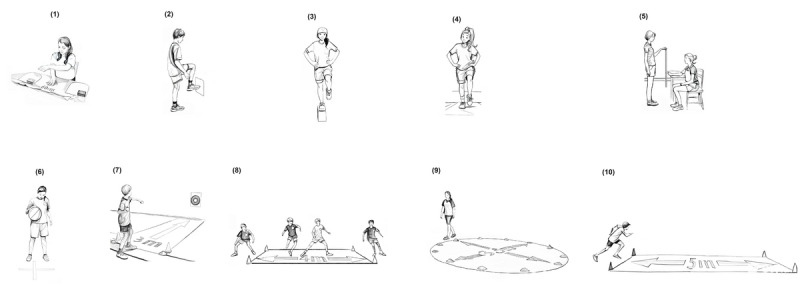
Methods: A convenience sample of 14 Moroccan children with ASD aged 6 to 12 years participated in this exploratory study. Children with ASD were divided into an experimental group (n=7) and a control group (n=7) based on age, sex, motor performance, and socioeconomic status. The control group followed the standard PE program, while the experimental group underwent a specialized program combining sensorimotor integration and hyperstimulation for a period of 15 weeks. All participants were classified as level 2 (moderate) on the Autism Severity Rating Scale based on the Diagnostic and Statistical Manual of Mental Disorders, Fifth Edition, Text Revision (DSM-5-TR) criteria. Gross motor skills were measured at baseline and after 15 weeks of intervention using the UQAC-UQAM (University of Québec in Chicoutimi-University of Québec in Montréal) test battery protocol, which includes 10 items.
Results: At baseline (T1), no significant difference was observed between the control and experimental groups of children with ASD. Following the 15-week intervention, the group participating in traditional PE showed an overall improvement in motor skills of approximately 14.5%. Conversely, the results of the ASD experimental group suggest a more substantial improvement of 44.5%. Additionally, the experimental group exhibited significant better performance across all motor skill variables compared to the control group (minimum P values of <.02) with large effect sizes (>0.80). In this regard, a 2-way repeated measures ANOVA confirms the efficiency of the program implemented within the experimental group, demonstrating significant effects associated with both group and time factors as well as a clinically highly significant group×time interaction across all measured variables (η2p>0.14).
Conclusions: The results of this study suggest that the approach that emphasizes sensorimotor integration and management of hyperstimulation was more effective in improving motor skills in this population. However, other more exhaustive studies will need to be carried out in order to be able to more precisely measure the full potential of this approach.





 京公网安备 11010802042870号
京ICP备2023020795号-1
京公网安备 11010802042870号
京ICP备2023020795号-1

 分享
分享
 求助内容:
求助内容: 应助结果提醒方式:
 扫码关注我们
