Fouling of Reverse Osmosis (RO) and Nanofiltration (NF) Membranes by Low Molecular Weight Organic Compounds (LMWOCs), Part 2: Countermeasures and Applications.
{"title":"Fouling of Reverse Osmosis (RO) and Nanofiltration (NF) Membranes by Low Molecular Weight Organic Compounds (LMWOCs), Part 2: Countermeasures and Applications.","authors":"Yasushi Maeda","doi":"10.3390/membranes15030094","DOIUrl":null,"url":null,"abstract":"<p><p>Fouling, particularly from organic fouling and biofouling, poses a significant challenge in the RO/NF treatment of marginal waters, especially wastewater. Part 1 of this review detailed LMWOC fouling mechanisms. Part 2 focuses on countermeasures and applications. Effective fouling prevention relies on pretreatment, early detection, cleaning, optimized operation, and in situ membrane modification. Accurate fouling prediction is crucial. Preliminary tests using flat-sheet membranes or small-diameter modules are recommended. Currently, no specific fouling index exists for LMWOC fouling. Hydrophobic membranes, such as polyamide, are proposed as alternatives to the standard silt density index (SDI) filter. Once LMWOC fouling potential is assessed, suitable pretreatment methods can be implemented. These include adsorbents, specialized water filters, oxidative decomposition, and antifoulants. In situations where pretreatment is impractical, alternative strategies like high pH operation might be considered. Membrane cleaning becomes necessary upon fouling; however, standard cleaning often fails to fully restore the original flow. Specialized CIP chemicals, including organic solvent-based and oxidative agents, are required. Conversely, LMWOC fouling typically leads to a stabilized flow rate reduction rather than a continuous decline. Aggressive cleaning may be avoided if the resulting operating pressure increase is acceptable. When a significant flow rate drop occurs and LMWOC fouling is suspected, analysis of the fouled membrane is necessary for identification. Standard FT-IR often fails to detect LMWOCs. Solvent extraction followed by GC-MS is required. Pyrolysis GC-MS, which eliminates the extraction step, shows promise. The review concludes by examining how LMWOCs can be strategically utilized to enhance membrane rejection and restore deteriorated membranes.</p>","PeriodicalId":18410,"journal":{"name":"Membranes","volume":"15 3","pages":""},"PeriodicalIF":3.6000,"publicationDate":"2025-03-17","publicationTypes":"Journal Article","fieldsOfStudy":null,"isOpenAccess":false,"openAccessPdf":"https://www.ncbi.nlm.nih.gov/pmc/articles/PMC11943549/pdf/","citationCount":"0","resultStr":null,"platform":"Semanticscholar","paperid":null,"PeriodicalName":"Membranes","FirstCategoryId":"5","ListUrlMain":"https://doi.org/10.3390/membranes15030094","RegionNum":4,"RegionCategory":"工程技术","ArticlePicture":[],"TitleCN":null,"AbstractTextCN":null,"PMCID":null,"EPubDate":"","PubModel":"","JCR":"Q2","JCRName":"CHEMISTRY, PHYSICAL","Score":null,"Total":0}
引用次数: 0
Abstract
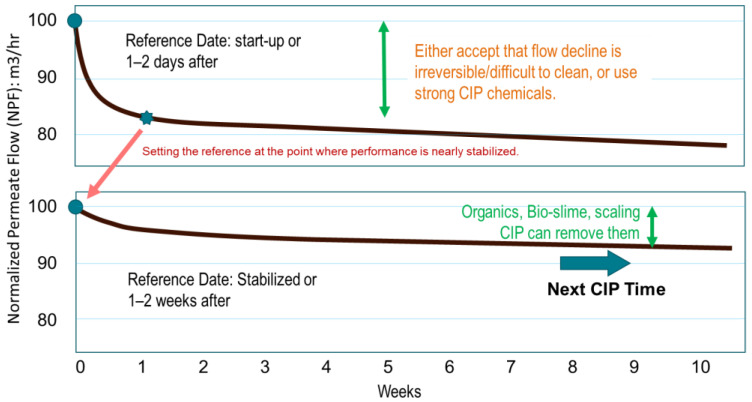
Fouling, particularly from organic fouling and biofouling, poses a significant challenge in the RO/NF treatment of marginal waters, especially wastewater. Part 1 of this review detailed LMWOC fouling mechanisms. Part 2 focuses on countermeasures and applications. Effective fouling prevention relies on pretreatment, early detection, cleaning, optimized operation, and in situ membrane modification. Accurate fouling prediction is crucial. Preliminary tests using flat-sheet membranes or small-diameter modules are recommended. Currently, no specific fouling index exists for LMWOC fouling. Hydrophobic membranes, such as polyamide, are proposed as alternatives to the standard silt density index (SDI) filter. Once LMWOC fouling potential is assessed, suitable pretreatment methods can be implemented. These include adsorbents, specialized water filters, oxidative decomposition, and antifoulants. In situations where pretreatment is impractical, alternative strategies like high pH operation might be considered. Membrane cleaning becomes necessary upon fouling; however, standard cleaning often fails to fully restore the original flow. Specialized CIP chemicals, including organic solvent-based and oxidative agents, are required. Conversely, LMWOC fouling typically leads to a stabilized flow rate reduction rather than a continuous decline. Aggressive cleaning may be avoided if the resulting operating pressure increase is acceptable. When a significant flow rate drop occurs and LMWOC fouling is suspected, analysis of the fouled membrane is necessary for identification. Standard FT-IR often fails to detect LMWOCs. Solvent extraction followed by GC-MS is required. Pyrolysis GC-MS, which eliminates the extraction step, shows promise. The review concludes by examining how LMWOCs can be strategically utilized to enhance membrane rejection and restore deteriorated membranes.
MembranesChemical Engineering-Filtration and Separation
CiteScore
6.10
自引率
16.70%
发文量
1071
审稿时长
11 weeks
期刊介绍:
Membranes (ISSN 2077-0375) is an international, peer-reviewed open access journal of separation science and technology. It publishes reviews, research articles, communications and technical notes. Our aim is to encourage scientists to publish their experimental and theoretical results in as much detail as possible. There is no restriction on the length of the papers. Full experimental and/or methodical details must be provided.





 京公网安备 11010802042870号
京ICP备2023020795号-1
京公网安备 11010802042870号
京ICP备2023020795号-1

 分享
分享
 求助内容:
求助内容: 应助结果提醒方式:
 扫码关注我们
