Juliana Dias de Lima, Jessica Plácido, Beatriz Andrade, Letícia Dalcero Abend, Aline Josiane Waclawovsky, Daniel Alves Pires, Danilo Rodrigues Pereira da Silva, Fabianna Resende de Jesus-Moraleida, Helena Ferreira Moura, Nicole Leite Galvão Coelho, Renato Sobral Monteiro-Junior, Thiago Sousa Matias, Felipe Barreto Schuch, Andrea Camaz Deslandes
{"title":"Intersectionality and mental health in university students: a jeopardy index approach.","authors":"Juliana Dias de Lima, Jessica Plácido, Beatriz Andrade, Letícia Dalcero Abend, Aline Josiane Waclawovsky, Daniel Alves Pires, Danilo Rodrigues Pereira da Silva, Fabianna Resende de Jesus-Moraleida, Helena Ferreira Moura, Nicole Leite Galvão Coelho, Renato Sobral Monteiro-Junior, Thiago Sousa Matias, Felipe Barreto Schuch, Andrea Camaz Deslandes","doi":"10.11606/s1518-8787.2025059006197","DOIUrl":null,"url":null,"abstract":"<p><p>To explore the associations between current mental health symptoms and social disparities in university students.</p><p><p>We recruited participants from nine public universities in Brazil, from August to November 2022, using online advertisements and in-person lectures. All participants completed an online survey containing social (sex, race/color, gender identity, sexual orientation, and income) and mental health assessments. The Jeopardy index was composed of social variables. The index considered zero points for subjects with less oppressive experienced characteristics (men, White, cisgender, heterosexual, higher income) and one point for the opposite characteristics. We defined six clusters according to Jeopardy Index results: 0, 1, 2, 3, 4, and 5 points, with the greatest number of points representing the most disadvantaged group. The mental health symptoms were assessed on two levels. First by the \"DSM-5 Self-Rated Level 1 Cross-Cutting Symptom Measure - Adult,\" and second by the \"Patient Health Questionnaire-9,\" and the \"Generalized Anxiety Disorder Questionnaire-7.\" Adjusted Odds Ratio (OR) analyses was performed for age and educational level.</p><p><p>748 participants were allocated into the six Jeopardy clusters: 0 (n = 46; 6.1%), 1 (n = 112; 15.0%), 2 (n = 163; 21.8%), 3 (n = 218; 29.1%), 4 (n = 171; 22.9%), and 5 (n = 38; 5.1%). It was observed a high prevalence of anxiety (42.5%) and depression (51.0%), however, the less privileged group (5) had a higher risk of having severe symptoms of anxiety (OR = 6.21; 1.51-25.58; p < 0.01) and depression (OR = 8.60; 2.15-34.43; p < 0.01), compared against the most privileged group.</p><p><p>Although anxiety and depressive symptoms were highly prevalent for all participants, these disorders are not equally distributed in this population and the intersectionality between social factors plays an important role in contributing to these differences.</p>","PeriodicalId":21230,"journal":{"name":"Revista de saude publica","volume":"59 ","pages":"e3"},"PeriodicalIF":2.1000,"publicationDate":"2025-03-24","publicationTypes":"Journal Article","fieldsOfStudy":null,"isOpenAccess":false,"openAccessPdf":"https://www.ncbi.nlm.nih.gov/pmc/articles/PMC11939081/pdf/","citationCount":"0","resultStr":null,"platform":"Semanticscholar","paperid":null,"PeriodicalName":"Revista de saude publica","FirstCategoryId":"3","ListUrlMain":"https://doi.org/10.11606/s1518-8787.2025059006197","RegionNum":4,"RegionCategory":"医学","ArticlePicture":[],"TitleCN":null,"AbstractTextCN":null,"PMCID":null,"EPubDate":"2025/1/1 0:00:00","PubModel":"eCollection","JCR":"Q3","JCRName":"PUBLIC, ENVIRONMENTAL & OCCUPATIONAL HEALTH","Score":null,"Total":0}
引用次数: 0
Abstract
To explore the associations between current mental health symptoms and social disparities in university students.
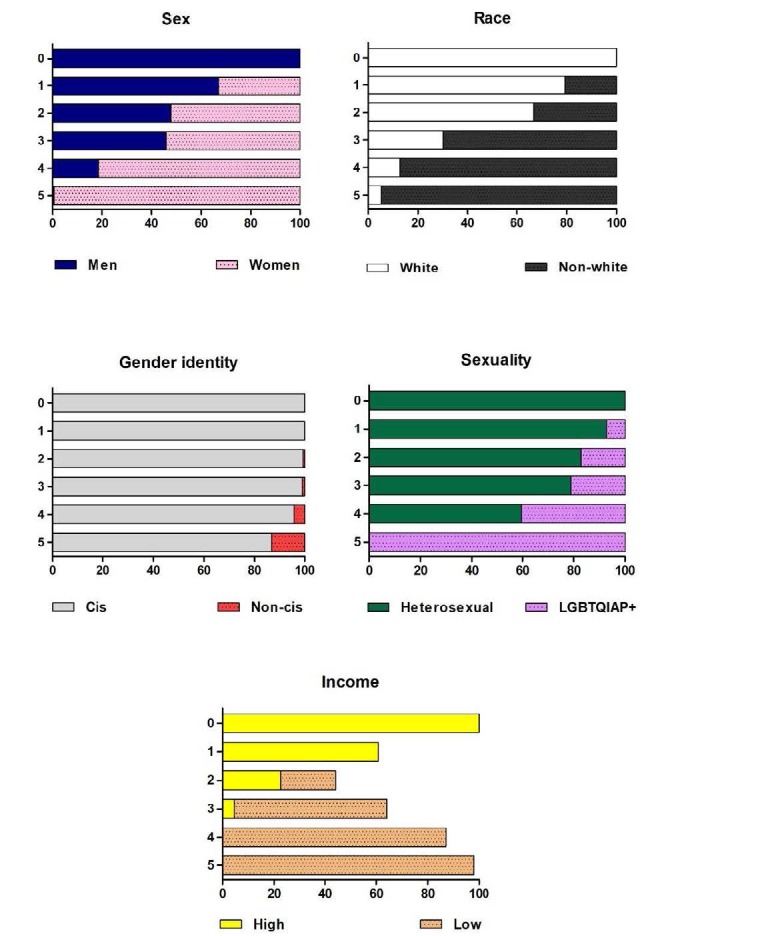
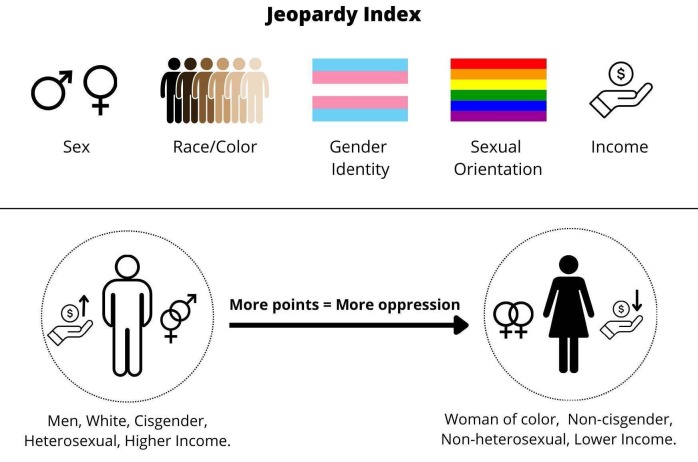
We recruited participants from nine public universities in Brazil, from August to November 2022, using online advertisements and in-person lectures. All participants completed an online survey containing social (sex, race/color, gender identity, sexual orientation, and income) and mental health assessments. The Jeopardy index was composed of social variables. The index considered zero points for subjects with less oppressive experienced characteristics (men, White, cisgender, heterosexual, higher income) and one point for the opposite characteristics. We defined six clusters according to Jeopardy Index results: 0, 1, 2, 3, 4, and 5 points, with the greatest number of points representing the most disadvantaged group. The mental health symptoms were assessed on two levels. First by the "DSM-5 Self-Rated Level 1 Cross-Cutting Symptom Measure - Adult," and second by the "Patient Health Questionnaire-9," and the "Generalized Anxiety Disorder Questionnaire-7." Adjusted Odds Ratio (OR) analyses was performed for age and educational level.
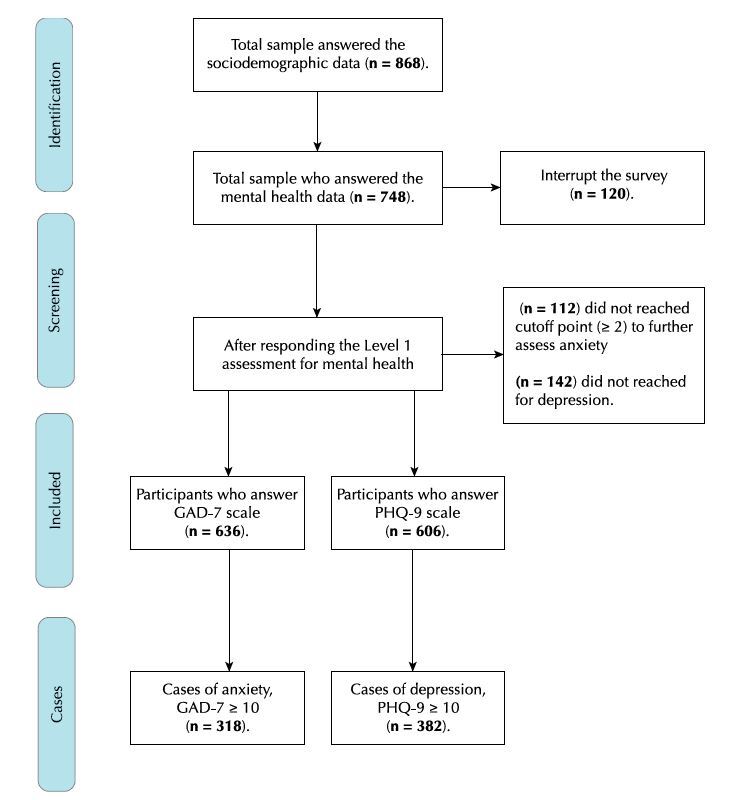
748 participants were allocated into the six Jeopardy clusters: 0 (n = 46; 6.1%), 1 (n = 112; 15.0%), 2 (n = 163; 21.8%), 3 (n = 218; 29.1%), 4 (n = 171; 22.9%), and 5 (n = 38; 5.1%). It was observed a high prevalence of anxiety (42.5%) and depression (51.0%), however, the less privileged group (5) had a higher risk of having severe symptoms of anxiety (OR = 6.21; 1.51-25.58; p < 0.01) and depression (OR = 8.60; 2.15-34.43; p < 0.01), compared against the most privileged group.
Although anxiety and depressive symptoms were highly prevalent for all participants, these disorders are not equally distributed in this population and the intersectionality between social factors plays an important role in contributing to these differences.



 京公网安备 11010802042870号
京ICP备2023020795号-1
京公网安备 11010802042870号
京ICP备2023020795号-1

 分享
分享
 求助内容:
求助内容: 应助结果提醒方式:
 扫码关注我们
