The Usefulness of the Glucose Management Indicator in Evaluating the Quality of Glycemic Control in Patients with Type 1 Diabetes Using Continuous Glucose Monitoring Sensors: A Cross-Sectional, Multicenter Study.
{"title":"The Usefulness of the Glucose Management Indicator in Evaluating the Quality of Glycemic Control in Patients with Type 1 Diabetes Using Continuous Glucose Monitoring Sensors: A Cross-Sectional, Multicenter Study.","authors":"Sandra Lazar, Ovidiu Potre, Ioana Ionita, Delia-Viola Reurean-Pintilei, Romulus Timar, Andreea Herascu, Vlad Florian Avram, Bogdan Timar","doi":"10.3390/bios15030190","DOIUrl":null,"url":null,"abstract":"<p><p>The Glucose Management Indicator (GMI) is a biomarker of glycemic control which estimates hemoglobin A1c (HbA1c) based on the average glycemia recorded by continuous glucose monitoring sensors (CGMS). The GMI provides an immediate overview of the patient's glycemic control, but it might be biased by the patient's sensor wear adherence or by the sensor's reading errors. This study aims to evaluate the GMI's performance in the assessment of glycemic control and to identify the factors leading to erroneous estimates. In this study, 147 patients with type 1 diabetes, users of CGMS, were enrolled. Their GMI was extracted from the sensor's report and HbA1c measured at certified laboratories. The median GMI value overestimated the HbA1c by 0.1 percentage points (<i>p</i> = 0.007). The measurements had good reliability, demonstrated by a Cronbach's alpha index of 0.74, an inter-item correlation coefficient of 0.683 and an inter-item covariance between HbA1c and GMI of 0.813. The HbA1c and the difference between GMI and HbA1c were reversely associated (Spearman's r = -0.707; <i>p</i> < 0.001). The GMI is a reliable tool in evaluating glycemic control in patients with diabetes. It tends to underestimate the HbA1c in patients with high HbA1c values, while it tends to overestimate the HbA1c in patients with low HbA1c.</p>","PeriodicalId":48608,"journal":{"name":"Biosensors-Basel","volume":"15 3","pages":""},"PeriodicalIF":5.6000,"publicationDate":"2025-03-16","publicationTypes":"Journal Article","fieldsOfStudy":null,"isOpenAccess":false,"openAccessPdf":"https://www.ncbi.nlm.nih.gov/pmc/articles/PMC11940097/pdf/","citationCount":"0","resultStr":null,"platform":"Semanticscholar","paperid":null,"PeriodicalName":"Biosensors-Basel","FirstCategoryId":"5","ListUrlMain":"https://doi.org/10.3390/bios15030190","RegionNum":3,"RegionCategory":"工程技术","ArticlePicture":[],"TitleCN":null,"AbstractTextCN":null,"PMCID":null,"EPubDate":"","PubModel":"","JCR":"Q1","JCRName":"CHEMISTRY, ANALYTICAL","Score":null,"Total":0}
引用次数: 0
Abstract
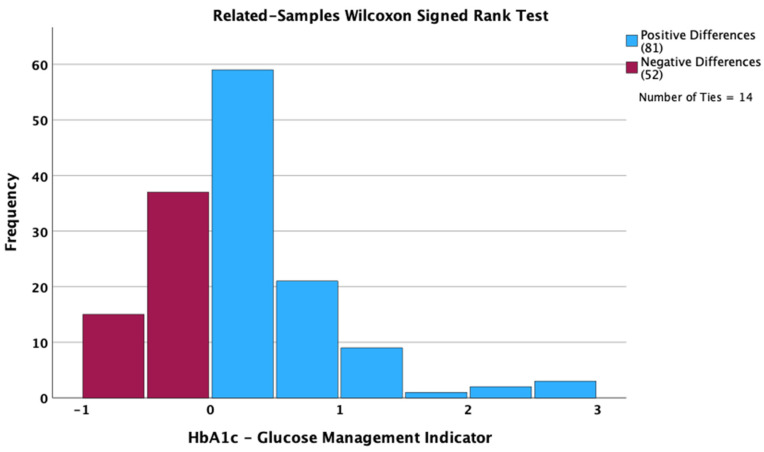
The Glucose Management Indicator (GMI) is a biomarker of glycemic control which estimates hemoglobin A1c (HbA1c) based on the average glycemia recorded by continuous glucose monitoring sensors (CGMS). The GMI provides an immediate overview of the patient's glycemic control, but it might be biased by the patient's sensor wear adherence or by the sensor's reading errors. This study aims to evaluate the GMI's performance in the assessment of glycemic control and to identify the factors leading to erroneous estimates. In this study, 147 patients with type 1 diabetes, users of CGMS, were enrolled. Their GMI was extracted from the sensor's report and HbA1c measured at certified laboratories. The median GMI value overestimated the HbA1c by 0.1 percentage points (p = 0.007). The measurements had good reliability, demonstrated by a Cronbach's alpha index of 0.74, an inter-item correlation coefficient of 0.683 and an inter-item covariance between HbA1c and GMI of 0.813. The HbA1c and the difference between GMI and HbA1c were reversely associated (Spearman's r = -0.707; p < 0.001). The GMI is a reliable tool in evaluating glycemic control in patients with diabetes. It tends to underestimate the HbA1c in patients with high HbA1c values, while it tends to overestimate the HbA1c in patients with low HbA1c.
Biosensors-BaselBiochemistry, Genetics and Molecular Biology-Clinical Biochemistry
CiteScore
6.60
自引率
14.80%
发文量
983
审稿时长
11 weeks
期刊介绍:
Biosensors (ISSN 2079-6374) provides an advanced forum for studies related to the science and technology of biosensors and biosensing. It publishes original research papers, comprehensive reviews and communications. Our aim is to encourage scientists to publish their experimental and theoretical results in as much detail as possible. There is no restriction on the length of the papers. The full experimental details must be provided so that the results can be reproduced. Electronic files and software regarding the full details of the calculation or experimental procedure, if unable to be published in a normal way, can be deposited as supplementary electronic material.





 京公网安备 11010802042870号
京ICP备2023020795号-1
京公网安备 11010802042870号
京ICP备2023020795号-1

 分享
分享
 求助内容:
求助内容: 应助结果提醒方式:
 扫码关注我们
