Research Dawadi, Mai Inoue, Jie Ting Tay, Agustin Martin-Morales, Thien Vu, Michihiro Araki
{"title":"Disease Prediction Using Machine Learning on Smartphone-Based Eye, Skin, and Voice Data: Scoping Review.","authors":"Research Dawadi, Mai Inoue, Jie Ting Tay, Agustin Martin-Morales, Thien Vu, Michihiro Araki","doi":"10.2196/59094","DOIUrl":null,"url":null,"abstract":"<p><strong>Background: </strong>The application of machine learning methods to data generated by ubiquitous devices like smartphones presents an opportunity to enhance the quality of health care and diagnostics. Smartphones are ideal for gathering data easily, providing quick feedback on diagnoses, and proposing interventions for health improvement.</p><p><strong>Objective: </strong>We reviewed the existing literature to gather studies that have used machine learning models with smartphone-derived data for the prediction and diagnosis of health anomalies. We divided the studies into those that used machine learning models by conducting experiments to retrieve data and predict diseases, and those that used machine learning models on publicly available databases. The details of databases, experiments, and machine learning models are intended to help researchers working in the fields of machine learning and artificial intelligence in the health care domain. Researchers can use the information to design their experiments or determine the databases they could analyze.</p><p><strong>Methods: </strong>A comprehensive search of the PubMed and IEEE Xplore databases was conducted, and an in-house keyword screening method was used to filter the articles based on the content of their titles and abstracts. Subsequently, studies related to the 3 areas of voice, skin, and eye were selected and analyzed based on how data for machine learning models were extracted (ie, the use of publicly available databases or through experiments). The machine learning methods used in each study were also noted.</p><p><strong>Results: </strong>A total of 49 studies were identified as being relevant to the topic of interest, and among these studies, there were 31 different databases and 24 different machine learning methods.</p><p><strong>Conclusions: </strong>The results provide a better understanding of how smartphone data are collected for predicting different diseases and what kinds of machine learning methods are used on these data. Similarly, publicly available databases having smartphone-based data that can be used for the diagnosis of various diseases have been presented. Our screening method could be used or improved in future studies, and our findings could be used as a reference to conduct similar studies, experiments, or statistical analyses.</p>","PeriodicalId":73551,"journal":{"name":"JMIR AI","volume":"4 ","pages":"e59094"},"PeriodicalIF":2.0000,"publicationDate":"2025-03-25","publicationTypes":"Journal Article","fieldsOfStudy":null,"isOpenAccess":false,"openAccessPdf":"https://www.ncbi.nlm.nih.gov/pmc/articles/PMC11979540/pdf/","citationCount":"0","resultStr":null,"platform":"Semanticscholar","paperid":null,"PeriodicalName":"JMIR AI","FirstCategoryId":"1085","ListUrlMain":"https://doi.org/10.2196/59094","RegionNum":0,"RegionCategory":null,"ArticlePicture":[],"TitleCN":null,"AbstractTextCN":null,"PMCID":null,"EPubDate":"","PubModel":"","JCR":"","JCRName":"","Score":null,"Total":0}
引用次数: 0
Abstract
Background: The application of machine learning methods to data generated by ubiquitous devices like smartphones presents an opportunity to enhance the quality of health care and diagnostics. Smartphones are ideal for gathering data easily, providing quick feedback on diagnoses, and proposing interventions for health improvement.
Objective: We reviewed the existing literature to gather studies that have used machine learning models with smartphone-derived data for the prediction and diagnosis of health anomalies. We divided the studies into those that used machine learning models by conducting experiments to retrieve data and predict diseases, and those that used machine learning models on publicly available databases. The details of databases, experiments, and machine learning models are intended to help researchers working in the fields of machine learning and artificial intelligence in the health care domain. Researchers can use the information to design their experiments or determine the databases they could analyze.
Methods: A comprehensive search of the PubMed and IEEE Xplore databases was conducted, and an in-house keyword screening method was used to filter the articles based on the content of their titles and abstracts. Subsequently, studies related to the 3 areas of voice, skin, and eye were selected and analyzed based on how data for machine learning models were extracted (ie, the use of publicly available databases or through experiments). The machine learning methods used in each study were also noted.
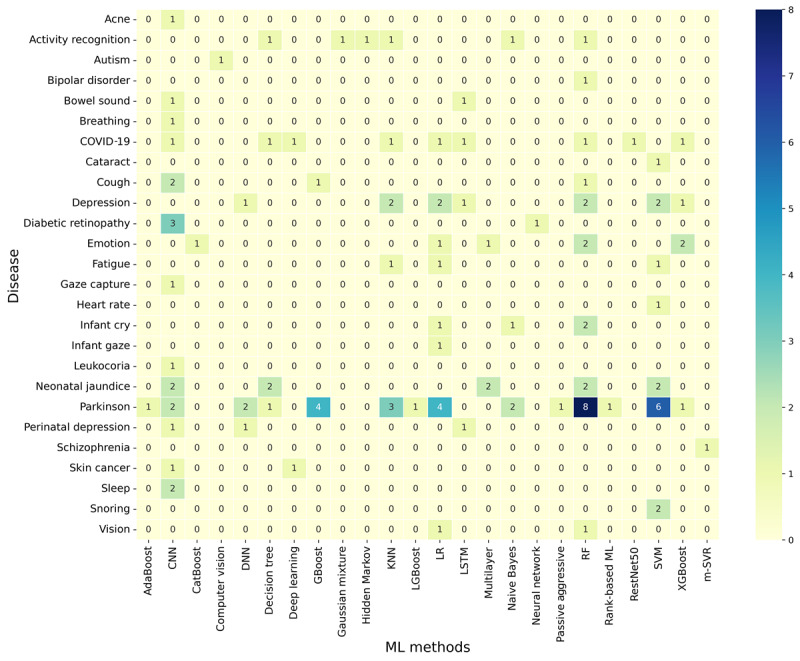
Results: A total of 49 studies were identified as being relevant to the topic of interest, and among these studies, there were 31 different databases and 24 different machine learning methods.
Conclusions: The results provide a better understanding of how smartphone data are collected for predicting different diseases and what kinds of machine learning methods are used on these data. Similarly, publicly available databases having smartphone-based data that can be used for the diagnosis of various diseases have been presented. Our screening method could be used or improved in future studies, and our findings could be used as a reference to conduct similar studies, experiments, or statistical analyses.





 京公网安备 11010802042870号
京ICP备2023020795号-1
京公网安备 11010802042870号
京ICP备2023020795号-1

 分享
分享

 求助内容:
求助内容: 应助结果提醒方式:
 扫码关注我们
